

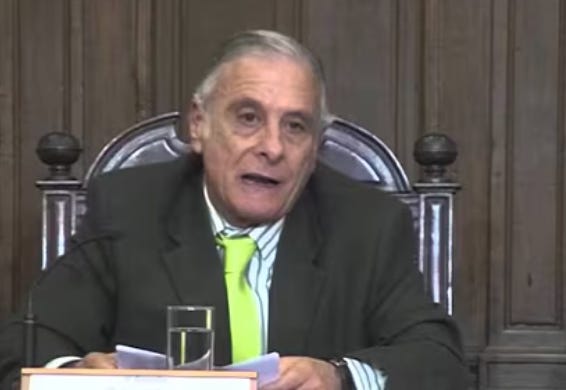
13 years before blazes scorched Chile’s Patagonia, Senator Eugenio Tuma Zedán stood in the Senate and exposed Israeli “tourists” as military scouts eyeing Chilean land. Today, as wildfires rage through the region he flagged, his foresight casts him as a modern prophet.
The senator from La Araucanía, representing one of South America’s most prominent Palestinian communities, accused thousands of Israeli backpackers of conducting a secret military operation on Chilean soil.
“Between 8,000 and 9,000 Israeli tourists entering Chile annually,” Tuma declared on the television program Controversia TV, were not tourists at all. He contended that these tourists were undercover soldiers from the Israel Defense Forces, “dressed as civilians” and systematically “mapping out the southern Chile region.” These young backpackers, Tuma insisted, presented a risk to Chile’s territorial integrity.
The claims seemed ripped from the pages of a spy thriller. But for those familiar with Latin American theories about Jewish influence, Tuma was invoking the Plan Andinia, a decades-old theory alleging that Israel secretly planned to establish a Jewish state in the pristine wilderness of Patagonia.
Eugenio Tuma Zedán was born July 29, 1945, in Temuco, the capital of Chile’s Araucanía region. His roots stretched back to Palestine through his father, Juan Tuma Masso, who had immigrated to Chile as a child in 1913. The elder Tuma built a textile empire and carved out a political career, serving as a deputy from 1961 to 1969. Politics and Palestinian identity were woven into the family fabric.
Young Eugenio followed his father’s path. He earned degrees in economics and business administration from the University of Chile, then worked his way through Chile’s development agencies during the tumultuous early 1970s. When General Augusto Pinochet’s coup against President Salvador Allende established a military dictatorship in 1973, Tuma joined the opposition forces. By 1986, he was helping found the Human Rights Committee in La Araucanía. A year later, he joined the Partido por la Democracia, a center-left party created to circumvent the dictatorship’s restrictions.
Democracy’s return in 1990 opened new doors for Tuma. Tuma won his election to Chile’s Chamber of Deputies in 1993, representing the agricultural communities around Temuco. He would hold that seat for 16 years, rising to become Second Vice President of the Chamber and chair of the powerful Economy Committee. In 2009, voters elevated him to the Senate.
Tuma’s views on Israel and the Jewish community first surfaced publicly in March 2008, during Israel’s military operations in Gaza. As a deputy, he called for Chile to sever all diplomatic and commercial ties with the Jewish state. His language was explicit.
“A new holocaust” is taking place in the Middle East, Tuma declared. ”The State of Israel is deliberately hiding the extermination practices that it is developing against the Palestinian people.” The situation reflected “terrorist” practices, he said, and “diplomacy has a limit that has been far exceeded.” Chile must end recognition of Israel to remain “consistent with the permanent stance of the Chilean nation to respect human rights, dignity of persons and self-determination of peoples.”
Two years later, in December 2010, Tuma’s rhetoric turned inward. He accused prominent Chilean Jews of serving as “agents” for Israel. His primary target was Rodrigo Hinzpeter, Chile’s Jewish Interior Minister, whom Tuma branded “an activist and militant for the Israeli cause.” Gabriel Zaliasnik, president of Chile’s central Jewish organization, received similar treatment. According to Tuma, these Chilean citizens were responsible for blocking Chile’s recognition of a Palestinian state.
The Jewish community watched nervously. Chile was home to approximately 15,000 Jews, vastly outnumbered by an estimated 300,000 to 400,000 people of Palestinian descent. The country hosted the largest Palestinian diaspora community outside the Middle East, and tensions over the Israeli-Palestinian conflict have frequently spilled into Chilean politics.
In 2012, as Chile debated landmark anti-discrimination legislation, Tuma escalated his attacks. During parliamentary debates, he allegedly stated that “It is precisely people like Gabriel Zaliasnik, a former president of the Jewish community in Chile, who have prevented Chile from having an anti discrimination law, because they wanted to introduce a special law for Jews.”
The accusation cut deeply. Chile’s Jewish community had been pushing for stronger hate crime legislation, not weakening it. Community leaders organized a march in Santiago, rejecting what they called “false, xenophobic accusations.” The protest drew hundreds who carried signs defending Chile’s Jewish minority and demanding respect.
Tuma dismissed the demonstration as “a manifestation that responds to a position of intransigence.” At the time, he showed no signs of backing down.
By January 2012, Tuma was publicly questioning the nationality and intentions of Israeli visitors to Chile. “Thousands of Israelis enter the country like they own the place, and nobody says a thing to them,” he told the Chilean news site BioBioChile. The senator suggested that the Israeli government was sending military personnel disguised as tourists.
The speculation Tuma about Plan Andinia was nurturing had deep roots. Members of the Argentine National Socialist Front first proposed the theory in the mid-1960s, and Chilean diplomat and esoteric Hitlerist Miguel Serrano later popularized it. Serrano asserted that for more than two decades, Jews posing as backpackers and destitute hikers have been traversing the remotest and most critical areas of southern Chile, aided by Chilean officials, the army, the navy, and the National Forest Corporation (CONAF), who recognize them as actual personnel from Israel’s military, air force, or intelligence agencies.
Tuma’s October 2013 television appearance brought everything together. These weren’t just tourists, he insisted. They were reconnaissance teams. The senator questioned why Hebrew language signs appeared throughout Torres del Paine and other Patagonian destinations. He claimed the Chilean government had “decided to do nothing given the power exerted by Israel and the U.S.”
The Simon Wiesenthal Center, a leading Jewish advocacy organization, responded with fury. The group’s leadership wrote directly to Michelle Bachelet, who was running for president again with Tuma serving as her campaign coordinator. The center demanded she remove him immediately.
Dr. Shimon Samuels, the center’s director of International Relations, was blunt. “Tuma’s slanders incite violence against innocent Israeli tourists,” he proclaimed. The organization noted that his accusations echoed “the Protocols of the Elders of Zion,” referring to the infamous propaganda text that alleged a Jewish conspiracy for world domination.
The American Jewish Committee joined the chorus of criticism. The organization called Tuma’s remarks “baseless,” and “extremely dangerous.” They were “all the more so in a country that has experienced an uptick in anti Semitism.”
The AJC called on Chilean government and civil society leaders to publicly condemn Tuma. They urged that Chile’s newly adopted anti-discrimination law, the same legislation Tuma had criticized during its passage, be used to punish him.
Behind the criticism lay a troubling reality. Young Israelis did travel to Patagonia in large numbers. After completing their mandatory military service, many embarked on extended backpacking trips throughout South America, with Chile’s spectacular southern landscapes a prime destination. However, such visits have had their fair share of controversies.
According to Radio Universidad de Chile, plenty of Israelis head to South America right after their required military stint, frequently picking Patagonia as a hotspot. A key example came in late December 2011 when Israeli tourist Rotem Singer accidentally triggered a huge blaze in Torres del Paine National Park in Chile, scorching more than 17,000 hectares of virgin wilderness.
Chilean officials held Singer, who agreed to pay CONAF roughly $10,000 in damages and then exited the country. The soft handling ignited public backlash in Chile, where people had hoped for incarceration. Crowds protested in front of the Supreme Court after it upheld the lenient ruling.
Furthermore, CONAF’s Magallanes regional director Elizabeth Muñoz stated in a 2017 interview that Israelis made up almost 66 percent of expulsions from Torres del Paine over a five-year period. As a result, several area hostel owners began unofficially turning away Israeli guests. In recent years, hostel owners and tour operators reported increased tensions. Some Israeli travelers encountered hostility where they had previously found warm welcomes.
In the meantime, Tuma served in Chile’s Senate until 2018, when he chose not to seek reelection. In 2021, Tuma attempted a political comeback, running for Regional Governor of La Araucanía. He advanced to a runoff but lost, securing just 41.79 percent of the vote. Later that year, he resigned from the Partido por la Democracia after 30 years, protesting the party’s support for presidential candidate Gabriel Boric. In 2025, he ran for Senate again, this time as a Liberal Party candidate, but captured only 4.97 percent of the vote.
Tuma’s political relevance has clearly waned. But his apprehensions about Israeli incursions into the Patagonia region have been recognized by an increasing number of Chileans and Argentines in the region well into the present
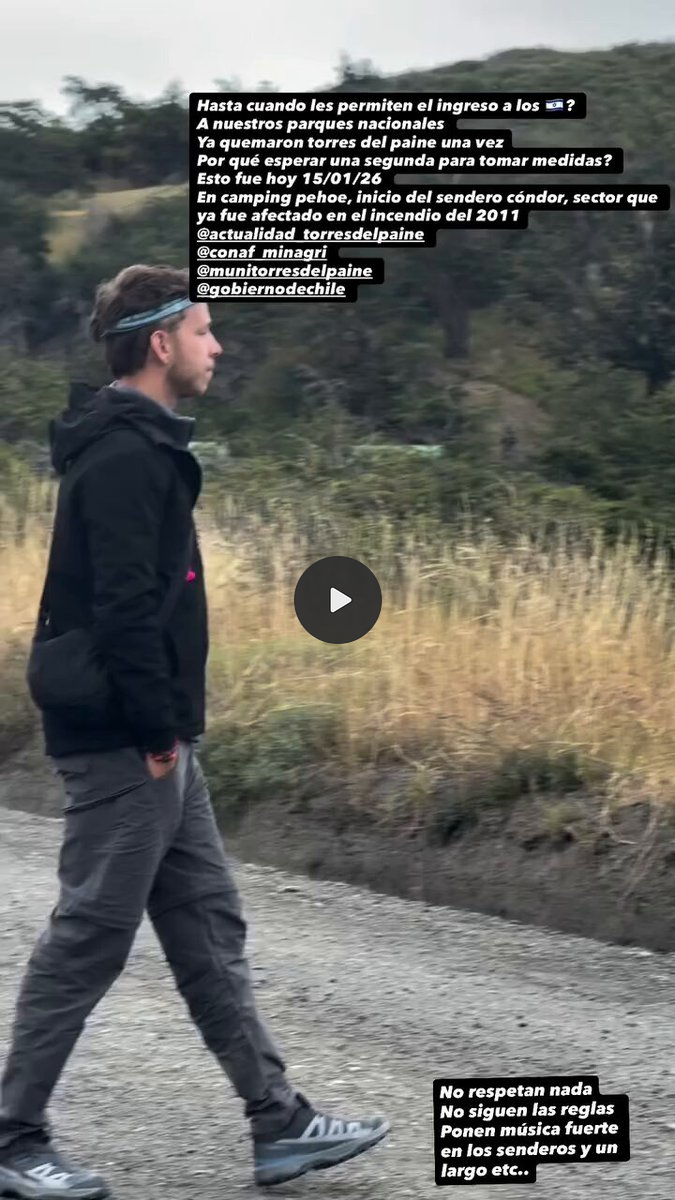
As wildfires currently blaze through Patagonia, Argentine social media users echo Senator Eugenio Tuma Zedán’s 2013 warnings, speculating that Israeli backpackers—whom he branded as covert mappers—may lie behind the blazes, a theory now crossing borders from Chile. With no official word on arson or foreign hands, these citizen journalists channel Tuma’s vigilance against perceived Israeli encroachments on southern lands. Should official investigations vindicate their suspicions, Tuma’s long-ago Senate stand would shine as prophetic foresight, a clarion call heeded too late.

NEXT:
Argentina’s Foreign Policy: Sovereignty Sacrificed at the Altar of NATO and Zionism

Argentine President Javier Milei campaigned as an outsider who promised to take a chainsaw to Argentina’s bloated bureaucracy. However, after assuming office he has governed as Washington’s most reliable partner in South America.
I wonder if fires in Australia, the USA and Canada fit into this pattern.
I recently read that 'investors' are buying up the land freed up by the Palisades fire.
Who are these 'investors'? Are they Jewish, perhaps Israelis?
It feels as though they are intentionally demoralizing the entire World on the global scale as leaders do nothing, trapped in fear.