

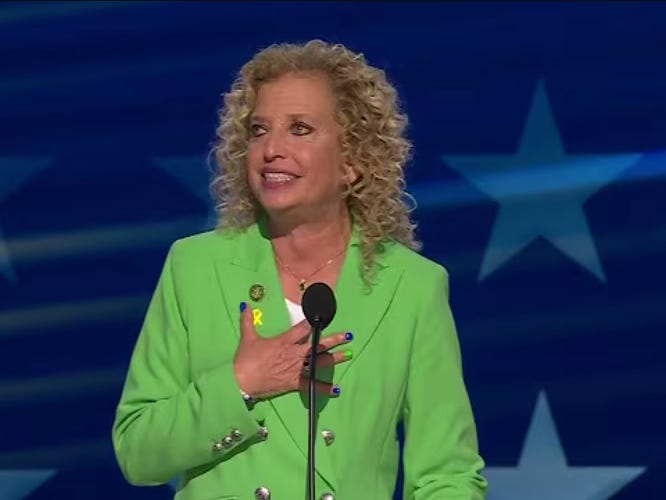
Debbie Wasserman Schultz’s announcement that she would leave her current congressional seat behind and compete for Florida’s 20th Congressional District has triggered one of the most intense confrontations between black and Jewish political forces in recent years. The district, situated in Broward County and reliably Democratic, has served as a cornerstone of black political power in South Florida for more than three decades. State lawmakers created the seat in 1992 under the Voting Rights Act expressly to guarantee that black voters would have the ability to elect representatives of their choosing, and it sent Florida’s first black members to Congress since the Reconstruction era.
Wasserman Schultz made her decision after Florida Republicans passed a new congressional map under Governor Ron DeSantis that dramatically altered her existing district, making it far more challenging terrain. Instead of defending her seat under these unfavorable conditions, the veteran congresswoman opted to seek election in a solidly Democratic district that black political organizers spent generations building.
Black leaders responded with swift condemnation. The Florida Legislative Black Caucus released a formal statement describing her decision as “disheartening” and emphasizing that the district “was established to remedy decades of racial exclusion and to ensure that black communities have the opportunity to elect leaders who truly reflect their experiences and needs.” The Broward County Democratic Black Caucus went further, specifically naming Wasserman Schultz and calling on all White Democratic elected officials to stay out of the race for the 20th District.
10 of 15 elected Florida DNC members put their names to a joint letter accusing her of “undermining Black political power when it becomes politically convenient.” Broward County State Senator Shevrin Jones declared that the fight is about expanding Black representation: “My fight is for Black representation, and I am in the business of expanding it, not diminishing it.” Congressional hopeful Elijah Manley stated, “I didn’t think a white Democrat would be the one to take away a Black seat.” Congressional Black Caucus Chair Yvette Clarke said Wasserman Schultz’s entry caused “consternation”—adding that when informed of the decision, she replied simply: “Thanks for informing me.”
Examining Wasserman Schultz’s political history helps explain why her candidacy in a black district has generated such fierce opposition. She has held elected office continuously since 1992, serving first in the Florida House of Representatives from 1992 to 2000, then moving to the Florida State Senate from 2000 to 2004, and occupying her seat in the U.S. House of Representatives since January 2005. She holds the distinction of being Florida’s first Jewish congresswoman and led the Democratic National Committee as its Chair from 2011 to 2016.
Wasserman Schultz ranks among the most forthright Zionists serving in Congress. She has steadfastly supported the constant delivery of American military aid to Israel and labored assiduously to ensure that U.S. aid flows to Israel without preconditions. She characterized her identity as a “Jewish mother” as the lens through which she views every foreign policy matter concerning Israel. AIPAC stands as her largest organizational donor at $940,552 in the 2025-2026 cycle, according to OpenSecrets data.
Her foreign policy profile is aggressively pro-Israel and hawkish across the board. She has repeatedly voted for U.S. security assistance to Israel, stood behind Israel in the wake of the Hamas attacks, characterized Israel as “only interested in living in peace with their neighbors,” and rejected any effort to attach conditions to military aid. On Russia, she championed expansive sanctions following the Ukraine invasion, describing them as “extremely biting” measures that would be “painful” for Russia; pushed for divestment from Russian corporations, leading a letter urging Florida to “wipe this blood-stained money off Florida’s investment books.” She also applauded the Trump administration’s decision to restore Cuba’s status as a State Sponsor of Terrorism.
Further, she established the Congressional Jewish Caucus in November 2023 as the Gaza conflict unfolded and shares leadership of the Congressional Latino-Jewish Caucus with Republican Rep. Mario Díaz-Balart. She additionally co-chairs the Caucus on Black-Jewish Relations alongside Reps. Nikema Williams and Wesley Hunt, and created the Interparliamentary Task Force to Combat Online Antisemitism, which works in coordination with the ADL.
Wasserman Schultz’s positions on immigration create another friction point with the historical trajectory of black political thought. She advocates consistently and forcefully for expansive immigration policy. Her official stance embraces “a pathway to citizenship, fair treatment under the law, and extending protections for DREAMers, Temporary Protected Status holders, and refugees.” This permissive approach to immigration policy clashes sharply with a deeply rooted black political tradition of resisting mass migration.
Numerous towering figures in black American history stood against mass immigration because they believed it displaced the economic prospects of freed slaves and their descendants. Booker T. Washington delivered his 1895 “Atlanta Compromise Address” with a direct appeal to industrialists to hire black Americans over immigrant labor, employing the memorable phrase “Cast down your bucket where you are.” A. Philip Randolph, who helped organize the 1963 March on Washington and stood as a preeminent black labor leader of his era, wrote in The Messenger in August 1924 that “This country is suffering from immigrant indigestion” and called for cutting immigration dramatically.
The most influential modern black voice advocating immigration restriction was Barbara Jordan, the legendary civil rights figure and former Texas congresswoman whom President Clinton appointed in December 1993 to lead the U.S. Commission on Immigration Reform. The Jordan Commission advanced proposals for substantial reductions in both legal and illegal immigration as a means of safeguarding American workers, with Jordan asserting that “It is both a right and a responsibility of a democratic society to manage immigration so that it serves the national interest.” By advocating for open borders and mass amnesty, Wasserman Schultz aligns herself against a century of black political thought that recognized unchecked immigration as a threat to black economic advancement.
In a similar token, Wasserman Schultz’s social views, which many members of her Hebraic tribe also hold, would likely ruffle many feathers in the black community. Her record on LGBT rights stands among the strongest in the House, earning her a perfect 100 percent score from the Human Rights Campaign and the Equality Florida “Voice for Equality Award.” She helped establish and serves as Vice Chair of the Congressional LGBTQ+ Equality Caucus, supported the repeal of Don’t Ask, Don’t Tell, voted to expand federal hate crimes protections to LGBT individuals, and has persistently advocated for the Equality Act.
Notwithstanding these controversies, Wasserman Schultz has routinely presented herself as a friend to the black community within the Democratic Party structure, releasing statements commemorating Black History Month, lending support to the Congressional Black Caucus, and serving on the House Oversight Subcommittee on Civil Rights and Civil Liberties. In her February 2020 Black History Month statement, she lauded the Congressional Black Caucus as “the conscience of the Congress” and called on all Americans to “join in the fight to protect the franchise that so many fought and died to secure.”
The primary contest for Florida’s 20th Congressional District now pits Wasserman Schultz against several black candidates, including former Rep. Sheila Cherfilus-McCormick, congressional candidate Rudolph Moise, who observed that her candidacy “sends the wrong message to Democrats all over Florida,” and State Rep. Ashley Gantt of the Florida Black Caucus, who raised concerns about how Wasserman Schultz handled her entry into the contest.
This confrontation represents the latest chapter in a troubled partnership between black and Jewish Americans in the political arena, a relationship that has experienced significant turbulence since the 1967 Six-Day War revealed a profound ideological divide. Black Power figures such as Stokely Carmichael drew connections between Zionism and colonialism. The most significant rupture came in the June-July 1967 SNCC Newsletter, which published a feature titled “The Palestine Problem: Test Your Knowledge,” charging that Israel had been established “through terror, force, and massacres” and alleging that “Zionist terror gangs (Haganah, Irgun, and Stern gangs) deliberately slaughtered and mutilated women, children and men.”
The October 7, 2023 assault on Israel brought these divisions roaring back. BLM Chicago posted and subsequently deleted an image on X featuring a paraglider with a Palestinian flag and the caption “I Stand With Palestine,” evoking the Hamas fighters who employed paragliders in the attack. BLM Grassroots published a statement on October 9 stating that “when a people have been subject to decades of apartheid and unimaginable violence, their resistance must not be condemned, but understood as a desperate act of self-defense.” The ADL condemned BLM Grassroots and BLM Chicago over social media content that appeared to justify the Hamas assault, with ADL CEO Jonathan Greenblatt accusing these chapters of glorifying Hamas terrorists.
The question of whether Wasserman Schultz can withstand this groundswell of opposition and capture the Democratic nomination remains unresolved. What has become unmistakably clear is that her campaign has compelled Democrats to grapple with uncomfortable questions that their coalition politics has long sidestepped. The battle for Florida’s 20th Congressional District transcends the fate of a single seat.
Wasserman Schultz is forcing a reckoning with black political leaders. This race will tell us if Jews are now about to discard an old golem class and look for new classes of more pliant golems in the ever-diversifying America.
NEXT:
Hindutva Meets Zionism: The Ideological Roots of Today’s India–Israel Axis

In 1938, Mahatma Gandhi famously declared, "Palestine belongs to the Arabs in the same sense that England belongs to the English or France to the French." His words reflected a broader current of Indian sympathy for Palestinian aspirations during the colonial era.…
If you like the content, feel free to continue supporting my work.
Buy Me A Coffee: https://buymeacoffee.com/josenino
It’s about time, isn’t it?