

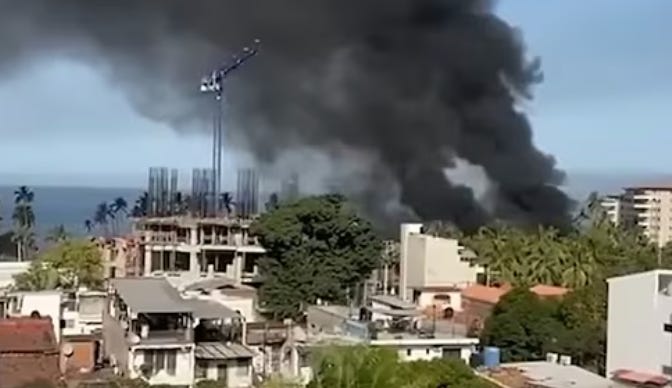
On February 22, 2026, the Mexican government announced what it called the most significant blow against organized crime in a generation. Nemesio Oseguera Cervantes, the man the world knew as “El Mencho,” the feared leader of the Jalisco New Generation Cartel, was dead. Violence erupted across Jalisco almost immediately as cartel gunmen blockaded roads, torched vehicles, and fired on military patrols. The kill was celebrated in Washington and Mexico City as a turning point. But beneath the headlines about El Mencho’s death lay a question that almost nobody in official circles wanted to ask. How did the CJNG become one of the most operationally sophisticated criminal armies on Earth? And who trained them?
The answer, buried in Mexican intelligence files, DEA debriefs, witness testimony, and international arms trafficking investigations, points to an uncomfortable and largely unexamined reality. For over two decades, Israeli nationals, including former intelligence operatives, organized crime figures, and arms dealers, have been entangled in the machinery of Mexico’s most violent cartels. They have laundered money, smuggled weapons, trained recruits, sold surveillance technology to corrupt officials, and sheltered fugitives. This is the story of that hidden connection.
Murder at the Shopping Mall
On a warm afternoon in July 2019, two men sat down for lunch at a restaurant inside Plaza Artz Pedregal, one of the most upscale shopping centers in Mexico City. Benjamin Yeshurun Sutchi was 44 years old. Alon Azulay was 41. Both were Israeli citizens. Both had extensive criminal records back home. Sutchi was described by Israeli media as an “underworld legend” who had been involved in gang wars and assassinations since the 1990s and had fled Israel in 2001 while on furlough from a murder sentence. They never finished their meal.
A woman approached their table and opened fire, killing both men in what CNN reported as a brazen execution in broad daylight. Mexico’s Security Minister Alfonso Durazo subsequently confirmed that both men were linked to money laundering operations tied to organized crime. But the details that emerged in the following weeks were far more explosive than a simple gangland hit.
Investigators established that Sutchi and Azulay had been laundering money for the Jalisco New Generation Cartel, establishing front companies across Oaxaca, Puebla, Guanajuato, Querétaro, and Mexico City. Cell phone records recovered by investigators showed that the CJNG organized the meeting with the Israelis at the mall. According to El Universal, authorities tracked the Israelis’ phones and movements and determined it was possible that Sutchi and Azulay had tried to rob or defraud the cartel, triggering the hit. A later investigation by the same outlet revealed that a woman known as “La Güera,” who managed financial operations for CJNG leader Nemesio Oseguera, had coordinated the meeting and then orchestrated the murder after something went wrong with the money laundering operation. A CJNG operative identified as “El Viejón” directed the gunmen who carried out the killing. Gabriel Regino, a former Mexican security official turned lawyer who had previously arrested Sutchi in 2005, told Radio Fórmula that the killing “was not a crime of passion, but a liquidation that was hired and carried out.”
Shortly after the killings, Interpol announced the arrest of Erez Akrishevski in the state of Quintana Roo. Akrishevski was one of Israel’s most wanted fugitives, having been convicted in 1998 of the attempted murder of a father and son as well as forgery. He escaped during a 48-hour prison leave in 2001, fled to Argentina where he was caught in 2004, then fled again while on bail. Interpol stated that he “is believed to have travelled throughout the Americas over the next decade, often to Mexico, and was allegedly connected to criminal activity and Israeli organized crime figures.” Mexican press reported that Akrishevski and Benjamin Sutchi had been business partners in Mexico.
What Mexican Intelligence Already Knew
The Plaza Artz killings shocked the public, but they did not shock Mexican intelligence. El Universal reported that intelligence files from the Peña Nieto administration revealed Israeli mafias had been active in Mexico since at least 2000, primarily involved in money laundering and the sale of high-powered weapons.
According to intelligence reports from the Peña Nieto administration obtained by El Universal, Israeli mafias had been active in Mexico since at least 2000, primarily involved in money laundering and the sale of high-powered weapons. Between 2000 and 2010, Israeli organized crime groups collaborated directly with the Beltrán Leyva Cartel, supplying the organization with weapons and laundering its money. Mexican authorities learned about the scope of Israeli mafia operations in the country by around 2013, primarily in Mexico City, though the Israeli individuals involved had entered the country legally. Separately, the now-defunct PGR (Mexico’s Attorney General’s Office) had intelligence on the presence of Israeli mafia members inside Los Zetas training camps in the states of Tamaulipas, Veracruz, and Hidalgo. And since 2012, Mexican authorities had launched investigations into the smuggling and sale of weapons by former Mossad agents operating within the country.
The Training Pipeline
The connection between Israeli military expertise and Mexican cartel violence has roots that stretch back decades. Los Zetas, the cartel that terrorized Mexico throughout the 2000s and 2010s, were founded by more than 30 defectors from GAFE (Grupo Aeromóvil de Fuerzas Especiales), Mexico’s most elite special forces unit. According to a 2010 Al Jazeera investigation, some of these soldiers had been trained in the early 1990s by America’s 7th Special Forces Group at Fort Bragg, North Carolina. Craig Deare, a former U.S. special operations commander who later became a professor at the National Defence University, confirmed to Al Jazeera that GAFE members “were given map reading courses, communications, standard special forces training, light to heavy weapons, machine guns and automatic weapons.”
Separately, the Foreign Policy Research Institute documented that “foreign specialists, including Americans, French, and Israelis, instructed members of this elite unit in rapid deployment, aerial assaults, marksmanship, ambushes, intelligence collection, counter-surveillance techniques, prisoner rescues, sophisticated communications, and the art of intimidation.” When these soldiers defected to the Gulf Cartel beginning in 1997 to form Los Zetas, they carried this expertise directly into cartel operations, building what analysts described as a paramilitary-grade criminal organization. The cartel also recruited Guatemalan Kaibiles (special forces) and corrupt police officers, compounding the foundational foreign military training.
Following El Mencho’s death in February 2026, renewed scrutiny fell on whether the CJNG had tapped into similar foreign training pipelines. A TRT World investigation cited a former DEA agent who reportedly described hearing about Israeli nationals meeting with CJNG members to provide sniper training and tactical instruction, noting methods that appeared “more technically advanced than typical Mexican cartel tactics.”
The Weapons Pipeline
Guns are the most tangible evidence of the Israeli connection. The “Deadly Trade“ report, a 2020 multi-country investigation by eight organizations including Global Exchange and the American Friends Service Committee, documented that between 2006 and 2018, the Israeli weapons firm IWI sold 24,280 firearms to Mexican police forces at a cost of approximately €34 million. The arsenal included 16,442 Galil and Tavor assault rifles and thousands of Jericho pistols. The investigation, based on more than 9,000 pages of declassified Mexican army documents, detailed how over 2,600 of these assault rifles went to police forces in Tamaulipas, Guerrero, and Jalisco, states that accounted for 60% of illegal weapons confiscations nationwide. Of the approximately 61,000 illegal firearms recovered by the Mexican army from 2010 to May 2020 for which a manufacturer was identified, 41 were IWI weapons, found at crime scenes across multiple states.
The Veracruz case was particularly disturbing. Between 2011 and 2014, IWI sold 1,199 rifles to the Veracruz state police, the same force later accused of running death squad operations that killed at least 15 people, mostly youths, during the governorship of Javier Duarte. During this period, Veracruz state police were also suspected of carrying out at least 202 enforced disappearances. The weapons sold to “law enforcement” ended up in the hands of the very forces perpetrating extrajudicial violence.
Mexico’s Defense Secretary, General Ricardo Trevilla Trejo, stated at a press conference on February 23, 2026 that of the approximately 23,000 weapons seized from cartels during the current administration, 80% were of U.S. origin. The statement came in the wake of the military operation that killed CJNG leader El Mencho and underscored the sheer volume of American firepower flowing south across the border. The broader “Deadly Trade“ investigation found that European and Israeli companies exported over 238,000 firearms to Mexico for police use between 2006 and 2018, revealing that the pipeline of foreign weapons into Mexico extends well beyond the U.S. border.
The Fugitive in the Luxury Tower
Perhaps no single figure illustrates the intertwining of Israeli and Mexican security and criminal networks more vividly than Tomás Zerón de Lucio. Zerón served as head of Mexico’s Criminal Investigation Agency, the country’s equivalent of the FBI, and played a central role in the 2014 capture of “El Chapo” Guzmán. He was later accused of torture, evidence tampering, and abduction in connection with the cover-up of the investigation into the 2014 disappearance of 43 Ayotzinapa students, whose case he had been tasked with solving. A panel of international investigators discredited his findings, discovering that crucial testimony was obtained under torture and evidence was mishandled. Separately, Mexico is investigating whether Zerón embezzled more than 1.1 billion pesos, approximately $50 million, earmarked for the purchase of defense and intelligence gear that in some cases was never delivered. He fled to Israel in 2019 and has been living in a luxury apartment in Tel Aviv’s Neve Tzedek Tower.
The Times of Israel reported that Zerón claimed “political persecution” to justify his flight. But the details of his living situation raised even more questions. CTech revealed that Zerón shared his Tel Aviv residence with David Avital, a shareholder in a subsidiary of Rayzone Group, an Israeli intelligence and cyber company with operations in Mexico. Israel has effectively blocked Zerón’s extradition despite an Interpol red notice, having neither acted on Mexico’s extradition request nor resolved Zerón’s asylum claim for years. A senior Israeli official acknowledged to the New York Times that the process was being slow-walked as “tit-for-tat diplomacy” against Mexico’s support for United Nations inquiries into allegations of Israeli war crimes against Palestinians. Israel also cited procedural failures by Mexico, including improperly translated legal documents, and suggested there may be merit to Zerón’s asylum claim.
The Spyware That Watched Everyone Except the Cartels
The surveillance dimension of the Israeli-Mexican nexus runs through one of the most notorious pieces of technology ever created. Israel’s NSO Group sold its Pegasus spyware to Mexico beginning in 2011, making Mexico its first and most prolific client globally. The software was ostensibly purchased for anti-cartel operations. It was instead extensively used against journalists, human rights defenders, and political opponents, not cartel figures.
Tomás Zerón himself was instrumental in integrating Pegasus into Mexico’s law enforcement apparatus. Le Monde documented the connections between the spyware, Israeli intelligence, and the Ayotzinapa case. The tool that was supposed to help Mexico fight its drug war was instead turned into a weapon against the people trying to hold the government accountable for its failures in that very war. And the man who helped deploy it fled to Israel when the consequences caught up with him.
These revelations compel a reckoning with the shadowy entanglements between Israeli networks and Mexico’s narco-apparatus, yet they persist in the margins of public discourse. The corporate media, overwhelmingly controlled by Jewish interests and aligned with entrenched power structures that prioritize communal solidarity over impartial reporting, systematically suppresses such narratives, framing them as fringe conspiracies rather than patterns of geopolitical maneuvering. This selective blindness ensures that the Israeli pipeline of arms, expertise, and impunity remains obscured, allowing its beneficiaries to evade scrutiny while scapegoating other actors for this perfidy.
However, these occurrences should not be treated as isolated incidents. When one examines Israel’s and American Jewry’s concerted efforts to render Latin America amenable to Jewish hegemony—through initiatives like the Isaac Accords and the strategic co-optation of pivotal regimes such as Argentina’s—it becomes evident that Mexico stands poised as the next arena for such influence operations orchestrated by Israel and international Jewry.
Make no mistake: Israel and the broader Jewish community harbor ambitions that extend far beyond consolidating control over the Middle East and the affluent nations of the West; emerging economies like Mexico represent fertile ground for subversion and dominance, even if it necessitates embedding operatives within the labyrinthine underbelly of its criminal syndicates. In the post-World War II global order, where Jewish interests enjoy unparalleled institutional privileges and protections from sovereign states worldwide, no nation escapes the scope of the pan-Judah’s expansive designs—Mexico, assuredly, forms no exception.
NEXT:
Villains of Judea: Yair Klein

From Israel’s paratrooper units to Colombia’s conflict zones, Yair Klein exported his special operations expertise to train cartel-linked fighters, leaving a trail of devastation amid ongoing questions about justice for his role. Klein had a storied career within the Israel Defense Forces. He served in the elite paratroopers and commanded a secretive re…
If you like the content, feel free to continue supporting my work.
Buy Me A Coffee: https://buymeacoffee.com/josenino
World jewry is at base THE original mafia, a global crime syndicate hell bent on subjugating and subverting every sovereign state and its citizens. And their field operations manual is the book of Deuteronomy - it's all you need to know.
Ya gotta give it to the Mossd and Unit 8200 and…………….
The Israeli Defense Forces (IDF) recently underwent a major technological reorganization, consolidating and forming several high-level divisions to lead their cyber and artificial intelligence (AI) operations. These units are primarily housed within the C4I and Cyber Defense Directorate and the Military Intelligence Directorate (Aman).
C4I and Cyber Defense Directorate: This directorate is responsible for building and operating the IDF’s digital, multi-domain, and strategic capabilities.
Information and Artificial Intelligence Division (Bina): Formed in late 2024, this division (Hebrew for “intelligence”) consolidates nearly all existing AI units under a single command. It includes:
Mamram: The Center of Computing and Information Systems.
Shahar: The unit responsible for data science and software development.
Matzpen: A software unit focused on operational systems.
AI Center of Excellence: A hub for advanced algorithmic research.
Software and Information School: The training arm for these technical roles.
Cyber Defense Division: Led by a Brigadier General, this division is responsible for protecting IDF networks and maintaining cyber resilience.
Spectrum and Communications Division: A new division created to manage the electromagnetic spectrum and strategic communications, including satellite and space-based networking.
Digital Transformation Division: Formed in 2019 to integrate civilian tech innovation into military infrastructure.
AIDF (Artificial Intelligence Reserve Unit): A specialized reserve unit that recruits experts from Israel’s high-tech industry to assist in military decision-making.
"AI has enabled the Israeli regime’s genocidal logic to be carried out with machine-driven efficiency—reducing Palestinians, their families, and their homes to what the military chillingly calls ‘garbage targets’"
Military Intelligence Directorate (Aman):
Aman manages the “collection” and analysis of intelligence through several elite technical units.
Unit 8200: Israel’s primary signal intelligence (SIGINT) and cyber warfare unit, often compared to the U.S. NSA. It has been instrumental in developing AI-powered target recommendation systems like Lavender and The Gospel.
Unit 81: A secretive technological unit that develops advanced hardware and software for special operations.
Unit 9900: Focused on visual intelligence (VISINT), utilizing satellites and mapping technologies often enhanced by AI for terrain analysis.
Unit 504: The human intelligence (HUMINT) unit, which increasingly uses digital tools to manage field data.
Specialized & Joint Units:
Unit 888 (Refaim): A multi-dimensional unit that integrates AI and advanced sensors directly into combat operations.
Cyber Innovation Unit: Focuses on developing new cyber tools in collaboration with the private sector.
Center for Consciousness Operations: A unit within the Operations Directorate that manages psychological warfare and information operations.
https://paulokirk.substack.com/p/in-defense-of-petro-masculinity