

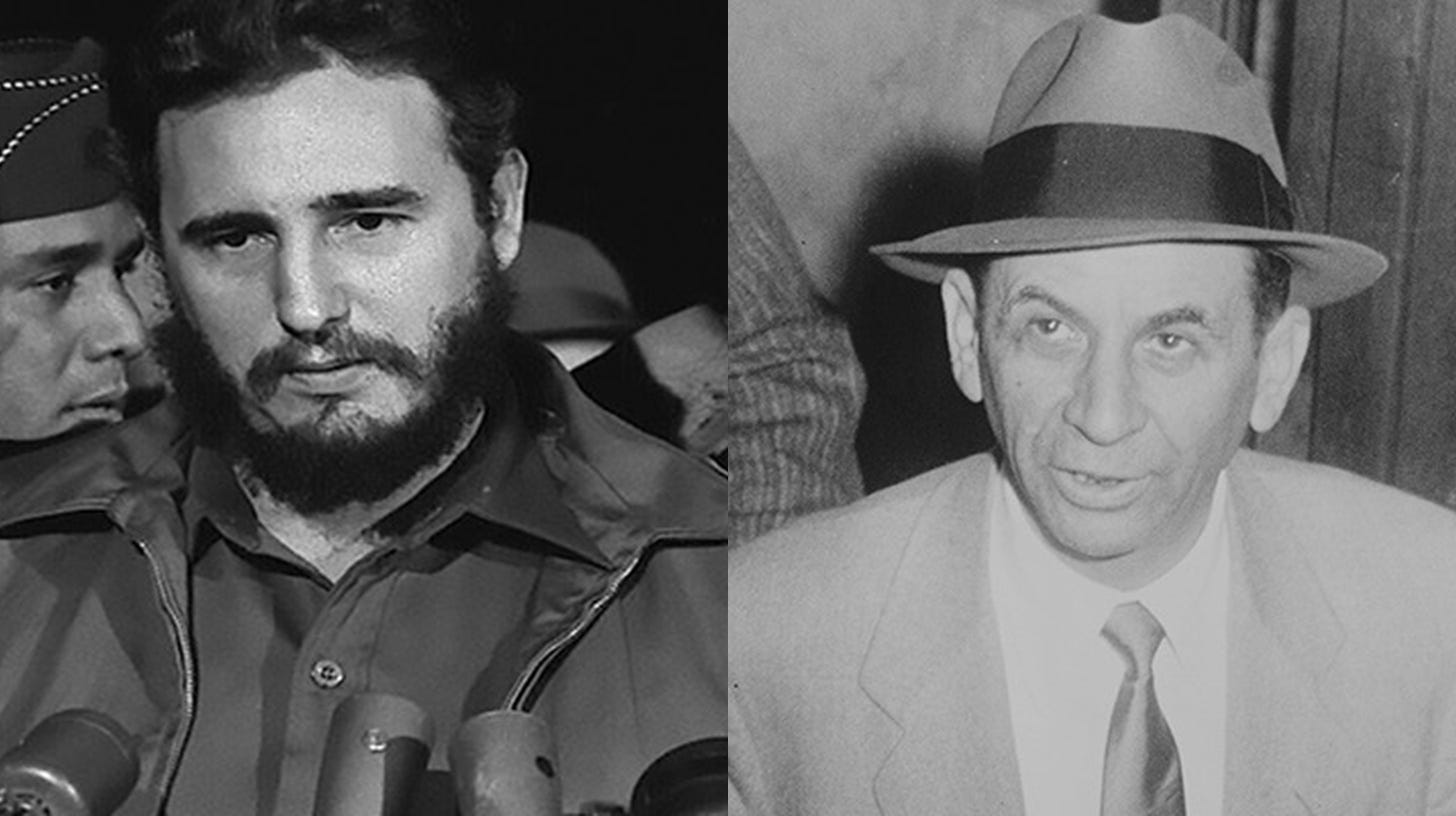
For more than two decades, Meyer Lansky built what he believed would be his permanent kingdom in the Caribbean. The Jewish gangster from New York’s Lower East Side had transformed Havana into the gambling capital of the Western Hemisphere, a glittering playground where American tourists could indulge every vice under the protection of a dictator on the mob’s payroll. Then came Fidel Castro, a young Catholic revolutionary from the Cuban countryside who would destroy everything Lansky had built in a matter of weeks.
Their conflict was never personal. The two men likely never met or spoke. But the collision between Lansky’s criminal empire and Castro’s revolutionary movement would reshape Cuba, spawn assassination plots that entangled the CIA, and leave a trail of consequences that echoes into the present day.
More than half a century later, as Washington once again toys with the idea of remaking Cuba’s political order, the ghost of Meyer Lansky’s Havana hangs over every discussion of regime change: the dream of turning the island back into a glittering casino colony has never fully died.
Meyer Lansky entered the world as Maier Suchowljansky on July 4, 1902, in Grodno, a city in the Russian Empire that now belongs to Belarus. His family was part of the vast population of Eastern European Jews who migrated to America in the early 20th century. In 1911, Lansky emigrated with his mother and brother Jacob through the port of Odessa, joining his father Max, who had arrived two years earlier and settled first in Brownsville, Brooklyn. The family later moved to the Lower East Side of Manhattan, where Max worked in the garment industry and young Meyer grew up among the crowded tenements where Yiddish filled the streets and opportunity meant whatever you could grab with your own hands.
Young Meyer found his opportunities in crime. By 1918 he and his friend Benjamin “Bugsy” Siegel were running floating dice games on the streets. They graduated to auto theft, then burglary, and when Prohibition arrived, they plunged into the liquor smuggling trade that would make fortunes for a generation of gangsters. Lansky also befriended Charles “Lucky” Luciano, an Italian immigrant who would become one of the most powerful mob bosses in American history.
The three young men rose together. Lansky and Siegel developed a squad of killers for hire that became the prototype for Murder, Inc. Lansky allegedly persuaded Luciano to arrange the 1931 assassination of mob boss Joe “The Boss” Masseria, a murder that consolidated power and helped establish the National Crime Syndicate between 1932 and 1934.
What set Lansky apart from the gunmen and enforcers around him was his financial chops. He became known as the “Mob’s Accountant,” the man who used Swiss bank accounts and shell companies to launder the Mafia’s wealth and hide it from federal investigators. He oversaw the syndicate’s finances as its unofficial banker and was instrumental in shifting the mob’s focus from bootlegging to gambling after Prohibition ended in 1933. His gambling operations stretched from Florida to New Orleans to Las Vegas.
But Lansky’s grandest ambition lay 90 miles off the coast of Florida.
Building the Havana Empire
Lansky’s relationship with Cuba began in 1933, the same year Prohibition ended, and a young military strongman named Fulgencio Batista seized control of the island nation. Lansky pitched Batista a proposal to open Mafia-owned casinos and nightclubs in Havana. The arrangement was straightforward. Batista and his inner circle would receive regular payments from the mob, and in return the gangsters could operate without interference from Cuban authorities.
By 1938, Lansky had been formally invited to help clean up and professionalize Havana’s gambling operations, which had been plagued by fixed races and crooked dealers. He was the fixer, the man who could make the casinos run honestly enough to keep the tourists coming back.
The landmark event came in December 1946 with what became known as the Havana Conference. More than 20 mob bosses from across the United States gathered at the Hotel Nacional de Cuba for a meeting organized by Lansky on Luciano’s orders. The expansion of mob operations in Cuba sat at the top of the agenda. Lansky then visited Batista, who was temporarily out of power and living in Florida, and urged him to return to Cuba to fulfill their grand plans.
Batista obliged. He returned to power through a military coup in 1952, and the arrangement with the mob became even more lucrative. The Batista-Lansky Alliance, included a deal where Batista agreed to match dollar for dollar any hotel investment over one million dollars, with each project automatically including a casino license. Casino hotels were exempted from Cuban taxes.
Lansky owned or held financial interests in at least three major gambling operations. The crown jewel was the Habana Riviera, which opened in December 1957 as the largest Mafia-owned hotel casino outside Las Vegas. It featured 440 rooms that were booked solid for its first winter season. Cuban development banks subsidized half of the $14 million construction cost.
But Lansky did not build this empire alone.
The Inner Circle
Jake Lansky, Meyer’s brother, served as his most trusted man on the ground in Cuba. Jake managed the casino at the Hotel Nacional, Cuba’s most prestigious hotel. By spring 1957, it was reportedly bringing in as much cash as the biggest casinos in Las Vegas.
Joseph “Doc” Stacher was a lifelong Lansky associate dating back to their youth in Newark, New Jersey. Born Gdale Oistaczer in Letychiv, in what is now Ukraine, Stacher was also Jewish and had risen through the criminal ranks alongside Lansky. He operated as the official bribe paymaster to Batista, managing the corrupt payments that kept the dictator and his inner circle cooperative.
Norman “Roughhouse” Rothman was another mobster deeply embedded in the Havana gambling scene. He was a close associate of Santo Trafficante Jr. and operated casinos in Havana, most notably the Sans Souci. Cuba’s slot machine concessions were controlled by Roberto Fernandez y Miranda, Batista’s brother-in-law and army general, who held them as a personal fief.
Ed Levinson, a longtime Lansky associate, ran illegal gambling operations from the Midwest to Kentucky. In Cuba, Levinson’s name appeared on the casino license for the Habana Riviera itself. Lansky kept his own name listed only as the hotel’s kitchen director while Levinson served as the official licensee.
Dino Cellini, though Italian-American rather than Jewish, worked hand in glove with the Lansky operation. He served as casino manager at the Habana Riviera before being replaced by Frank Erickson, and was later detained alongside Jake Lansky at the Tiscornia immigration camp after Castro took power.
The operation also included powerful Italian-American mobsters. Santo Trafficante Jr., the Tampa crime family boss, openly operated the Sans Souci nightclub and the Casino Internacional at the Hotel Nacional. He was also suspected of having behind-the-scenes interests in the Habana Riviera, the Tropicana Club, the Sevilla-Biltmore, the Capri Hotel Casino, the Commodoro, the Deauville, and the Havana Hilton.
The Revolutionary in the Mountains
While Lansky counted his profits in Havana’s glittering casinos, a revolutionary movement was gathering strength in the mountains of eastern Cuba.
Fidel Castro came from a background that could not have been more different from Lansky’s. Born on August 13, 1926, near Birán in Oriente Province, Castro was the son of a prosperous Spanish immigrant landowner. He was raised Catholic and educated at Jesuit schools in Santiago de Cuba and Havana, including the prestigious Colegio de Belén. He studied law at the University of Havana beginning in 1945, earned his degree in 1950, and briefly practiced as a lawyer before turning fully to revolutionary politics. Where Lansky had clawed his way up from immigrant poverty through criminal enterprise, Castro came from rural privilege and channeled his ambitions into armed struggle against the Batista regime.
Castro’s 26th of July Movement directly targeted the Mafia’s presence in its propaganda. In 1958, the revolutionaries denounced the mobsters in radio broadcasts from their guerrilla redoubt in the Sierra Maestra, accusing them of turning Havana into a center of commercialized vice through gambling, prostitution, and drugs. The casinos, the brothels, the drugs, the corruption that enriched Batista and his American gangster partners would all be swept away when the revolution triumphed.
The Fall
On December 31, 1958, Batista’s army was defeated at the Battle of Santa Clara. That night, Batista fled the country for the Dominican Republic, abandoning his gangster partners along with everything else. Lansky left Cuba on January 7, 1959, the day before Castro marched into Havana.
What happened next was a settling of accounts that played out in the streets of Havana. On January 1, 1959, citizens took to the streets after hearing news of Batista’s flight, ransacking casinos, smashing slot machines, and dragging gambling equipment into the streets to be burned. To many Cubans, the American-owned hotels symbolized a corrupting foreign influence. At the Riviera, Lansky’s crown jewel, campesinos (peasants) reportedly brought a truckload of pigs into the lobby. Castro vowed to “clean out all the gamblers.” The revolutionary government eventually nationalized the Riviera and all other Mafia-owned properties, though the final nationalization of hotel casinos did not come until October 1960. Some casinos briefly re-opened on February 19, 1959, after casino workers who depended on tourism jobs marched to the presidential palace demanding their livelihoods back, but tourists stopped coming. Lansky, who told many associates that Cuba had ruined him financially, looked to other outposts in the Caribbean and South America.
Not everyone fled immediately. Jake Lansky and Dino Cellini were arrested by Cuban authorities in May 1959 and detained at the Tiscornia immigration camp outside Havana, the same facility where Santo Trafficante Jr. was also being held. According to the House Select Committee on Assassinations, U.S. Commissioner of Narcotics Harry J. Anslinger had sent a list of suspected drug traffickers to Cuban authorities that included both Jake Lansky and Cellini. Jake Lansky and Cellini were detained for approximately 25 days before being released; Trafficante was held until August. All eventually left Cuba.
By October 1960, Castro formally nationalized all hotel casinos on the island and outlawed gambling entirely.
Revenge and Assassination Plots
Lansky did not merely accept his losses. He actively sought to use the U.S. government and its intelligence apparatus to reclaim his Cuban empire.
According to Doc Stacher, Lansky “indicated to the CIA that some of his people who were still on the island might assassinate Castro” and was “quite prepared to finance the operation himself.”
This was not Lansky’s first collaborative effort with American intelligence. During World War II, he had served as a key intermediary in Operation Underworld, a classified program in which the U.S. Navy’s Office of Naval Intelligence enlisted the Mafia to counter Axis sabotage on the northeastern seaboard. That wartime relationship established a precedent for cooperation between organized crime and the U.S. government.
In August 1960, according to a report by Salon, Lansky struck a deal with exiled Cuban politician Manuel Antonio Varona, offering him several million dollars to form a Cuban government-in-exile to replace Castro. Lansky also promised to arrange a public relations campaign to polish Varona’s image, with the single-minded objective of reopening the Mafia’s casinos, hotels, and nightclubs in a post-Castro Cuba.
Around the same time, the CIA formally recruited mobsters with deep ties to the Havana gambling operations into plots to eliminate Castro. In September 1960, the agency enlisted Chicago Mob operative Johnny Rosselli through former FBI agent Robert Maheu. Rosselli brought in Chicago boss Sam Giancana and Tampa boss Santo Trafficante Jr. The CIA created poison pills to be slipped into Castro’s food, but the attempts failed. The CIA-Mafia assassination partnership was scuttled in early 1963, though the CIA continued plotting against Castro through other means.
Norman Rothman’s trajectory after the revolution was particularly dramatic. Before the revolution succeeded, Rothman had actually been running guns to Castro’s rebels alongside Joe Merola and the Mannarino brothers of Pittsburgh. Sam Mannarino had reasoned that if Castro won, the mobsters who helped arm him would be in the driver’s seat for Cuba’s gambling industry. Rothman advised Mannarino to place his bets on Castro, predicting he would allow the casinos to remain under Mafia control. When that calculation proved disastrously wrong, the scheme unraveled. The weapons in question, 317 guns, had been stolen from a National Guard armory in Canton, Ohio. A plane carrying 121 of the stolen weapons was captured at Morgantown, West Virginia on November 4, 1958. Rothman was convicted on February 4, 1960, along with five co-defendants, for possession, receiving, transportation, and exportation of firearms stolen from the United States government.
Lansky also explored contingency plans in case Cuba could not be recovered. He traveled to the Dominican Republic in 1958 to meet with dictator Rafael Trujillo about potentially relocating the entire Havana operation there. None of these schemes succeeded.
The Final Years
Lansky spent his final years living quietly in Miami Beach. In 1970, facing federal tax evasion charges, he fled to Israel, hoping to claim citizenship under the Law of Return. But after two years, Israel rejected his bid for permanent residency due to his criminal record and deported him back to the United States, where he was arrested at Miami International Airport.
He was acquitted of the tax evasion charges, in part because the government’s main witness lacked credibility, and other indictments were abandoned due to his chronic ill health. He died on January 15, 1983, at age 80 from lung cancer. Despite nearly half a century of involvement in organized crime, the most serious conviction he ever received was for illegal gambling in 1953, which resulted in only a brief jail term.
Despite a lifetime running one of the world’s most profitable criminal enterprises, a granddaughter later claimed he left behind just $57,000 in cash. The FBI believed he had hidden at least $300 million in offshore bank accounts, but this money was never recovered. His heirs later filed a compensation claim against Cuba for the Riviera with the U.S. Foreign Claims Settlement Commission, valuing the property at $70 million.
The mob never returned to Cuba. The casinos that Lansky built were nationalized, and gambling was outlawed entirely. The slot machines that crowds smashed in the streets on New Year’s Day 1959 were never replaced. The Habana Riviera still stands on the Malecón waterfront, declared a National Monument in 2012 and now managed by the Spanish chain Iberostar, still maintaining its original 1950s style. Staff members still refer to it as “el hotel de Meyer Lansky.”
Fidel Castro outlived Meyer Lansky by more than three decades, dying in 2016 at age 90. The revolutionary who had vowed to clean out all the gamblers kept that promise, at least regarding the foreign mobsters who had turned Havana into their personal playground.
The confrontation between these two men, the Jewish gangster from the Lower East Side and the Catholic revolutionary from Oriente Province, ended decisively in Castro’s favor.
Castro’s revolution did what no rival gangster or corrupt strongman ever managed: it toppled the dictatorship that shielded Lansky’s operations and erased his Havana casino empire almost overnight. In the name of sovereignty, the new regime shut down the glittering hotels and gambling halls that had turned Cuba into a playground for American tourists, mafiosi, and intelligence services alike.
But the pressures now bearing down on Cuba suggest that history’s wheel is turning back toward Lansky’s original blueprint. A successful regime change engineered from abroad would not simply “liberate” the island; it would open prime waterfront real estate and tourist infrastructure to the same forces of vice, speculation, and foreign ownership that once made Havana the mob’s favorite casino.
The danger is that Cuba’s next great transformation would replace revolutionary austerity not with genuine self‑determination, but with a return to what Lansky always wanted. Namely, a Caribbean Macau where the house is global finance, the chips are Cuban sovereignty, and the people of the island are once again reduced to serving drinks on someone else’s casino floor.
NEXT:
Watch Out for Those Cuban Republicans

On January 28, 2026, Rep. María Elvira Salazar (R-FL) posted a message on social media that cut straight to the point. “This moment demands action on immigration reform, and I’m encouraged to see growing support in Congress for the DIGNITY Act, now with 35 cosponsors and a growing national coalition behind the bill. This is the only serious, bipartisan …
If you like the content, feel free to continue supporting my work.
Buy Me A Coffee: https://buymeacoffee.com/josenino
Amazing how the South Florida Cubans are now in bed with Israel. Rubio is the worst but yet these Cubans think he the 2nd coming . Trump fooled me for sure but the Cubans remain loyal to this scumbag .
Jews are the biggest Gangsters in the World.