

Two earthquakes hit northern Venezuela on June 24, 2026, striking 39 seconds apart. The first registered 7.2. The second registered 7.5. The United States Geological Survey classified the pair as a doublet and placed both epicenters near Moron on the Caribbean coast, roughly 100 miles west of Caracas and about three miles from each other. USGS seismologist Paul Earle told NPR that simultaneous quakes of that size rarely occur. “This doesn’t happen very often,” he said. “When they’re right together, it’s hard to understand what would happen.”
Buildings folded across Caracas and the coastal state of La Guaira. National Assembly President Jorge Rodriguez put the toll at 4,734 dead, 16,740 injured and 17,907 homeless on July 14, with rescuers pulling 6,462 people alive from the wreckage. It ranks as the strongest earthquake to strike Venezuela since 1900.
Israel had no embassy in Caracas. It had no ambassador, no consulate and no diplomatic relations of any kind. It sent a delegation anyway. Israel’s National Security Council reviewed the operation and cleared a joint mission from the Foreign Ministry and the Israel Defense Forces. The team left Israel on June 30 and an advance group landed on July 1. Ambassador Yoed Magen, Israel’s ambassador designate to Mexico, who grew up in Venezuela and handles the Venezuela portfolio in Jerusalem, led the civilian side. Brigadier General Elad Edri, chief of staff of the IDF Home Front Command, commanded the military contingent.
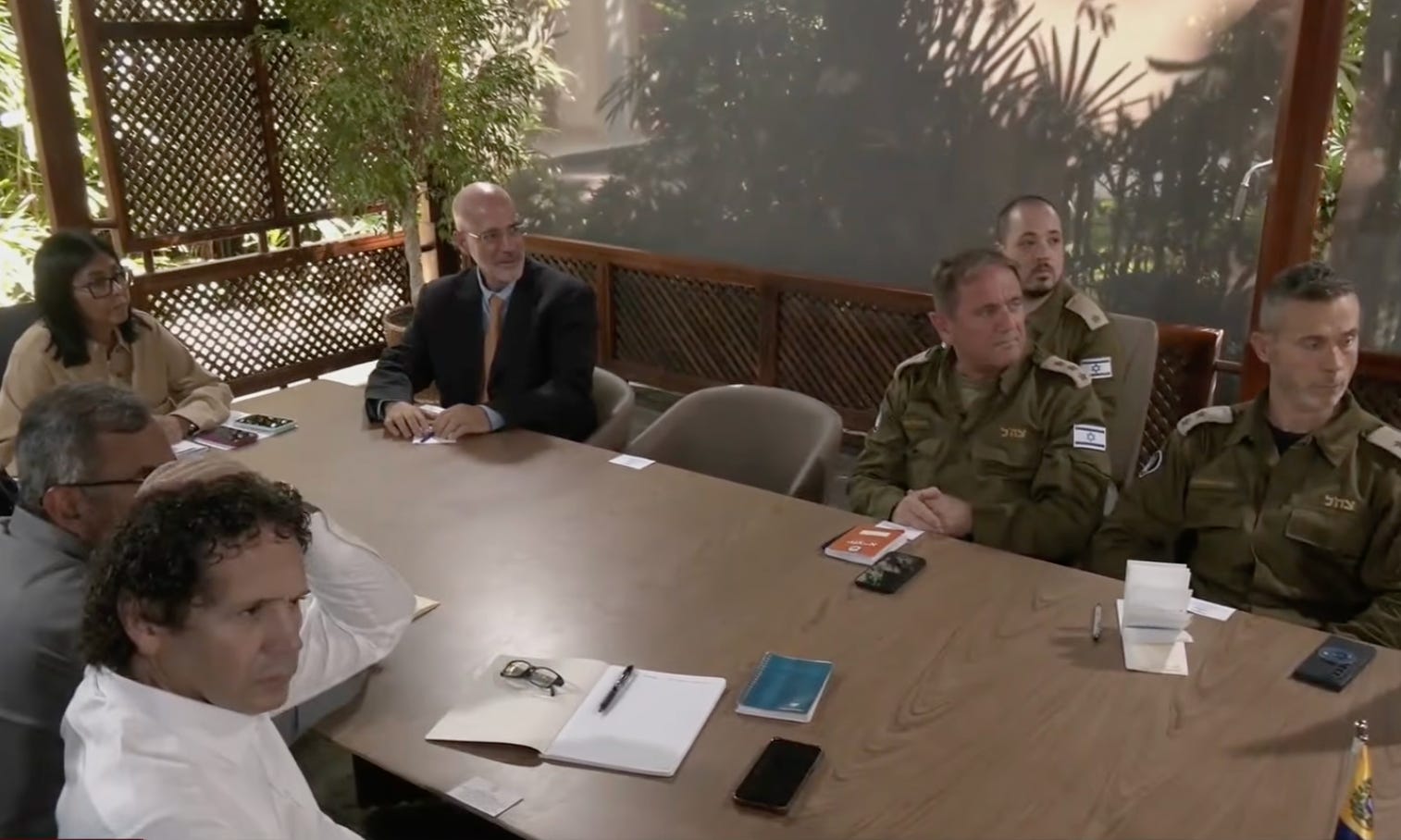
The delegation arrived with 28 members—including eight Home Front Command engineers and Foreign Ministry representatives—and grew to around 30 as additional specialists from the National Emergency Management Authority joined the effort. Uniformed Israeli officers moved openly through a country that had spent 17 years treating their government as an enemy, keeping their uniforms and Israeli insignia prominently displayed throughout.
The assignment was engineering, not rescue. Beginning at 3 p.m. on July 6, Edri’s teams started mapping roughly 1,300 damaged buildings, sorting each into demolish or salvage, and advised Venezuelan engineers on debris removal and recycling plans. Edri noted the contrast with past deployments, where the IDF fielded over 400 personnel—Venezuela asked for 30. Edri and Magen then presented Delcy Rodriguez with a multi-year national reconstruction plan. Her government approved the blueprint in days, a process that would normally take weeks or months.
The mission produced something no diplomat had managed since 2009. Venezuelan Foreign Minister Yván Gil picked up the phone and spoke directly with Magen—Israel’s ambassador-designate to Mexico, who also oversees the Venezuela portfolio at the Foreign Ministry—the first such exchange between senior officials of the two governments in years.
Rodriguez went further. At a press conference she became the first Venezuelan leader since Hugo Chávez to praise Israel publicly. “I would like to report that yesterday we received a highly professional and skilled team from Israel,” she said. “I would like to report that yesterday we received a highly professional and skilled team from Israel.”
Rabbi Yitzhak Cohen told Ynet he had offered the mission himself. “We offered the president of Venezuela the possibility of having the Israeli delegation come to assist in the disaster,” Cohen said. “She gladly accepted our assistance and gave all the necessary approvals for the delegation’s arrival. This was the first step.”
Rodriguez then called Sa’ar directly and asked him to keep the team in the country. Netanyahu approved a two-week extension on July 8 in coordination with Sa’ar. Two days later Netanyahu addressed the delegation by video. “You are rebuilding ruins, and you are also rebuilding relations. You are showing the people of Venezuela, as well as the Venezuelan government, the true face of the State of Israel,” he said. He added that the delegation had come “to a country that severed relations nearly 20 years ago” and proved “how beneficial it is to have ties with Israel.” Edri responded that “We are very proud to represent the country here. Both official representatives and the Venezuelan people have been very warm toward the delegation.”
Understanding why any of this counts as extraordinary requires going back nearly 80 years. Venezuela backed Jewish statehood early. It voted for the United Nations partition plan on November 29, 1947, and two years later supported Israel’s admission to the United Nations, joining the first wave of Latin American governments to recognize the new state. Venezuela’s mission opened in Jerusalem and stayed there until 1980, when Caracas joined the general exodus of embassies to Tel Aviv. Decades of practical cooperation followed in agriculture, science, and military affairs. A 1961 technical accord sent Israeli planners and agronomists to Venezuela, where they shaped irrigation schemes such as Las Majaguas, a resettlement project for 2,200 peasant families. Caracas managed all this while helping found OPEC in 1960 alongside Saudi Arabia, Iraq, Iran, and Kuwait. It balanced the Arab oil partnership against the Israeli one and kept both.
However, Hugo Chávez ended that pro-Israel alignment.
Chávez won the presidency in 1998 and radically reshaped Venezuelan foreign policy around opposition to Washington, which pulled Israel into the target set by association. The 2006 Lebanon war produced the first break. Chavez recalled Ambassador Hector Quintero and, on his weekly broadcast, sharply denounced the Israeli offensive. He proclaimed, “Israel has gone mad. They are massacring children, and no one knows how many are buried.” At the time, Israeli Foreign Ministry spokesman Mark Regev responded that Chávez “is not known for his objectivity when it comes to the Middle East conflict.”
Operation Cast Lead finished the relationship. On January 6, 2009, Venezuela expelled Israeli Ambassador Shlomo Cohen and part of his staff. The Foreign Ministry statement condemned Israel’s “flagrant violations of international law” and denounced “their planned utilization of state terrorism.” No other government with Israeli ties took that step. Eight days later, on January 14, Caracas severed relations outright, citing the “cruel persecution of the Palestinian people.” Bolivia broke ties hours earlier.
Israel expelled Venezuela’s diplomats in late January. Chávez welcomed it. “It is an honor for this socialist government and this revolutionary people to have our representatives expelled by a genocidal government such as Israel,” he said. Recognition of Palestine came separately, on April 27, 2009, when Venezuela recognized the State of Palestine and established formal diplomatic relations under President Hugo Chávez, formalizing the commitment through a signed treaty. Canada took over as Israel’s protecting power in Caracas that spring, and Spain assumed Venezuela’s interests in Tel Aviv by September.
Nicolás Maduro was foreign minister during the rupture and carried the posture into his presidency. Venezuela deepened its strategic partnership with Iran and became one of Israel’s loudest critics.
It should be noted that Chavismo was never monolithic on Israel, and by 2017 the softening reached the top. That February, President Nicolás Maduro welcomed a Jewish delegation to the presidential palace, among them Sephardic Chief Rabbi Isaac Cohen and Elias Farache, who headed the country’s umbrella Jewish organization. Maduro called it a good day of dialogue for peace. A month later, then Foreign Minister Delcy Rodríguez, the same woman who now serves as interim president, told those same leaders of “the desire to establish full relations with the State of Israel.” Cohen described his pitch to AJN News. “We suggested to start with a period of courtship, which means a beginning through consular relations, so that later it will become a marriage, which would be Israel’s own embassy again in Venezuela, as we have always had here.” Nothing followed at the time. It was the first sign that Rodríguez would do business with the Israelis.
Israeli Prime Minister Benjamin Netanyahu recognized Juan Guaidó in January 2019, joining Washington and much of Latin America in treating the opposition leader as Venezuela’s rightful president. No election had produced the standoff. Maduro had been declared winner of a May 2018 vote that the opposition and most of the hemisphere called fraudulent, and when he took a second oath in January 2019 the National Assembly, then controlled by the opposition, declared the presidency vacant. Guaidó, its young speaker, swore himself in as acting president days later
Weeks later Guaidó told the Israeli news outlet Israel Hayom that he was renewing ties. “We have begun working toward renewing the ties, and I’m very happy to announce that the process of stabilizing the relations with Israel is at its height,” he said, staying noncommittal on whether the embassy would return to Jerusalem. He never held power.
American forces captured Maduro in Caracas on January 3, 2026, in Operation Absolute Resolve, a raid that launched more than 150 aircraft across the hemisphere, and flew him to New York to face narcoterrorism charges. Israeli Foreign Minister Gideon Sa’ar welcomed “the removal of the dictator who led a network of drugs and terror,” hoping for “friendly relations between the states.” Delcy Rodríguez took over and turned toward Washington after Maduro’s kidnapping.
On January 16, Maduro’s son Nicolas Maduro Guerra, a National Assembly deputy and PSUV vice president for religious affairs, floated normalization at the Teresa Carreno Theater. “Advancing respectful relations with the US and with any country in the world (…) I believe we should have relations with the US, an embassy (…) because it is our self-determination, we could even think about having diplomatic relations with Israel (…) it is an idea that I am proposing here, in the context of diplomacy, these are ideas that come to my mind,” he said.
Tel Aviv, meanwhile, was cultivating the other side. Sa’ar met opposition leader Maria Corina Machado in Washington on February 3. “Israel and Venezuela have historically shared very close ties, which we will reclaim and strengthen in this new era of democracy and freedom,” the Nobel laureate said.
A week later Bloomberg reported that traders were routing Venezuelan crude to Haifa based Bazan Group, Israel’s largest refiner, the first such cargo since mid 2020. The Middle East Forum estimated 200,000 barrels were bound for Haifa. Information Minister Miguel Perez Pirela called the report fake news. Bazan and Israel’s Energy Ministry declined comment, consistent with Israeli practice.
Venezuelan political scientist Carlos Eduardo Pina argues in an Al Jazeera opinion piece that survival drives Rodríguez, not conviction. He tracks the turn month by month. She said the January operation that removed Maduro carried “Zionist overtones.” By late February her foreign ministry had declined to condemn the American and Israeli strikes on Iran, calling instead for dialogue and faulting Tehran for retaliating against neighbors that host U.S. forces. In April she posted a Passover greeting to Rabbi Cohen and the Jewish community, then told them days later in a televised address that Venezuela held “no anti-Semitic positions.”
Pina reads the sequence as a bid for Trump’s protection and a maneuver against María Corina Machado, the opposition leader who spent years building her own alliance with Netanyahu. Strip Machado of Israeli backing and she loses a lever in Washington, where pro-Israel networks carry weight. Pina grants the strategy has worked so far. He stops short of predicting it holds. “But whether this bargain can survive the weight of 27 years of anti-Israel rhetoric and produce a durable alliance with a state the ruling party long treated as an enemy remains far from certain,” he writes.
Rabbi Cohen reads it differently, and he has reason to hope. Israeli reports have floated his name as Venezuela’s ambassador should relations resume. “We hope, and are almost certain, that this will move another step forward,” he told Ynet. “There is no doubt that this was a moving gesture.”
A new era is dawning in Venezuela. One in which the revolutionary zeal of Chavismo is being discarded in favor of submission—spun by some as pragmatism—to the Judeo-American order. Because the United States serves as the military guarantor of Jewish supremacy worldwide, no country can challenge Israel without facing American retaliation. With great powers in Eurasia pushing back on multiple fronts, Washington will re-focus on Latin America to consolidate its hegemony, plunder wealth, and retool its global grand strategy, all while creating safe havens for Jewish influence. At first glance, Delcy Rodriguez’s Venezuela is poised to become the next Zionist satellite in South America.
Only a resurgence of authentic nationalism can prevent Venezuela’s absorption into the Pan-Judah.
NEXT:
The Right-Wing Zionist Wave Sweeping Latin America

Abelardo de la Espriella’s razor-thin victory over leftist Iván Cepeda on June 21, 2026 represented the most recent rightward shift in Latin America’s politics. The defense attorney from Barranquilla captured 49.66 percent of the vote against Cepeda’s 48.7 percent—a margin of roughly 250,000 votes in what Al Jazeera called
If you like the content, feel free to continue supporting my work.
Buy Me A Coffee: https://buymeacoffee.com/josenino