

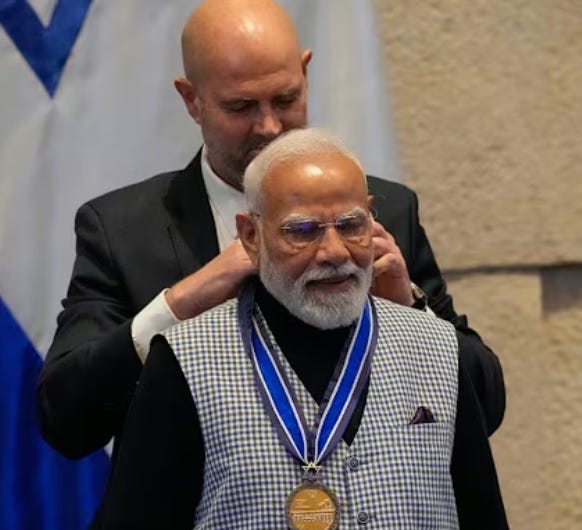
On February 25, 2026, Indian Prime Minister Narendra Modi arrived in Israel for a two-day state visit at the invitation of Prime Minister Benjamin Netanyahu. Standing before the Knesset, Modi declared: “We feel your pain. India stands with Israel firmly, with full conviction, in this moment and beyond. Nothing justifies killing civilians.” The Israeli parliament gave him a standing ovation, and Knesset Speaker Ohana placed the first-ever Knesset Medal on the Indian leader.
Netanyahu, calling Modi “more than a friend, a brother,” used the occasion to announce a “hexagon of alliances” that would include India in a strategic bloc committed to standing against what he termed “radical axes.” The visit was preceded by an intense flurry of bilateral engagements: the first-ever round of India-Israel Free Trade Agreement negotiations, the 10th Joint Working Group on Counter-Terrorism, and a defense industry seminar pairing 30 Indian and 26 Israeli defense companies. India is now Israel’s largest arms customer, accounting for 46% of Israeli weapons exports, with discussions reportedly including technology transfer for the Iron Dome missile defense system and Israel’s new Iron Beam high-energy laser weapon.
The corporate media depicted this as a story about trade deals and diplomatic optics. What went almost entirely unmentioned was the far darker foundation on which this alliance rests: a history of covert military planning, sabotage, assassination, and an aborted joint operation that nearly brought India, Israel, and Pakistan to the brink of nuclear war.
From Pariahs to Partners: The Roots of an Unlikely Alliance (1948 to 1980)
India’s relationship with Israel began inauspiciously. Although India recognized Israel in 1950, Prime Minister Jawaharlal Nehru declined to establish full diplomatic relations, aligning India with the Non-Aligned Movement and the broader cause of Palestinian self-determination. For decades, New Delhi kept Jerusalem at arm’s length in public.
In private, the calculus was different. Even before establishing full diplomatic relations, Israel quietly supplied weapons to India during the 1962 war with China, as well as during the 1965 and 1971 wars with Pakistan. By 1968, Prime Minister Indira Gandhi had instructed RAW chief R.N. Kao to establish contact with Mossad, forging an intelligence liaison that would deepen over the following decades. The relationship was transactional, ideologically awkward, and entirely covert. At the time, both nations were nuclear-threshold states that existed outside the Western security architecture, and each saw in the other a partner that could be useful precisely because the partnership was deniable.
The real catalyst for acceleration came not from shared values but from shared enemies. India fought three wars with Pakistan in its first quarter century of independence. Israel, surrounded by hostile states, saw in Pakistan’s nuclear ambitions a threat that extended far beyond the subcontinent. When Pakistani leaders began openly framing their nuclear program as an “Islamic Bomb“ available to the broader Muslim world, the interests of New Delhi and Jerusalem converged with an urgency that no amount of diplomatic caution could contain.
“Mortal Danger”: Menachem Begin and the Fear of the Islamic Bomb
Israeli anxiety about Pakistan’s nuclear program did not begin with intelligence briefings or satellite imagery. It began with a phrase that haunted Israeli strategists from the moment it entered public discourse: the “Islamic Bomb.”
On May 17, 1979, Prime Minister Menachem Begin wrote to newly installed British Prime Minister Margaret Thatcher, warning that Pakistan’s nuclear program posed a “mortal danger” to Israel. Begin cautioned Thatcher about what he described as dangerous collaboration between Pakistan and Libyan leader Muammar Gaddafi, writing that nuclear weapons could fall “into the hands of an absolute ruler like Colonel Qaddafi.” He sent similar letters to the leaders of France and West Germany as part of a broader lobbying campaign to get Western nations to clamp down on Pakistan’s nuclear development.
The British Foreign and Commonwealth Office was unimpressed and dismissed Begin’s letter as “sensationalist.” Naturally, Begin was not content with diplomatic letters. On June 7, 1981, he demonstrated Israel’s preferred method of nonproliferation when eight Israeli F-16A fighter jets, escorted by F-15As, destroyed Iraq’s Osirak nuclear reactor in a daring long-range strike. The operation, condemned internationally at the time, established what would come to be known as the Begin Doctrine: Israel would prevent hostile states from acquiring nuclear weapons by any means necessary.
Emboldened by the success over Iraq, Israeli planners turned their attention eastward.
Within a Hair’s Breadth: The Kahuta Strike Plan (1982 to 1984)
The most advanced scheme to destroy Pakistan’s nuclear capability involved a joint Israeli-Indian military operation against the Kahuta Research Laboratories, the uranium enrichment facility near Rawalpindi that formed the heart of Pakistan’s weapons program. According to investigative journalists Adrian Levy and Catherine Scott-Clark, whose book Deception: Pakistan, the United States, and the Secret Trade in Nuclear Weapons is based on hundreds of interviews and declassified documents, the plan unfolded in stages.
In February 1983, with the strike plan already at an advanced stage, Indian military officials traveled secretly to Israel to purchase electronic warfare equipment designed to neutralize Kahuta’s air defenses. The operational design called for Israeli F-16s and F-15s to fly into Indian airspace, refueling at the Jamnagar airbase in Gujarat and at Udhampur in northern India, while Indian Jaguar deep-strike aircraft would assist the mission.
What happened next remains disputed. According to Levy and Scott-Clark, in March 1984 Indian Prime Minister Indira Gandhi formally signed off on the Israeli-led operation, bringing India, Pakistan, and Israel, as they wrote, “within a hair’s breadth of a nuclear conflagration.” Indian defense analyst Bharat Karnad, citing retired Major General Aharon Yaariv, corroborated that Gandhi “first approved of an Israeli strike” before calling it off. However, former CIA counterproliferation officer Richard Barlow, who served during Pakistan’s clandestine nuclear development, told news outlet ANI in November 2025 that the operation “never happened, it was just talk. It’s a shame that Indira didn’t approve it. It would have solved a lot of problems.”
What is not disputed is that the plan was ultimately abandoned. The CIA tipped off Pakistani President General Zia-ul-Haq, and the U.S. State Department warned India that “the US will be responsive if India persists.” Whether Gandhi formally approved and then reversed herself, or never gave final authorization, the operation died. Pakistan’s Vice Chief of Army Staff, General K.M. Arif, later confirmed the intelligence breach: “Our friends had let us know what the Israelis and Indians intended to do, and so we let them know how we would respond.”
India’s own nuclear scientist Raja Ramanna had also been warned by Pakistan’s Atomic Energy Commission chairman Munir Ahmed Khan that if Kahuta were attacked, Pakistan would retaliate against India’s Trombay nuclear complex. The mutual vulnerability that defined the Cold War’s logic of deterrence had already taken root in South Asia.
Letter Bombs and Phone Threats: The Shadow Campaign Against Khan’s Network
When the airstrike option collapsed, Israel did not abandon its campaign. Instead, Mossad turned to the darker arts of sabotage and intimidation, targeting the European procurement network that A.Q. Khan had built to feed Pakistan’s enrichment program.
According to a detailed investigation by Middle East Eye, executives at European companies doing business with Khan’s network were systematically targeted. A letter bomb was sent to one supplier in West Germany. The man survived, but his dog was killed. Another bombing targeted a senior executive at Swiss company Cora Engineering.
Siegfried Schertler, the owner of a Swiss company supplying Pakistan’s program, told Swiss Federal Police that Mossad agents phoned him and his salesmen repeatedly. An employee of the Israeli embassy in Germany told him bluntly to stop “these businesses” regarding nuclear weapons. The campaign bore the hallmarks of the pressure tactics Israel had refined over decades of countering proliferation networks, but it ultimately proved insufficient. Khan’s network was too diffuse, too well-funded, and too thoroughly protected by the Pakistani state to be dismantled by intimidation alone.
The failure gnawed at Israeli intelligence for decades. Former Mossad Chief Shabtai Shavit openly stated that had he correctly understood what Khan was doing, he would have “considered sending a Mossad team to kill Khan and thus ‘change the course of history.’” The Mossad had monitored Khan’s extensive Middle Eastern travels but failed to properly identify his proliferation activities in time. It remains one of the most consequential intelligence failures in Israeli history.
The Playbook Perfected: From Kahuta to Natanz
What Israel could not accomplish against Pakistan, it refined and executed against others. The operational playbook developed for Kahuta did not disappear. It evolved, and its fingerprints are visible across every subsequent Israeli campaign against a nascent nuclear program.
In September 2007, eight Israeli F-15s and F-16s destroyed Syria’s al-Kibar nuclear reactor in Deir al-Zour province, a facility built with North Korean assistance. Israel officially confirmed the operation only in 2018, over a decade later. Syria’s air defenses were blinded by sophisticated electronic jamming systems, and the facility was flattened in approximately three minutes.
But it was against Iran that the full spectrum of capabilities developed across decades was unleashed. Beginning in 2007, Israeli intelligence orchestrated a systematic campaign of assassination, cyberwarfare, and sabotage targeting Iran’s nuclear program. Between 2007 and 2012 alone, at least five Iranian nuclear scientists were killed in operations attributed to Mossad, most by magnetic bombs attached to their cars by assailants on motorcycles. In November 2020, Mohsen Fakhrizadeh, widely regarded as the father of Iran’s nuclear weapons program, was killed by a remote-controlled AI-powered machine gun smuggled into Iran in pieces and operated via satellite from outside the country.
In January 2018, a Mossad team broke into a Tehran warehouse, used torches to cut through 32 safes, and smuggled out approximately 50,000 pages and 163 compact discs documenting Iran’s covert nuclear weapons program.
The campaign reached its most dramatic escalation on the night of June 12 to 13, 2025, when nine top Iranian nuclear scientists were assassinated simultaneously in their homes as part of broader Israeli strikes on Iran’s nuclear infrastructure. At least 14 Iranian nuclear scientists were killed in Israeli attacks between June 12 and 15, 2025. The United States subsequently joined the campaign, with B-2 bombers and Tomahawk missiles striking the Fordow, Natanz, and Isfahan nuclear sites on June 22, 2025.
The Lingering Fear: Pakistan’s Arsenal in the Crosshairs
Pakistan today possesses approximately 170 nuclear warheads. Its delivery systems span aircraft, ballistic missiles capable of reaching deep into Indian and Middle Eastern territory, and the Ababeel missile designed to defeat India’s missile defenses with multiple independently targetable reentry vehicles.
For Israeli strategists, the nightmare was never Pakistan’s arsenal aimed at Israel. It was the possibility that Pakistan’s nuclear umbrella could extend to other Muslim states, creating a deterrent architecture that Israel could neither penetrate nor neutralize. The fear was vindicated in part by Khan’s proliferation network and has resurfaced with new urgency in recent years.
During the June 2025 Israel-Iran war, Iranian IRGC Commander Major General Mohsen Rezaei claimed on state television that “Pakistan has told us that if Israel uses nuclear missiles, we will also attack it with nuclear weapons.” Pakistan’s government firmly denied this, with Deputy Prime Minister Ishaq Dar calling the allegations “false and inflammatory” and stating: “No one from the government has made any such statement. This is not child’s play.”
Yet the denial did little to calm Israeli nerves. In February 2026, just days before Modi’s visit, former Israeli Prime Minister Naftali Bennett addressed the Conference of Presidents of Major American Jewish Organizations in Jerusalem and issued the most explicit warning about Pakistan’s nuclear program in recent Israeli political history:
“Turkey is the new Iran. Erdogan is sophisticated, dangerous, and he seeks to encircle Israel. We can’t close our eyes again.”
Bennett then directly invoked Pakistan’s nuclear arsenal:
“Turkey is trying to flip Saudi Arabia against us and establish a hostile Sunni axis with nuclear Pakistan.”
“The current government is once again sleeping. The dangers of radicalism are growing on our borders. An axis of the Muslim Brotherhood, supported by Pakistani nuclear weapons, is being led by Turkey.”
Pakistan’s Foreign Office dismissed Bennett’s statement as “purely speculative,” declining to comment further on “a statement from an official of a country whom we do not recognize.”
Pakistan’s Senate unanimously condemned Netanyahu’s aforementioned “hexagon of alliances” remarks. Retired Pakistani General Naeem Khalid Lodhi publicly warned that Israel may target Pakistan’s nuclear arsenal after Iran. The structural logic is clear: having neutralized Iraq’s program in 1981, Syria’s in 2007, and devastated Iran’s in 2025, Pakistan represents the last significant nuclear capability in the Muslim world that Israel has not been able to reach.
Brothers in Arms: The Alliance Deepens Under Narendra Modi
The India-Israel relationship that nearly produced the Kahuta strike has not merely survived; it has flourished beyond anything its Cold War architects could have imagined. The 1999 Kargil War cemented the alliance when Israel supplied laser-guided bombs, drones, electronic warfare systems, and satellite intelligence at a time when the United States and Europe had imposed sanctions over India’s nuclear tests. Former Israeli ambassador Daniel Carmon later remarked: “The Indians always remind us that Israel was there for them during the Kargil war... The Indians don’t forget this and might now be returning the favour.”
Since then, cooperation has expanded into multi-billion-dollar programs: the Barak missile systems, developed jointly with India’s Defence Research and Development Organisation (DRDO); the Phalcon AWACS deal of 2004, worth $1.1 billion; purchases of UAVs from early Searcher drones to advanced Heron systems; indigenous production of Hermes 900 drones; and joint development of the Barak-8 long-range surface-to-air missile. Annual defense trade now exceeds $1.5 billion, with Israel ranking as India’s second-largest arms supplier.
Bilateral trade expanded from $200 million in 1992 to a peak of $10.77 billion in 2022 to 2023. Key sectors include diamonds, accounting for nearly half of trade, with Indian cutters in Surat and Israeli traders in Tel Aviv forming a global supply chain; defense equipment spanning weapons parts, electronics, and aerospace systems; and high technology in semiconductors, cybersecurity, and telecommunications. Commerce Minister Piyush Goyal has set a target of tenfold growth, envisioning trade reaching $65 billion by 2037.
Cooperation has extended into more controversial territory. The Pegasus spyware, developed by Israeli firm NSO, was deployed in India against journalists, activists, and political opponents, underscoring how Israeli surveillance technology is now integrated into India’s security state. Strategically, Israeli authorities have reassured India that they would never “support Pakistan on the Kashmir issue,” an alignment that emboldens the BJP’s hardline approach in the disputed territory while Israel benefits from a loyal Asian partner and lucrative defense contracts.
The Long Shadow
The story of India and Israel’s campaign against Pakistan’s nuclear program is not merely a Cold War era curiosity. Effectively, it marked a pivotal juncture in Israeli-Indian relations, forging an unspoken pact that propelled both nations toward a robust, multi-faceted alliance rooted in mutual strategic imperatives.
Today, as Israel’s global standing erodes amid its ruthless campaign in Gaza—earning widespread condemnation in the West—India emerges as an ideal proxy, a formidable golem to advance Tel Aviv’s expansive geopolitical designs. With Western support waning, Israel will inevitably pivot to more melanin-enhanced climes in Africa, South America, and South Asia, where India stands preeminent as a nuclear-armed and willing ally in the current reconfiguration of global power.
NEXT:
Hindutva Meets Zionism: The Ideological Roots of Today’s India–Israel Axis

In 1938, Mahatma Gandhi famously declared, "Palestine belongs to the Arabs in the same sense that England belongs to the English or France to the French." His words reflected a broader current of Indian sympathy for Palestinian aspirations during the colonial era.…
If you like the content, feel free to continue supporting my work.
Buy Me A Coffee: https://buymeacoffee.com/josenino
As always, thank you.