

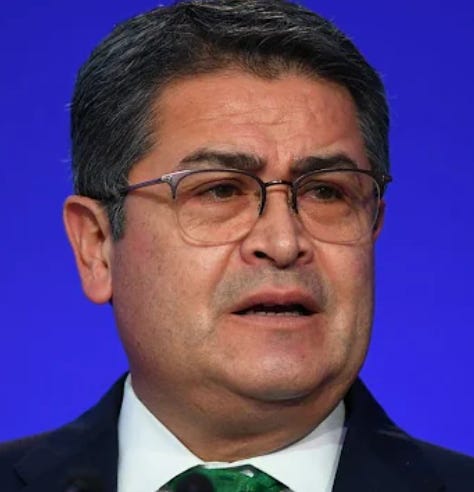
The news came in quietly from a federal prison in West Virginia. Juan Orlando Hernández, the former president of Honduras once sentenced to spend most of the rest of his life behind bars, had walked out of Hazelton penitentiary a free man.
According to an AP report, Hernández had received a presidential pardon from Donald Trump after a conviction that tied him to hundreds of tons of cocaine shipped into the United States. On paper, this was a spectacular reversal of fortune for a man whom federal prosecutors had branded the head of a Central American narco state. In practice, it looked like something else. It looked like a reward for loyalty to the one cause that towers above all others in Washington and in Trump world.
Hernández did not rise overnight. He entered Congress in the late 1990s, representing the rural department of Lempira, and spent more than a decade climbing inside the National Party machine. He then became president of the National Congress and finally president of Honduras from 2014 to 2022. While he projected the image of a tough conservative modernizer at home, another storyline unfolded in U.S. courtrooms.
Federal prosecutors charged him with a vast cocaine conspiracy involving the movement of multi-ton loads into the United States and with the possession of machine guns and other weapons in support of that network. The Justice Department later described his administration as a narco state fueled by millions in cartel bribes. Testimony and media investigations painted an even darker picture. According to Democracy Now, Hernández allegedly used Honduran security forces to protect drug shipments, partnered with major traffickers including the Sinaloa cartel, and used drug money to build his own political power. His brother Tony Hernández ended up with a life sentence in a U.S. prison on similar charges.
Court filings and investigative reports in outlets like CNN repeatedly tied the sitting Honduran president to drug traffickers. U.S. prosecutors said he took payoffs from drug networks as early as 2004. Hernández’s story also intersected with one of Honduras’s most prominent Jewish families. Prosecutors alleged that he received bribe payments and other favors from the Rosenthal family, a powerful clan of Romanian-Jewish origin led by Jaime Rosenthal, whose Grupo Continental controlled Banco Continental, a soccer club, and auto import businesses, as reported by Reuters.
The Rosenthal patriarch, a frequent Liberal Party presidential hopeful of Romanian Jewish extraction, stood near the top of the Honduran economic and political pyramid for decades. For his part, Hernández treated that network as another source of money and influence. A Univision investigation detailed allegations that he used drug money to finance political campaigns. After his arrest, Honduran authorities seized dozens of properties, vehicles, businesses, and other assets linked to his family.
The saga culminated in extradition to the United States in 2022. A New York jury convicted Hernández in March 2024, and a federal judge handed down a 45-year sentence plus supervised release in June of that year. By any normal standard, this was the end of the story. A disgraced former head of state, proven in court to have worked hand in glove with traffickers, destined to spend the rest of his days in prison.
However, Hernández did not bet his future on normal standards. For decades, he had invested in a different kind of protection. That protection wore a blue and white flag with a Star of David at the center.
His relationship with Israel began long before he held national office. As a young man in the early 1990s Hernández traveled to Israel under the auspices of Mashav, the Israeli Agency for International Development Cooperation. The Jewish Telegraphic Agency noted that he completed a Mashav enrichment course in 1992, at the beginning of his diplomatic career.
Three decades later, at the opening of the Honduran embassy in Jerusalem, Hernández stood before an audience and called that first visit to Israel a “life-changing” experience. He said the trip had shaped his view of security, agriculture, and innovation.
Once he entered the presidential palace, Hernández turned that personal link into state doctrine. In October 2015, he arrived in Jerusalem as head of state and told an audience convened by the Israel Council on Foreign Relations and the World Jewish Congress that “As long as I am president, Honduras will stand behind Israel.” The World Jewish Congress described the event in glowing terms and singled out his declaration that ties between the two countries had never been closer.
This was not idle rhetoric. Hernández set out to reposition Honduras as one of the most reliable pro-Israel governments in Latin America. Honduran and Israeli diplomats had initially signed formal relations in the 1950s, and Honduras had allowed Jewish immigration during the Second World War. Under Hernández, those historical connections became the foundation for a new foreign policy.
He adjusted the Honduran voting record at the United Nations so that his country would abstain from or oppose resolutions deemed hostile to Israeli interests. During the 2017 General Assembly vote that condemned the U.S. decision to move its embassy to Jerusalem, Honduras was one of only a tiny group of countries that sided with Washington and Israel against the overwhelming majority.
Hernández also opened a diplomatic and trade office in Jerusalem, signaling recognition of the city as Israel’s capital. He then promised to relocate the full Honduran embassy from Tel Aviv to Jerusalem, issuing joint statements with Israeli and U.S. officials that set public deadlines for that step. In June 2021, he completed the move. At the inauguration, Hernández proclaimed that he was “here today in the eternal capital of Israel” and vowed to work “against antisemitism, often presented as anti Zionism,” as quoted by Israel Hayom.
Israel rewarded this loyalty with gestures of its own. It agreed to reopen its embassy in Tegucigalpa and provided security cooperation, technical assistance and emergency relief after devastating hurricanes and during the early stages of the COVID era.
Furthermore, Hernández pushed Honduras into the orbit of Christian Zionist networks. The Friends of Zion Museum in Jerusalem, an institution that promotes Christian support for Israel and campaigns against antisemitism and BDS, gave him its Friends of Zion Award in 2019 for recognizing Jerusalem as Israel’s capital and for his diplomatic support. The Friends of Zion Museum and the Jerusalem Post emphasized that he now shared an honor roll with figures like Donald Trump and other leaders celebrated for their pro-Israel policies.
In the security arena, Hernández took positions that aligned perfectly with Washington and Tel Aviv. His government designated Hezbollah as a terrorist organization, a move welcomed by major American Jewish groups. This decision mirrored similar steps by other U.S.-aligned governments in the region–such as Argentina under Mauricio Macri–and confirmed that Tegucigalpa had no intention of straying from the Judeo-American consensus on Middle East security.
Even when the walls began to close in, Hernández treated Israel as his ultimate safety net. As his legal exposure increased and the prospect of extradition grew more likely, he reportedly turned to Israeli officials to ask for help in delaying or preventing his transfer to U.S. authorities. The Times of Israel reported that plea and underscored Hernández’s assumption that his years of unwavering support had earned him political capital in Jerusalem.
That calculation looked naïve when he arrived in New York in chains. It looks far more rational now that Donald Trump has delivered a pardon.
Trump himself cultivated a brand as perhaps the most pro-Israel president in U.S. history. He recognized Jerusalem as Israel’s capital, moved the U.S embassy there, backed the annexation of the Golan Heights, and surrounded himself with advisers and donors who made support for Israel a central test of loyalty. The Friends of Zion Museum honored him with the same award it later gave Hernández, presenting both men as partners in a shared historic mission.
So when Trump announced in late 2025 that he would pardon Hernández, it was natural for mainstream outlets to emphasize the legal controversy and the scale of the drug conspiracy. But there is another thread that runs from the Mashav classroom in the early 1990 to the Jerusalem embassy ribbon cutting to the moment the gates opened at Hazelton. That thread is the politics of Zionism in the Americas and the unwritten rule that governs advancement and protection in that world.
Hernández spent his adult life proving that he would stand behind Israel. He did it in the United Nations chamber, in ceremonial torch lighting invitations, in embassy relocations, in his fights against BDS and in his designation of Hezbollah. He did it in speeches where he promised that “as long as I am president, Honduras will stand behind Israel” and in the moment when he described Jerusalem as the “eternal capital of Israel.”
Trump saw that record and recognized a fellow shabbos goy traveler. He understood that this was not just a corrupt Central American politician but a loyal member of a global pro-Israel camp who had delivered meaningful victories in a region where Israel has long worked to secure dependable allies. In a political universe where servility to world jewry carries more weight than any anti-corruption sermon, Hernández did not just have a lawyer. He had a patron.
The pardon of Juan Orlando Hernández is therefore more than a quirky case of presidential clemency. It is a message about the real hierarchy of values in U.S. foreign policy in the Trump era. Flooding American streets with cocaine will not necessarily erase your credit if you have spent years moving embassies to Jerusalem, voting the right way at the United Nations, and branding your small Central American country as an extension of Israel’s diplomatic network.
In that world, a man who helped turn his own nation into a narco playground can still find a way out of a 45-year sentence, as long as his record on Zionism is pure and his friendship with the most pro-Zionist president in modern U.S. history remains intact. For Juan Orlando Hernández, that friendship did not simply buy influence. It bought his freedom.
NEXT:
Argentina’s Foreign Policy: Sovereignty Sacrificed at the Altar of NATO and Zionism

Argentine President Javier Milei campaigned as an outsider who promised to take a chainsaw to Argentina’s bloated bureaucracy. However, after assuming office he has governed as Washington’s most reliable partner in South America.
What are the connections between DJT, JOH, and Maria Corina Machado? Why are these birds of a feather flocking together?
My take on things: https://www.menonpause.info/p/juan-orlando-hernandez-this-the-be
Holy shit.