

Tucker Carlson stood before his primetime audience in July 2019 and delivered a blistering indictment of the First Step Act, the criminal justice reform law that President Trump had signed just months earlier. Carlson claimed the law “has allowed hundreds of violent criminals and sexual predators back on the street” and cited statistics suggesting that nearly 500 of the roughly 2,200 released inmates had been imprisoned on weapons or explosives charges while another 239 had committed sex offenses. Sen. John Kennedy (R-LA), one of only 12 senators who voted against the bill, appeared alongside Carlson and declared “I didn’t believe it... because I read the bill. Good intentions sometimes have nothing to do with actual consequences.”
What Carlson did not mention, and what few Americans understood, was that the First Step Act was not primarily a product of mainstream prison reform advocacy groups. Its conceptual origins, ground-level lobbying, and political momentum were driven by a tight network of Chabad Lubavitch-affiliated activists and Orthodox Jewish organizations operating under a theological framework rooted in the teachings of the Lubavitcher Rebbe.
The Rebbe’s Philosophy of “Criminal Justice”
The ideological foundation for Chabad’s involvement in criminal justice reform traces directly to Rabbi Menachem Mendel Schneerson, the Lubavitcher Rebbe. As early as the 1970s, the Rebbe articulated his view that incarceration disconnected from rehabilitation was fundamentally flawed. In a 1976 talk delivered in Yiddish, the Rebbe stated: “If a person is being held in prison, the goal should not be punishment but rather to give him the chance to reflect on the undesirable actions for which he was incarcerated. He should be given the opportunity to learn, improve himself and prepare for his release when he will commence an honest, peaceful, new life, having used his days in prison toward this end.” This philosophy would become the intellectual backbone of Chabad’s entire criminal justice advocacy enterprise over the following decades.
The Aleph Institute Takes Shape
At the Rebbe’s direct instruction, Rabbi Sholom Lipskar founded the Aleph Institute in 1981. Lipskar had been present at a farbrengen—a Hasidic gathering combining Torah discourse, song, storytelling, and communal celebration, typically held on Jewish holidays or the Rebbe’s anniversaries—in Brooklyn that year when the Rebbe observed that while tremendous effort was being made to reach Jews from all walks of life, hundreds of Jews were sitting in prisons ready to study Torah with no one reaching them. The Institute pioneered programs beyond pastoral services. It was among the first organizations to introduce family support groups in the prison context and played a role in introducing electronic monitoring as a sentencing alternative.
Moshe Margareten and the Decade-Long Campaign
The “little-known answer,” as Dovid Margolin of Chabad.org described it, “is that the First Step Act was initiated, drafted and spearheaded by a small group of passionate Jewish community activists led by Moshe Margareten, a member of the Skverer Chassidic group.” Margareten’s motivation stemmed from personal experience. He visited the Otisville Correctional Facility in New York and witnessed a mother break down in tears as her young children recited the Passover “Four Questions” in the sterile visiting room of a federal prison. “At that time I figured, I’m going to go home, I will be sitting... at a beautiful seder. Those kids, look what they’re going through. I felt, no more. I’m going to jump in; we have to do something,” Margareten recalled. In 2009, Margareten connected with Rabbi Zvi Boyarsky of the Aleph Institute and began building a coalition. In March 2011, he hired the Mitchell Firm and brought in Brett Tolman, a former U.S. Attorney for Utah, to draft legislative language.
The Kushner Connection
When Trump was elected on a “law and order” platform and appointed Jeff Sessions as attorney general, Margareten’s effort appeared doomed. Sessions had been a vocal opponent of sentencing reform. But the election created an unexpected opportunity through Jared Kushner. “The key, this time, was the president’s son-in-law and senior advisor, Jared Kushner,” Margolin noted. “Kushner’s father had been incarcerated for 14 months in a federal prison, and like almost anyone with such firsthand experience, he felt strongly for the cause.” The Trump and Kushner family foundations had previously donated thousands of dollars to Chabad institutions. According to the Times of Israel, the Kushner family foundation gave over $342,500 to Chabad institutions over a 10-year period. Kushner personally lobbied Republican senators and cultivated conservative media support among figures like Tucker Carlson, Sean Hannity, and Laura Ingraham, as well as making a rare public appearance on Hannity’s show, to assuage their concerns about the bill.
Bipartisan Passage and White House Recognition
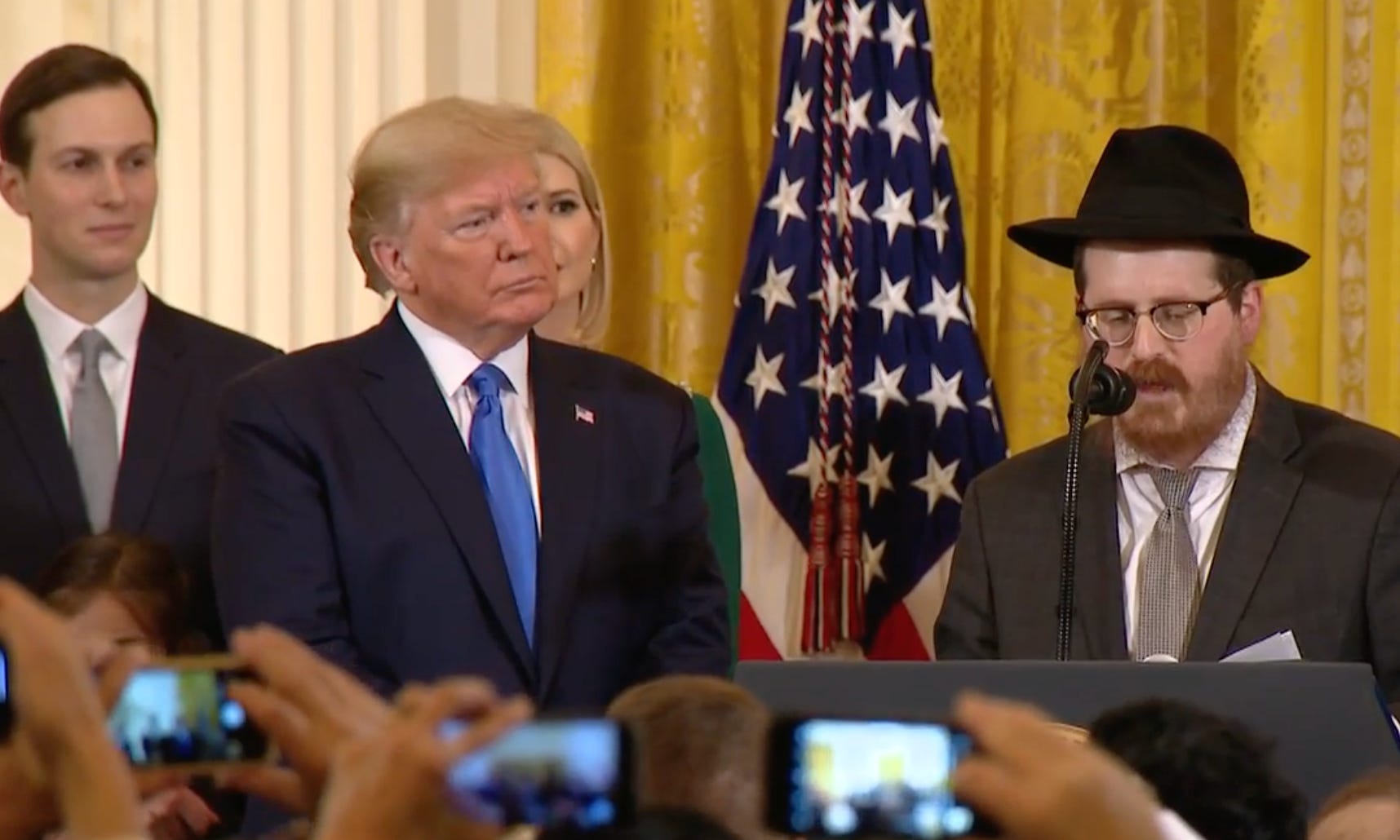
“Particularly unique has been the bipartisan nature of support for the bill,” Chabad.org observed. The original House bill was co-sponsored and championed by Rep. Doug Collins (R-GA) and Rep. Hakeem Jeffries (D-NY), while the Senate bill was pushed by Sens. Mike Lee (R-UT), John Cornyn (R-TX), Cory Booker (D-NJ), Chuck Grassley (R-IA), and Dick Durbin (D-IL). The Senate passed the bill 87 to 12 on December 18, 2018, followed by a 358 to 36 House vote on December 20. Trump signed it into law on December 21, 2018. At the White House Chanukah reception on December 11, 2019, Trump stated: “Last year, Rabbi Moshe and Rabbi Zvi helped lead thousands of Jewish Americans in urging congressmen, judges, prosecutors, and Jewish communities to support the First Step Act.” Boyarsky then addressed the assembly, explicitly characterizing the bill as the fulfillment of the Lubavitcher Rebbe’s vision from the 1970s. He told the assembled crowd:
“The Rebbe advocated that, through good behavior and participating in educational programs, by demonstrating remorse and a will to lead a life of honesty and integrity, prisoners should be able to earn a reduced sentence.”
The Pardon Controversy
The same network that built the First Step Act subsequently leveraged its White House access for clemency outcomes. A March 2021 New York Times investigation revealed that of 238 pardons and commutations granted by Trump during his presidency, 27 went to individuals supported by Aleph, Tzedek, and the lawyers and lobbyists who worked with them.
Notable beneficiaries included Philip Esformes, convicted in what the Justice Department described as the largest Medicare fraud scheme ever prosecuted in U.S. history, involving approximately $1.3 billion in fraudulent claims. Esformes’ family donated $65,000 to the Aleph Institute after his indictment. Trump commuted Esformes’ 20-year sentence in December 2020.
Sholom Rubashkin, a Chabad-affiliated businessman and former CEO of what was then the country’s largest kosher slaughterhouse, received a commutation on December 20, 2017—one year before the First Step Act itself passed. Eliyahu Weinstein, convicted of running a Ponzi scheme that stole approximately $230 million from fellow Orthodox Jews, received a commutation on January 19, 2021—Trump’s final full day in office. Within months of his release, Weinstein launched a new $44 million fraud scheme under a false identity. He was sentenced to 37 years on November 14, 2025.
What the First Step Act Actually Does
The law made the Fair Sentencing Act of 2010 retroactive, created a system of earned time credits for inmates participating in rehabilitative programming, fixed a Bureau of Prisons miscalculation of good-time credits, reduced certain mandatory minimums, expanded compassionate release, and required the Bureau of Prisons to place inmates within 500 miles of family when feasible. The Bureau of Prisons formally recognized Aleph’s “Sparks of Light” Torah correspondence course as an approved evidence-based recidivism reduction program, earning inmates up to 15 days of early release credit for every 30 days of Torah study. As Margareten wrote after the Bureau recognized Torah study under the First Step Act: “There’s no greater rehabilitation and self-improvement than learning Torah. And so it’s a no-brainer that Torah courses should be considered ‘productive activity’ under the First Step Act. It was indeed an honor to work on this together with Aleph Institute.”
The First Step Act was never about the abstract notion of “justice”; it was about the successful assertion of a particular ethnic agenda within the heart of the federal government. When the Bureau of Prisons begins legitimizing Torah study as a formal tool for early release, it confirms that the American state is being operated as a subsidiary of Jewish interests.
This reality reveals that Donald Trump’s administration was merely a different vehicle for the same trajectory of gentile dispossession, one that effectively laundered special-interest legislation through the machinery of the GOP. At the end of the day, Trump’s presidency, from his foreign policy to domestic policy, must be viewed as a vessel to advance the interests of organized Jewry and no one else.
Once we acknowledge all U.S. presidents since the end of World War II are golems, then we can have a serious political conversation. Blindness to who truly wields power in Washington guarantees the perpetuation of Jewish supremacy. For those of European extraction, this willful ignorance ensures a future as mere cattle, eventually erased from the map by the very Jewish power configuration they refuse to name.
NEXT:
Villains of Judea: Philip Esformes and the Largest Healthcare Fraud in American History

If there’s one thing the Trump era has taught us, it’s that President Donald Trump is hyper-focused on serving the interests of the slimiest elements of American Jewry.
If you like the content, feel free to continue supporting my work.
Buy Me A Coffee: https://buymeacoffee.com/josenino
I'm reminded of the Eastern State Penitentiary in Philadelphia. It became notorious as a dangerous hellhole, and was closed. But the Quakers had built it from the best intentions. They believed that criminals locked in their little cells would read the Bible all day and come to repent their crimes. They would become penitents - hence the name of the institution.
But I very much doubt that Chabad has good intentions, other than keeping their tribe out of prison.