

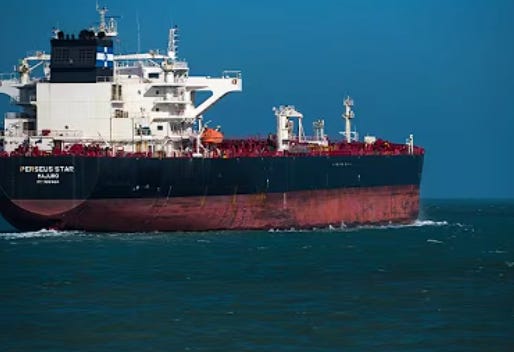
The ongoing war between the United States, Israel, and Iran has sent shockwaves through global energy markets, creating extreme volatility and threatening the stability of critical transit points like the Strait of Hormuz. While the rest of the world braces for the economic fallout of these surging oil prices, Israel remains uniquely insulated from the chaos. This security is not accidental but rather the logical result of an arrangement where the United States acts as a de facto energy supplier of last resort to the Jewish state, ensuring that Israel remains fully supplied regardless of regional instability.
In September 1975, then-Secretary of State Henry Kissinger signed a secret memorandum that committed the United States to guarantee Israel’s oil supply—an arrangement that has been quietly renewed and extended over the decades, most recently expanded to 15 years by the 1979 U.S.-Israel MOA signed alongside the Egypt-Israel Peace Treaty.
Everything begins with the 1973 Arab oil embargo, when OPEC nations cut off oil to the United States and other Western supporters of Israel during the Yom Kippur War. This shock exposed Israel’s extreme vulnerability. Israel depended heavily on oil from Egypt’s Sinai oil fields, which it had captured in 1967. When Kissinger began brokering disengagement agreements between Israel and Egypt through shuttle diplomacy, Israel faced a dilemma: giving back Sinai meant losing its own energy lifeline.
As part of the Sinai II Disengagement Agreement initiated on September 1, 1975, and formally signed on September 4, the United States and Israel signed a secret Memorandum of Understanding. In it, the United States pledged to guarantee Israel’s oil supply in times of crisis as compensation for Israel withdrawing from the Sinai oil fields at Abu Rudeis and Ras Sudar, which had supplied Israel with 4.5 million tons of oil annually. Essentially, Kissinger told Israel that if it gave back the oil fields, America would become its backup energy insurer—for an initial period of five years.
The specific terms of the 1975 agreement—confirmed verbatim in FRUS Document 227—committed the United States to step in as Israel’s oil supplier if Israel could not purchase oil on the world market, whether due to embargo, war, or other disruption. The agreement treated Israel as an IEA member for purposes of emergency oil sharing, even though Israel was not a member of the International Energy Agency, per the 2014 Congressional Research Service memo to the Senate Energy Committee. It gave “special attention” to Israel’s oil import needs when providing foreign assistance, and pledged to help arrange oil transport if Israel was unable to secure tankers on its own.
The agreement did not pass through Washington without initially raising concerns on Capitol Hill. Sen. William Proxmire (D-WI) voiced misgivings at the time that this commitment could harm the American economy. Kissinger sought to reassure Congress that the commitment would carry minimal economic cost. He stated that Israel required 140,000 barrels per day but could conserve during an emergency, tap into strategic reserves, and manage with imports of 100,000 barrels per day. Such an arrangement would have “no significant effect” on the American economy, he said, noting that consumption in this country surpasses 17 million barrels per day.
The original 1975 agreement was designed to last five years. When Israel and Egypt signed their 1979 peace treaty and Israel surrendered all its Sinai oil fields as part of the Camp David Accords, President Carter signed a new, expanded 15-year agreement formalizing the arrangement, signed by Secretary of State Cyrus Vance on June 22, 1979. The U.S. Congress passed specific legislation to enable this, including a special exception to the Export Administration Act’s prohibition on Alaskan oil exports to allow U.S. oil to reach Israel.
This agreement was extended by the Clinton administration in 1994 and the Bush administration in 2004. It expired in November 2014 when the Obama administration initially allowed it to lapse, but was renewed in April 2015 following bipartisan pressure from the Senate Energy Committee. The arrangement commits the United States to supply oil to Israel when Israel cannot secure it on the international market, at world market prices, under the same IEA emergency-sharing guidelines—a commitment that extends to Alaskan oil, making Israel the only country with a bilateral oil supply exception of this kind under U.S. export law.
The 1975 agreement was only one piece of a far larger American commitment to Israel’s energy security across the region. According to The Guardian, the vision of channeling Iraqi oil to the Israeli port of Haifa had long been a quiet ambition among certain figures in U.S. and Israeli policy circles. The reference to the “Haifa project” links this MOU to broader geopolitical ambitions around the old Kirkuk to Haifa pipeline, an oil route that once ran from Iraqi oil fields to the Israeli port city of Haifa but was shut down in 1948 at the start of the Arab-Israeli war. After the 2003 U.S. invasion of Iraq, discussions re-emerged in Washington and Tel Aviv about re-building that pipeline. At the time, then-Finance Minister Benjamin Netanyahu told British investors in 2003: “It won’t be long when you will see Iraqi oil flowing to Haifa.” The 1975 MOU, in this reading, forms the legal and diplomatic foundation for this broader energy partnership with Israel.
The MOU was never made fully public when signed. Kissinger told the Senate Foreign Relations Committee it would be disclosed but many details remained secret for years. The full text is now declassified and available in the State Department’s FRUS series. Israel has never actually invoked the agreement to request emergency oil from the United States.
In the current conflict with Iran, Israel can rest easy knowing it will be safe from any energy disruption, as the United States stands ready to provide for its every security and energy need. Over the last century, organized Jewry has ascended to command the heights of Western institutions, effectively turning the United States into Israel’s personal security and energy guarantor. Regardless of the crisis Israel encounters, it can count on Washington to bail it out—a testament to the fact that American foreign policy exists primarily to advance Israeli interests.
NEXT:
If you like the content, feel free to continue supporting my work.
Buy Me A Coffee: https://buymeacoffee.com/josenino
So, it isn't enough that the US has to step in and guarantee Israel's oil supply, US funds must go to pay for Israel's oil in the case of Israel not getting the best possible deal on world markets. It would be nice if there were a few Congresstwits who might stand up and say 'ENOUGH!' to the greed of Israel's beneficiaries both here and abroad.
Jose`, this is exactly the kind of reporting on what Israel gets from ordinary Americans. The people I talk to seem to think that Israel pays its own way and stands ready to defend US soldiers in the Middle East, thanks to the misinformation from the American MSM.
Thanks for a great read.
Cracking piece! Ty.