

Audio Version of this article can be found here.
On the surface, Donald Trump’s 2024 victory was powered by minority men, but the deeper story reveals an elite strategy to fragment political unity along racial and gender lines.
Trump’s victory last November was the first time since 2004 that the Republican Party won both the electoral college and the popular vote. A major storyline of the past election was the Republican Party’s significant gains with minority voters.
For perspective, Trump won 43% of the overall Latino vote, marking an eight-point increase from his 2020 performance, according to Associated Press exit polling. Similarly, Pew Research Center found that Trump secured 48% of Latino voters nationwide, coming within striking distance of capturing a historic majority of Hispanic voters. This represented a dramatic improvement from Trump’s previous campaigns, where he captured only 28% of the Hispanic vote in 2016 and 32% in 2020.
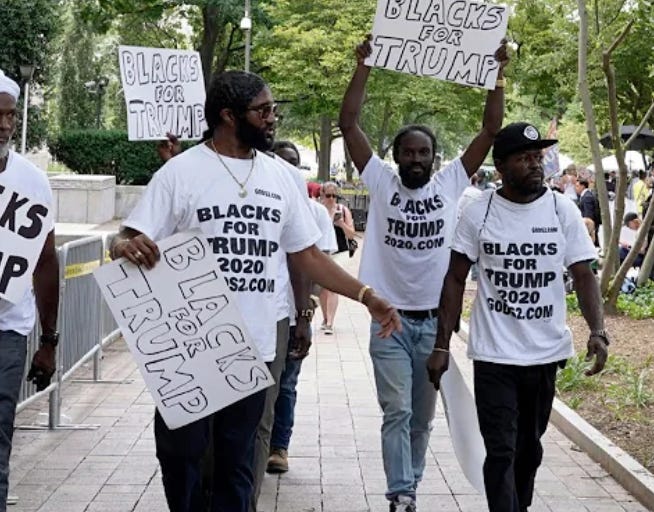
In a similar vein, Trump picked up 15% of the Black vote, up from 8% in 2020 and 6% in 2016. Trump also made gains with Asian voters — 35-40% supported Trump depending on the poll. Support for Trump among Asian voters has grown significantly since his previous campaigns, where he garnered 27% in 2016 and 30% in 2020.
While these shifts are often heralded as evidence of a diversifying and more inclusive GOP, a closer analysis suggests these successes are also providing a pretext for party elites and strategists to deracialize and potentially displace the party’s key voter base — White voters. This deracialization strategy is not accidental: it is part of a broader effort by segments of the political and economic elite to fragment traditional coalitions, especially White voters, by amplifying gender divisions and other culture war issues that are not identitarian in nature.
Trump’s improvement with minorities was the product of a unique outreach strategy implemented by his campaign and surrogates that focused more on gender war divisions to acquire voters. A 2024 Vox report detailed how Trump’s campaign made it a point to actively court men, above all non-White men, through endorsements from influencers, athletes, and musicians, and by emphasizing themes of masculinity, economic ambition, and outsider grit. According to the Vox report, the Republican Party concentrated its outreach efforts to minority men by ramping up attacks on “wokeism,” diversity, equity, and inclusion (DEI) initiatives, and the excesses of feminism.
These attacks against wokeism served to appeal to minority voters who may have felt alienated by the Democratic Party’s excessive focus on intersectionality and other divisive, culturally leftist agendas that generally privilege female and/or sexually deviant members of their coalition. The explicit strategy, described succinctly by Tim Alberta of The Atlantic, “For every Karen we lose, we’re going to win a Jamal and an Enrique,” sought to capitalize on the widening gender divide and deepening frustration with the Democratic Party. Based on the 2024 election results, this strategy appears to have yielded results.
Edison Research found that Trump won 54% of Latino men in 2024, compared to Biden’s commanding 59% to 36% victory among this group in 2020. This represents a 33-point swing on the margin in just four years. The shift was particularly pronounced among younger Hispanic men. Among Latino men under 40, Trump captured 48% of the vote, with 20% of these voters casting ballots for the first time in 2024. This age-based pattern showed 48% of Latino men under 40 voting for Trump compared to 32% of Latinas in the same age group, creating a significant gender gap within young Hispanic voters. With respect to Black men, support for Trump surged to 21% in 2024, compared to just 8% in 2020 and 6% in 2016.
Ironically, 57% of White voters still cast their ballots for Trump to return him to office. Nevertheless, the gains Trump made with minorities, above all, Hispanics, will be cited as a justification for further non-White outreach by Republican consultants who are desperately trying to move away from any type of politics that’s explicitly White-coded.
All told, the strategic use of minority outreach by both parties is designed to fragment the White electorate. Through the revival of cultural wars and Cold War-era anti-communist rhetoric, elites deflect attention from White Americans’ legitimate concerns and block the emergence of a cohesive White political bloc to challenge organized Jewry and their shabbos goyim lackeys. At the same time, the GOPs economic agenda—tax cuts, deregulation, Big Business worship—remains largely unchanged, benefiting the same corporate and elite interests as before.
Once rooted in White Protestant values, today’s GOP plays its part in facilitating the Great Replacement by championing a crude, negro hustler capitalism agenda that promotes profit above racial solidarity. One needn’t look further at Trump’s constant pandering to Blacks— whether it be his “Platinum Plan” or constant pardoning of rappers with criminal records— to see where his racial priorities lie. The interests of the very White voters that continue making the GOP a relevant political force are ignored in this equation. Consider this a feature, not a bug of the post-World War II political order that labors to erase White European identities off the map.
As long as the terms of debate are set by culture wars and gender divisions, the possibility of genuine solidarity—across White European lines—will remain elusive.
Far from reshaping politics, the GOP’s diversity push dilutes White populist momentum and erodes solidarity under the pretense of inclusion. In the end, the GOP’s “diversity wins” only confirm one thing: racial solidarity among Whites remains the greatest threat to the system.
NEXT:
Nationalists On Both Sides of The Pond Face a Common Foe

Being out of touch with political reality is the modus operandi of establishment conservatism in the Anglosphere. National identity is the political question of our epoch, yet many self-styled political experts in Conservatism Inc. would rather debate the increasingly irrelevant points of taxation or get into petty debates about how their mass consumeri…
Are you concerned about your wealth during this times of economic uncertainty?
Allocating parts of your wealth into physical precious metals is your best play.
Whether you are:
An institutional client,
A HNWI or UHNWI,
Or a retail customer,
You should contact my good friend Claudio Grass directly.
Claudio is a veteran precious metal investor and wealth manager who has mastered precious markets and knows how to protect people’s wealth no matter the economic and political circumstances.
He will grant you access to his carefully-selected network of trustworthy partners which he has been working for multiple years.
Claudio will advise you on the best players, the appropriate terms, and the necessary safeguards you must take to protect your wealth.
In addition, he will guide you each step of the way when you buy, sell, and store physical bullion.
Your precious metals will be privately stored in Switzerland outside of the banking system, and you can physically pick them up at the vault anytime at your own convenience.
Are you ready to make your wealth recession-proof?
Do not hesitate to contact Claudio; his initial consultations are free.
Contact him below and tell him that José Niño was your reference:
https://claudiograss.ch/contacts/
All part of the plan.
Whites should press for indigenous minority status.