

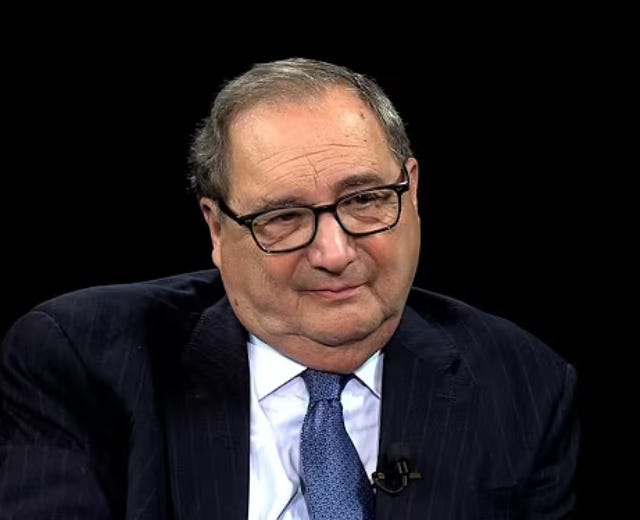
When Abraham Foxman died on May 10, 2026, tributes poured in from presidents, prime ministers, and Jewish leaders worldwide, yet his legacy remains defined as much by controversy as by accomplishment.
Foxman described himself as “a passionate supporter of the State of Israel” and spent his career building the ADL into a roughly $60 million per year organization that defined mainstream American Jewish advocacy on antisemitism, civil rights, and the Jewish state.
Foxman was born Avraham Chanoch Hanach Fuksman on May 1, 1940, in Baranovichi, then under Soviet occupation, now Belarus. When German forces entered Vilnius in June 1941 and began subjecting the Jewish population to forced labor and deportation, his parents placed their 15-month-old son in the care of his Polish Catholic nanny Bronisława Kurpi. Kurpi baptized the child into the Catholic Church, gave him the Polish Christian name Henryk Stanisław Kurpi, and raised him as a Catholic in Vilnius for four years. He learned to pray the rosary, attended church every Sunday, and genuinely believed he was Catholic.
His parents survived the war. After bitter custody battles—Kurpi initially refused to release him, telling the Fuksmans, “I raised him, and he belongs to me, and he is Catholic”—the family escaped to a displaced persons’ camp in Vienna in 1947 and arrived in the United States in 1950.
Foxman settled in Brooklyn, attended the Yeshivah of Flatbush, earned a Bachelor of Arts from the City College of New York, and received his J.D. from New York University School of Law. He joined the ADL in 1965 as a legal assistant and rose quickly through the organization’s ranks. When longtime director Nathan Perlmutter died of cancer in July 1987, Foxman became National Director.
Under Foxman’s 28-year leadership, the ADL built a formidable research arm monitoring white advocacy groups, neo-Nazis, and other dissident groups. The ADL expanded its international reach with consultations across Europe, Russia, the Middle East, Asia, and Latin America. Foxman was appointed to the council of the U.S. Holocaust Memorial Museum by President Ronald Reagan in 1987 and was re-appointed by Presidents George H.W. Bush, Bill Clinton, and Joe Biden—making him, as the USHMM confirmed, “the only member of the Museum’s governing Council to be appointed by four presidents from both parties.”
With Foxman at the helm, the ADL also advocated for LGBTQ rights, including protesting the Supreme Court’s 2000 ruling in Boy Scouts of America v. Dale—which held 5-4 that the Boy Scouts could exclude a gay scoutmaster on First Amendment associational grounds. The organization also developed diversity training for law enforcement agencies and advocated for policies promoting mass migration.
Foxman operated at the center of American Jewry. The ADL and AIPAC were close partners in White House meetings and lobbying coordination. Foxman was a key participant in the Conference of Presidents of Major American Jewish Organizations and worked closely with the American Jewish Committee on public advocacy.
Further, Foxman was one of the most internationally active American Jewish leaders of his era. In March 2012, releasing the ADL’s survey of ten European countries, Foxman warned that antisemitism in Europe remained a dangerous reality. “In Hungary, Spain and Poland the numbers for anti-Semitic attitudes are literally off-the-charts and demand a serious response from political, civic and religious leaders,” he stated—findings based on poll data showing 63% of Hungarians, 53% of Spaniards, and 48% of Poles holding antisemitic views.
Foxman held consultations in Russia on “problems of ethnic hatred, violence, terrorism and promoting democracy,” attended Limmud FSU conferences engaging Russian-speaking Jewish youth, and remained deeply concerned about antisemitism in post-Soviet states. He consistently condemned Arab and Palestinian resistance and Hamas’s liberation agenda. He insisted that much criticism of Israel crossed into antisemitism, arguing: “If the only nationalism that you find apartheid in is Jewish nationalism, then you’re an anti-Semite.”
Retiring in 2015, Foxman warned that antisemitism was “the worst that it has been since World War II, and it is global”—saying he “never thought anti-Semitism would still be a clear and present danger to Jews around the world.” In 2024, he delivered an address at the ADL’s “Never Is Now” conference stating that antisemitism is “a disease without an antidote and without a vaccine.”
Foxman viewed Iran under President Mahmoud Ahmadinejad as an existential threat. In a 2007 speech to the ADL National Commission, he declared: “The greatest threat to the Jewish people and closest thing to dangers of the 1930s and 1940s is a potent cocktail consisting of the ideology of hate from an Iran with a potential nuclear weapon. This is an existential threat to Israel from an irrational regime that must be taken with the utmost seriousness.” When Iranian Supreme Leader Ali Khamenei posted content questioning the Holocaust on Twitter in 2014, Foxman responded: “Once again, the injection of Holocaust denial by an Iranian leader shows the world how such deep-seated hatred exists at the helm in Iran. We have seen the Ayatollah spew his vehement animosity toward Jews before on other national occasions in Iran and these statements once again show the bigotry and hypocrisy of this regime.”
Weeks before his death, Foxman backed the U.S.-Israel war on Iran. On February 28, 2026—the day the war broke out—he posted on social media: “Thank you President Trump and Prime Minister Netanyahu for standing up to evil and jihadist extremism. The world hopefully will be a better and safer place in the future.”
Foxman’s willingness to take controversial public stands was no late development. He led or supported numerous high-profile campaigns throughout his career. When Nation of Islam spokesperson Khalid Abdul Muhammad delivered a speech at Kean College in November 1993 referring to Jews as “bloodsuckers” and calling for the genocide of white people, Foxman’s ADL ran a full-page ad in The New York Times reprinting Muhammad’s statements. This mobilization directly contributed to Congress issuing a bipartisan condemnation of the speech in February 1994.
Foxman regularly addressed antisemitic or borderline remarks by public figures. In September 2003, during pre-release controversy over The Passion of the Christ, he asserted that Gibson’s remarks were painting “the portrait of an anti-Semite”—though he walked back the characterization the following day, and by February 2004 told ABC’s Diane Sawyer that Gibson was not an anti-Semite and the film was not antisemitic. Foxman co-authored the 2013 book Viral Hate: Containing Its Spread on the Internet with attorney Christopher Wolf, who served as national chair of the ADL Civil Rights Committee, addressing how antisemites and racists exploited the internet.
Foxman produced several other books warning about the alleged scourge of antisemitism. Never Again? The Threat of the New Anti-Semitism appeared in 2003. The Deadliest Lies: The Israel Lobby and the Myth of Jewish Control came out in 2007 as a direct rebuttal to John Mearsheimer and Stephen Walt’s The Israel Lobby and U.S. Foreign Policy, which Publishers Weekly described as “a rebuttal of a pernicious theory about a mythically powerful Jewish lobby.”
Not all of Foxman’s tenure at the ADL would be remembered in such favorable terms. In April 1993, San Francisco police and the FBI executed searches at ADL offices in California and discovered that the organization had been running an extensive domestic intelligence operation for decades. The operation centered on Roy Bullock, an undercover operative and art dealer who had collected files on more than 12,000 individuals and 950 organizations for more than three decades. His targets included not just white advocates and neo-Nazis but also Arab American groups, the American Civil Liberties Union, the African National Congress, Central America solidarity organizations, Greenpeace, the Earth Island Institute, approximately 20 San Francisco area labor unions, anti-apartheid activists, and Jewish peace groups. Bullock had also sold information to South African intelligence for $16,000.
Foxman denied any improper activity while testifying that the ADL had a right to do “whatever it must” to monitor antisemitism and threats to Jews. Critics across the political spectrum condemned the operation as a massive breach of civil liberties.
One of the most sustained controversies of Foxman’s career involved his refusal to unequivocally recognize the Armenian genocide. Critics, including the Armenian National Committee of America, accused Foxman of “genocide denial” motivated by the ADL’s desire to maintain good relations with the Turkish government. The backlash was severe. A dozen Massachusetts communities and the Massachusetts Municipal Association withdrew from the ADL’s “No Place for Hate” program. The ADL’s 2007 statement that the “consequences” of Ottoman actions were “tantamount to genocide” was widely rejected as insufficient because it circumvented the “intent” required under the 1948 UN Genocide Convention. Foxman also sent a letter to Turkish Prime Minister Erdoğan expressing regret over the difficulty his position caused for the Turkish government. It was not until May 2014 that Foxman publicly and unambiguously used the word “genocide” in remarks at Suffolk University Law School’s commencement, after years of sustained pressure.
The Armenian Genocide controversy was not the only multi-decade fight to mark Foxman’s career. Foxman engaged in a 22-year campaign against paleoconservative commentator Pat Buchanan. After Buchanan’s 2011 book Suicide of a Superpower was published, Foxman called him “a racist and an anti-Semite.” Buchanan was suspended from MSNBC in January 2012 and fired in February, and he publicly credited Foxman with playing a role in his dismissal. The ADL published a formal report titled “Patrick Buchanan: Over the Line.” Buchanan described Foxman as leading efforts to “blacklist” him, working “behind closed doors, with phone calls, mailed threats, and off-the-record meetings.” In a similar vein, Justin Raimondo, founder of Antiwar.com, was one of the most sustained libertarian critics of the ADL and Foxman. Raimondo argued that the ADL used antisemitism accusations to suppress foreign policy debate.
Whatever his American critics made of him, Foxman moved comfortably among Israel’s top political leadership across multiple governments. Foxman met with multiple Israeli prime ministers, some of whom made direct appeals to President Bill Clinton for the Marc Rich pardon. Foxman cooperated with World Jewish Congress leader Edgar Bronfman on major campaigns including Holocaust-era Swiss bank restitution. While the primary negotiation was led by Bronfman and the World Jewish Congress, the ADL under Foxman was a coalition partner in pressing Swiss banks to settle Holocaust-era claims, which resulted in a $1.25 billion settlement in 1998.
Foxman made a well-documented intervention in favor of fugitive financier Marc Rich’s pardon from President Clinton. The ADL had received $250,000 from Rich over a period of 16 years, including a $100,000 pledge made just before Foxman traveled to Paris. In February 2000, Foxman met at a Paris restaurant with Avner Azulay, head of the Marc Rich Foundation, and Zvi Rafiah, an Israeli arms consultant, and it was Foxman himself who proposed the strategy of recruiting Denise Rich to approach Clinton for a pardon. “I told them maybe they should consider trying to get a pardon,” Foxman said. “I told them, ‘Why don’t you reach out to Denise Rich... and have her approach the president and see about a pardon.’”
He wrote Clinton on December 7, 2000, urging a pardon on the grounds that “we are a country that was founded on the belief in second chances.” New York Times columnist William Safire called for Foxman to resign, writing that Rich’s $250,000 to the ADL had “induced its national director to lobby President Bill Clinton for forgiveness and thereby bring glee to the hearts of anti-Semites.”
Abraham Foxman was the consummate architect of a specific brand of ethnic activism, relentlessly searching for every angle to advance Jewish institutional interests and cement a landscape where the concerns of world Jewry were elevated above all others. Yet, even as he built these formidable structures of influence, he unwittingly accelerated the very forces he claimed to fight.
His career served as a catalyst for a tide of grassroots resentment against World Jewry that has only surged since October 7, 2023. Like many of his kin who sought to reshape Western nations in their own image, Foxman dedicated his life to the systematic erosion of gentile civilization for the benefit of his tribe.
Now that he has exited the stage, he leaves behind a nation awakening to the nature of his subversion. May he face that eternal justice that human institutions could not provide, aware that the tide has finally turned against the Jewish supremacist agenda he spent his entire life promoting.
NEXT:
Villains of Judea: Charles Bronfman

The Jeffrey Epstein files continue to spill their secrets. With each new document release, each newly unsealed court record, the spotlight inches closer to a network of Jewish billionaires who operated in the shadows long before the convicted sex trafficker became a household name. The names in Epstein’s black book read like a roster of Jewish power. Bu…
If you like the content, feel free to continue supporting my work.
Buy Me A Coffee: https://buymeacoffee.com/josenino
Will you ever cover some Kremlin villains of Judea?
Maybe Abramovich, Deripaska, Kovalchuk, Setchin, Rosenberg bros, Kiriyenko, Shoigu, Soloviev, Karaganov, Progozhin, Gref … I could go on.
Or is this topic off limits?
Chabad Runs RUSSIA and that Includes PUTIN and Many others
https://www.youtube.com/watch?v=ZyQEkj7evZE