

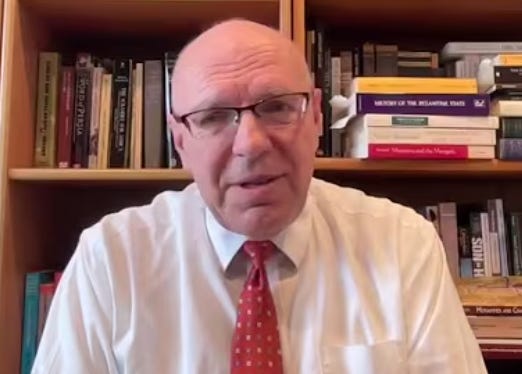
As American forces clash with Iran in 2026, a decades-long campaign orchestrated from the shadows of Washington has finally reached its climax. Earlier this year, foreign policy strategist David Wurmser openly called for Washington to let Israel start a war of aggression against Tehran, portraying the conflict as a historic reckoning akin to the Soviet collapse. For avid critics of American foreign policy, the current war represents the ultimate triumph of a shadowy Jewish operative who spent over 30 years advancing Israeli strategic priorities inside the highest echelons of the United States government.
Born in Switzerland, David Wurmser earned three degrees from Johns Hopkins University, including a doctorate. He spent 11 years in Navy Reserve intelligence and reached the rank of lieutenant commander. During that service, the Defense Intelligence Agency mobilized him for its Iraq Intelligence Task Force in 1994, 1996 and 1998.
Yet his defining partnership was personal as much as institutional. His Israeli born wife, Meyrav Wurmser, wrote her doctoral dissertation on Revisionist Zionism. In 1998, she cofounded the Middle East Media Research Institute, known as MEMRI, with Yigal Carmon, a former colonel in the Israeli military. Carmon served in Israel Defense Forces intelligence from 1968 to 1988. He later advised prime ministers Yitzhak Rabin and Yitzhak Shamir on counterterrorism.
During the mid-1990s, Wurmser moved seamlessly between Washington institutions and Jerusalem policy circles. Wurmser worked as a project officer at the U.S. Institute of Peace from 1988 to 1994. He then served as director of institutional grants at the Washington Institute for Near East Policy, known as WINEP, from 1994 to 1996. The Intercept described WINEP as an AIPAC spinoff.
In 1996, he became director of research in the strategy and politics program at the Institute for Advanced Strategic and Political Studies, known as IASPS. The Intercept called him one of the main thinkers behind “A Clean Break,” a 1996 policy paper prepared for incoming Israeli Prime Minister Benjamin Netanyahu. The paper said Israel could weaken, contain and even roll back Syria, and that this effort “can focus on removing Saddam Hussein from power in Iraq” as “an important Israeli strategic objective in its own right.” It also urged “striking Syrian military targets in Lebanon, and should that prove insufficient, striking at select targets in Syria proper.”
Months later, Wurmser developed this vision in a paper titled “Coping with Crumbling States.” “Whoever inherits Iraq dominates the entire Levant strategically,” he wrote in the 1996 IASPS paper. He then joined the American Enterprise Institute, where journalist Jim Lobe reported that Irving Moskowitz’s contributions funded his work. Wurmser thanked Moskowitz in the acknowledgments of his 1999 book, Tyranny’s Ally, for “generous support of AEI.” The book blamed the failure to remove Saddam on a “stubborn embrace” of covert coup plots and criticized how intelligence agencies managed the Iraq crisis. The Iraqi National Congress, Chalabi’s group, figures very prominently in its analysis.
The attacks of September 11 gave Wurmser an opening inside the Pentagon. Douglas Feith appointed Wurmser and veteran defense analyst Michael Maloof to a two man secret intelligence unit. The pair began work in October 2001 in a 15 by 15 foot space on the Pentagon’s third floor, and the unit had produced a slide presentation by November 2001.
Feith later said the team’s main conclusion was that groups and states were willing to cooperate across ideological lines. Wurmser’s own biography says he consulted for the Office of the Secretary of Defense until January 2002, months before the Office of Special Plans formed in October 2002.
The unit still sparked fierce controversy. Newsweek reported in August 2004 that ideas from the unit fed into a memo, which the 9/11 Commission said appears to have been written by Feith. The memo proposed attacks in South America or Southeast Asia as “a surprise to the terrorists.” In February 2007, the Pentagon Inspector General concluded that Feith’s policy office produced alternative intelligence assessments on Iraq and al Qaeda, some inconsistent with the consensus of the Intelligence Community. It called the actions “inappropriate” but not illegal or unauthorized. In June 2008, the Senate Intelligence Committee detailed what it called inappropriate intelligence activities by the same policy office, conducted without the knowledge of the Intelligence Community or the State Department.
Wurmser then served as a special assistant to John Bolton at the State Department, before joining Vice President Dick Cheney’s staff in mid September 2003. Jim Lobe wrote that Wurmser had long called for the United States and Israel to work together to roll back Syria’s Baathist government.
Shadows of espionage and leaks trailed his circle. The Washington Post reported in September 2004 that FBI counterintelligence investigators had asked current and former officials about Wurmser and other neoconservatives in a leak inquiry. The agents were investigating whether Pentagon officials leaked classified information to Iraqi politician Ahmad Chalabi and the American Israel Public Affairs Committee. In October 2005, Raw Story quoted an anonymous source close to the Plame investigation saying Libby “used David Wurmser” to discredit Joseph Wilson.
By mid-2007, Wurmser’s views on Iran had drawn public scrutiny. IAEA chief Mohamed ElBaradei warned, “You do not want to give additional argument to new crazies who say, ‘let’s go and bomb Iran.’” The New York Times reported that Cheney’s staff confirmed the broad outlines of a Steven Clemons report, and that some hawkish statements to outsiders came from Wurmser. Secretary of State Condoleezza Rice said the United States was not preparing for war against Iran and that Cheney supported that policy.
In September 2007, Newsweek reported, citing two knowledgeable sources, that Wurmser told a small group a few months before he quit that Cheney had mulled pushing for limited Israeli missile strikes on the Natanz nuclear site. The strikes were meant to provoke Tehran into lashing out. AFP summarized the report as saying Cheney considered provoking an exchange of strikes between Iran and Israel to give the United States a pretext to attack Iran. Wurmser denied the story, saying,
Cheney’s office said Wurmser left in 2007 to “spend more time with his family.” He then launched his consultancy, Delphi Global Analysis. In an October 2007 interview with The Telegraph, Wurmser said America should seize every opportunity to force regime change in Syria and Iran. He said that should include “the willingness to escalate as far as we need to go to topple the regime if necessary.” He also said, “We need to do everything possible to destabilise the Syrian regime.” In April 2008, Wurmser broke with the Bush administration’s policy regarding Gaza. David Rose’s Vanity Fair article quoted him accusing the Bush administration of “engaging in a dirty war in an effort to provide a corrupt dictatorship [led by Abbas] with victory.”
His campaign never paused. In March 2017, Wurmser emailed an article attacking Iran deal negotiator Sahar Nowrouzzadeh to former Republican House Speaker Newt Gingrich, writing, “I think a cleaning is in order here.” Gingrich forwarded the message to an aide to Secretary of State Rex Tillerson. Politico had published the emails in March 2018, and The New Yorker later reported them in a May 2018 article by Evan Osnos.
From December 2018 until September 2019, Wurmser again served in the Trump White House, where John Bolton was national security adviser. Bloomberg columnist Eli Lake obtained a series of unclassified memos Wurmser sent Bolton in May and June 2019. Wurmser wrote that “unexpected, rule-changing actions taken against Iran” would “confuse the regime.” Lake called the approach “regime disruption.” In a June 22 memo, Wurmser urged a strike on “someone like Soleimani or his top deputies.” Bolton had already asked the Pentagon and intelligence community in May for military options against Iran, including a strike on Soleimani, which the United States ultimately carried out on January 3, 2020.
Wurmser now writes as a senior analyst at the Center for Security Policy, known as CSP, and as a fellow at the Misgav Institute. He is also a senior fellow at the Jerusalem Center for Security and Foreign Affairs, known as JCFA.
Critics have long accused Wurmser and his allies of putting Israel’s interests ahead of America’s. Pat Buchanan listed Wurmser among neoconservative “agents of influence” in a June 2003 American Conservative column titled “Is the Neoconservative Moment Over?”. Buchanan’s March 2003 column “Whose War?” cited a Washington Post report naming Wurmser as part of a pro-Israel network inside the administration. Democratic Senator Fritz Hollings named Wurmser in a June 2004 Senate statement about the Clean Break task force. In July 2004, Hollings wrote that Bush changed Mideast policy by “invading Iraq to secure Israel by democratizing the Mideast.”
Iran is not the same country Wurmser began writing about in the 1990s. It has fought a prolonged war, absorbed sanctions, weathered the loss of senior commanders, and continued to build out the network that now defines the region’s balance of power. The civilizational confidence Tehran displays today is a direct response to two decades of pressure that failed to produce capitulation. Wurmser’s project assumed an enemy that would fold. Instead the enemy has adapted and is giving the Judeo-American axis a run for their money.
Make no mistake about it, Iran’s resilience is keeping David Wurmser and his fellow travelers wide awake at night.
NEXT:
Villains of Judea: Douglas Feith

Few individuals embody the conflict between American national interest and the demands of world jewry as sharply as Douglas Feith. Throughout his career, Feith has operated as a consummate advocate for the Jewish state, positioning himself within the highest echelons of the U.S. government to ensure that American military and foreign policy served as a …
If you like the content, feel free to continue supporting my work.
Buy Me A Coffee: https://buymeacoffee.com/josenino