

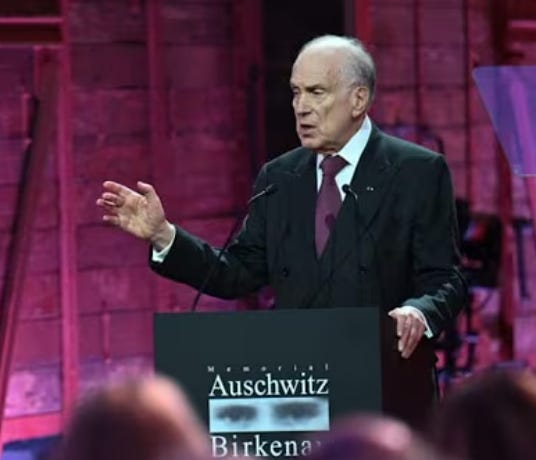
World Jewish Congress President Ronald Lauder likes to present himself as a civic minded elder statesman, a sober billionaire warning America about a rising tide of antisemitism.
At the Israel Hayom Summit on December 2, 2025, he framed the moment as a crisis of the West itself, calling it “a full-scale assault on truth, on democracy, and on the safety of Jewish people everywhere,” and insisting, “This is not normal. And it is not ‘just criticism of Israel.’ It is the world’s oldest hatred, once again wearing political clothing.”
Lauder was referring to the rise of antisemitism and anti-Israel sentiment worldwide in the wake of Israel’s 2-year bombing campaign in Gaza.
Then he sharpened the spear and aimed it at domestic enemies like Tucker Carlson, who has been one of the most vocal critics of Israel in the post-October 7 reality we live in. He told the audience, “Tucker Carlson is the Father Coughlin of our generation.” In the same speech he warned that complacency is over, because “antisemitism is rampant throughout our culture,” and he demanded a political and institutional counteroffensive.
That is the Lauder formula in its purest form. He wraps a totalizing political program in the language of safety and moral emergency, then treats America’s public life as territory to be reorganized around his crusade. The target is never merely hatred. The target is dissent, drift, and disobedience from the priorities he has chosen, priorities that consistently put Israel first.
Lauder did not arrive at this posture late in life. He was born into power in New York City in 1944, the heir to the Estée Lauder fortune, raised in elite institutions, and trained for international influence through business and foreign policy studies. He entered the family company early, then moved into government in the Reagan era, where he served at the Pentagon as Deputy Assistant Secretary of Defense for European and NATO policy.
Ronald Reagan then tapped him as U.S. ambassador to Austria in 1986. In Vienna, he did not behave like a neutral American emissary. He turned his diplomatic post into a stage for historical confrontation and political signaling. Lauder refused to attend the inauguration of Austria’s president Kurt Waldheim amid allegations of him being involved in or being aware of National Socialist atrocities in the Balkans during his service as a German army lieutenant in World War II. He also fired U.S. diplomat Felix Bloch for engaging in suspected espionage activities.
After government service, Lauder tried to convert his vast wealth into formal power at home. In 1989, he ran for mayor of New York City as a Republican, where he spent big bucks to get his name out and campaign to the right of Rudy Giuliani, only to lose the primary. Even in defeat, the pattern held. He treated politics as an arena where money does all the talking, and he kept looking for levers that could bend public life to his will.
He found one in term limits. During the 1990s he poured resources into imposing term limits on New York City officials, selling it as a democratic reform and a check on machine party politics. Yet in 2008, when Mayor Michael Bloomberg wanted a third term, Lauder reversed course and supported extending those limits, a turn that mainstream critics interpreted as a billionaire bargain dressed up as civic necessity. However, from the perspective of long-time observers of Jewish behavior, Lauder’s support for Bloomberg reflects a pattern of co-ethnic solidarity among Jewish power brokers.
While Lauder played these games in New York, his real career was consolidating leadership in the organized Jewish political world. Notably, Lauder was a member of the Mega Group—a mysterious network of Jewish oligarchs that worked behind the scenes to advance Jewish interests and strengthen pro-Israel bonds among Jews in America. Leslie Wexner, founder of The Limited and Victoria’s Secret, and the late Jewish sex criminal Jeffrey Epstein were among the most prominent members of this Jewish consortium. By 2007, Lauder had become president of the World Jewish Congress, a position that turned him into a roaming power broker who meets heads of state and treats international politics as a permanent lobbying campaign.
From that perch, he repeatedly framed Western security architecture as a vehicle for Israeli priorities. In 2011, he publicly argued that Israel should be admitted into NATO, insisting, “Israel needs real guarantees for its security,” and pressing NATO states to bring Israel into the alliance.
In 2012, he attacked European pressure campaigns on Israel with maximalist rhetoric. When Irish officials floated an EU ban on goods from Israeli communities in the West Bank, Lauder called boycott talk “cynical and hypocritical,” and declared, “Minister Gilmore is taking aim at the only liberal democracy in the Middle East while keeping quiet about those who really wreak havoc in the region: the Assads, Ahmadinejads and their allies Hezbollah and Hamas.” He added that the West Bank was “legally disputed and not illegally occupied.”
He carried the same posture with respect to Iran — enemy #1 for world Jewry at the moment. In 2013, as Western diplomats negotiated with Tehran, he mocked their perceived softness and conjured Munich analogies, warning, “Just as the West gave up Czechoslovakia to Hitler in Munich in 1938, we see what is happening again and the world is silent,” and boasting, “Frankly, only France stands between us and a nuclear Iran.” In 2015, he escalated again, attacking the nuclear deal with a moral curse, saying, “The road to hell is often paved with good intentions,” and arguing that the agreement could revive Iran economically without stopping long term nuclear ambitions.
The story kept darkening as his proximity to Israeli power deepened. In 2016, Israeli police questioned Lauder in connection with “Case 1000,” the Netanyahu gifts affair. Reports said investigators sought his testimony because of his closeness to Netanyahu and the broader allegations involving luxury gifts and favors. Lauder was not charged, but the episode revealed how near he operated to Israel’s governing circle, not as an outside friend, but as part of the broader, transnational Jewish network.
By 2023, he openly wielded donor money as a disciplinary weapon in American institutions. After the October 7 attacks and campus controversies, he warned the University of Pennsylvania that, “You are forcing me to reexamine my financial support absent satisfactory measures to address antisemitism.” The message was simple. If a prestigious American university fails to police speech and activism the way he demands, he will squeeze it financially until it complies.
In 2025, Lauder continued supporting Israel’s ethnic cleansing campaign in Gaza. He categorically rejected the idea that Israel bears any responsibility for ending the conflict, insisting, “The truth is simple: the war could end tomorrow if Hamas were to release the remaining hostages and disarm.” On education and propaganda, he stopped pretending the solution is persuasion alone. At the World Jewish Congress gala in November 2025, he argued that the education pipeline must be rebuilt from the ground up, declaring, “The entire education system — K-12 to college — must be retaught,” and adding, “It’s time we fight back with stronger PR to tell the truth.”
He also made the threat explicit. In a widely shared clip, he vowed, “Any candidate running for a seat… whose platform includes antisemitism, we will target them as they target us.”
Like most of the Israel First set, Lauder was ecstatic about the toppling of Bashar al-Assad’s government in Syria in late 2024. In September 2025, he met former al-Qaeda terrorist-turned Syrian President Ahmad al-Sharaa on the sidelines of the United Nations General Assembly and afterward said, “We had a very positive discussion about normalization between Israel and Syria.”
Seen in order, the picture is not complicated. Lauder builds influence through money, embeds himself in elite institutions, and uses both to steer policy and culture toward a relentless Zionist agenda. He does not talk like a man defending American sovereignty. He talks like an agent of world Jewry who expects America’s parties, schools, media, and alliances to function as enforcement arms for a foreign cause.
That is why his December 2025 sermon about antisemitism matters. It is not only a warning. It is a blueprint. When Lauder says “If we don’t tell our own story, others will rewrite it,” he is not describing a cultural debate. He is declaring ownership over the narrative, and claiming the right to punish anyone in American life who refuses to repeat it.
In the end, Ronald Lauder emerges not as a guardian of American civic life but as a disciplined enforcer of a foreign political creed, using wealth, intimidation, and moral blackmail to bend institutions to his will. What he calls a fight against hatred looks increasingly like a campaign to subordinate American sovereignty, speech, and policy to the imperatives of Israel and the transnational Jewish clique that sustains it.
NEXT:
Jeffrey Epstein's Secret War Against Iran

On the morning of August 10, 2019, Jeffrey Epstein was found unresponsive in his cell at the Metropolitan Correctional Center in Manhattan. The infamous JEwish financier and convicted sex offender was transported in cardiac arrest to New York Downtown Hospital, where he was pronounced dead at 6:39 a.m. He was 66 years old. The circumstances of his death…
Jews: just take their money, and there's nothing left: problem solved.