

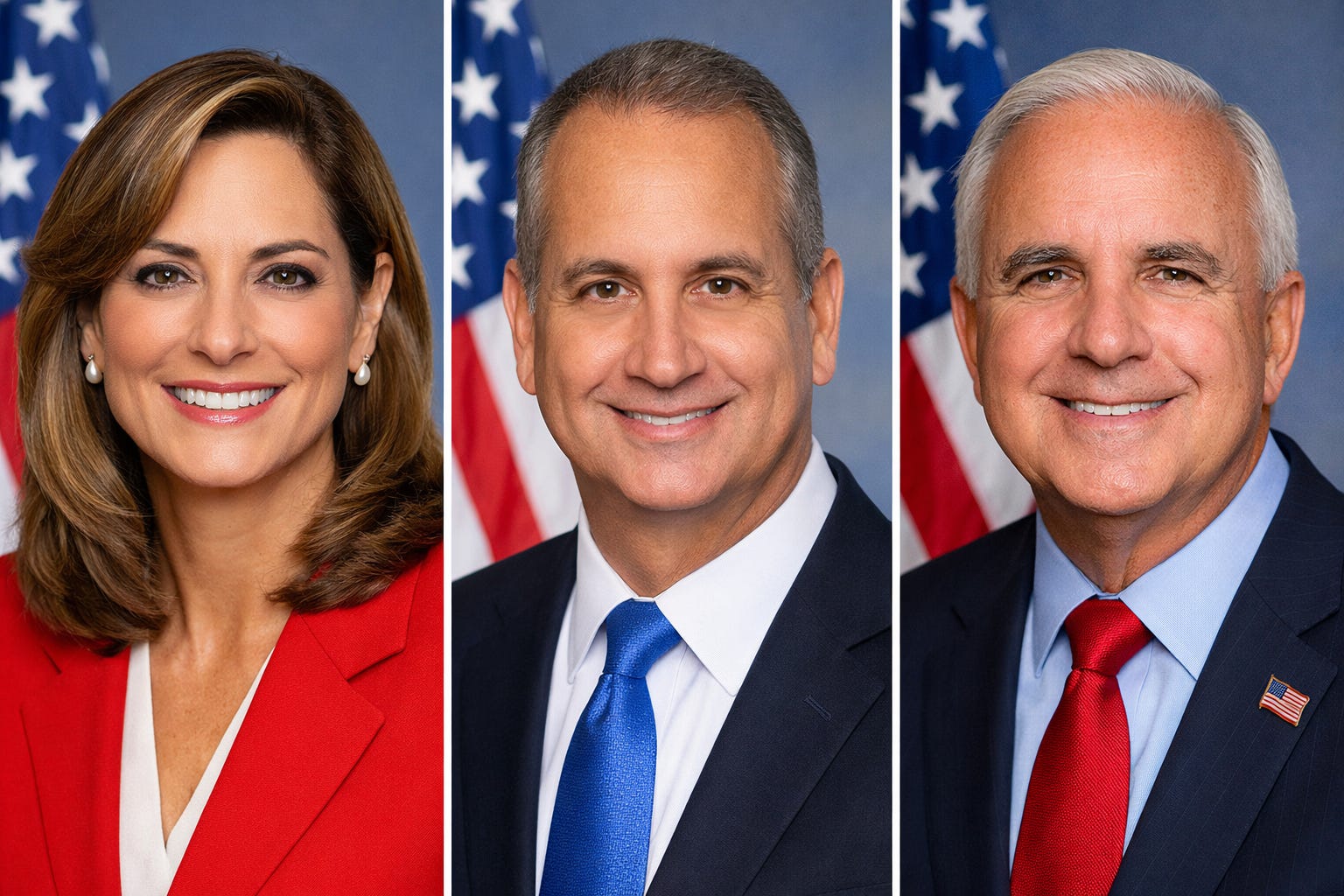
On January 28, 2026, Rep. María Elvira Salazar (R-FL) posted a message on social media that cut straight to the point. “This moment demands action on immigration reform, and I’m encouraged to see growing support in Congress for the DIGNITY Act, now with 35 cosponsors and a growing national coalition behind the bill. This is the only serious, bipartisan solution to fix what isn’t working in our immigration system. Not amnesty. Not citizenship. Just Dignity and accountability.” Salazar had been building toward this for years, and the language she used made clear she knew the moment was here. Reform, her supporters would say. Amnesty, the other side would insist.
But before anyone in Congress could define the terms, the White House had already begun rewriting them. In April 2025, at a Cabinet meeting, Donald Trump said something that sent chills down the spines of many Trump voters who desire the implementation of tough immigration restriction measures. “We have to take care of our farmers, the hotels and, you know, the various places where they tend to need people. So a farmer will come in with a letter concerning certain people, saying they’re great, they’re working hard. We’re going to slow it down a little bit for them, and then we’re going to ultimately bring them back. They’ll go out. They’re going to come back as legal workers.” By summer, the administration was developing a temporary pass system for key industries. Immigration restrictionist and Executive Director of the Center for Immigration Studies Mark Krikorian fired back: “Any time someone says, ‘This isn’t an amnesty because...’ then it’s an amnesty.”
The signal opened a door that a specific group of Republican lawmakers had been trying to pry open for years. Three Cuban Republican figures have gradually positioned themselves as the most likely architects of a bipartisan immigration expansion. María Elvira Salazar, Mario Díaz-Balart, and Carlos Giménez each represent South Florida districts with deep Cuban exile roots, and each has spent years building legislative frameworks that could become the vehicle for the largest immigration overhaul since the Simpson-Mazzoli Act legalized nearly three million illegal aliens in 1986.
Salazar’s Dignity Act, introduced in 2023 with Rep. Veronica Escobar (D-TX), would allow illegal aliens who have lived in the country for at least five years with clean records to work legally and receive deportation protections. Díaz-Balart has carried the pro-amnesty torch longer than almost anyone in the Republican caucus. In March 2021, he was among only nine Republicans in the House to vote for the American Dream and Promise Act, which included a citizenship pathway for DREAMers. He is a co-sponsor of the Dignity Act, and his decades of work give him cross-aisle relationships few Republicans can match.
Giménez occupies a middle position. On his congressional website, he states he supports allowing illegal aliens to “come out of the shadows and be placed on a path to legal status,” while drawing a firm line against blanket citizenship. His willingness to defend Venezuelans facing deportation signals he is no hardliner.
These three did not emerge from a vacuum. They are the latest chapter in a Cuban Republican tradition of pushing immigration expansion that traces to former representatives Lincoln Díaz-Balart and Ileana Ros-Lehtinen in addition to current Secretary of State Marco Rubio, who was a prominent amnesty booster during his time in the U.S. Senate.
Lincoln Díaz-Balart, Mario’s brother, authored NACARA in 1997, granting legal residency to hundreds of thousands of immigrants from Nicaragua, Cuba, Guatemala, El Salvador, and former Eastern Bloc countries. On the House floor he stated: “I think it is our moral obligation and a requirement of elemental fairness that at the very least these refugees be considered under the rules in existence when they filed their applications.”
Ros-Lehtinen, the first Cuban American elected to Congress, became the second Republican to co-sponsor a Democrat-led comprehensive immigration reform bill in 2013 and consistently defended DREAMers throughout her career. Rubio, now Secretary of State, played the most dramatic role. He helped craft the Gang of Eight bill in 2013, which passed the Senate 68 to 32 with a thirteen year citizenship pathway for 11 million illegal immigrants. He argued, “Leaving things the way they are, that’s the real amnesty.” He later retreated during his 2016 presidential run, but the bill remains the most ambitious immigration reform to clear either chamber since 1986.
The current set of Cuban Republicans, just like their predecessors, operate within the “invade the world, invite the world” consensus, a neoconservative framework linking expansionist foreign policy with expansionist immigration policy. All three have backed military aid to Israel, supported the 2024 supplemental sending roughly $95 billion dollars to Israel, Ukraine, and Taiwan, and taken hawkish positions on China, Iran, and Russia. Salazar has warned that “China, Russia and Iran are trying to invade the Western Hemisphere.”
Their financial records reinforce the picture. Díaz-Balart has received over $800,000 from pro-Israel PACs, with AIPAC as a key supporter. Salazar has received over $250,000, backed by both AIPAC and the Republican Jewish Coalition. For these politicians, the United States should function as a shopping mall domestically, while serving as a veritable private military company for the very Jewish interests they have entered a Faustian pact with.
The coming months will test whether Trump’s signals translate into legislative action. If they do, the Cuban Republicans will almost certainly play a central role. Salazar’s Dignity Act has the structure, the co-sponsors, and the political branding as a “responsible” form of immigration reform. Díaz-Balart has the relationships and decades of experience navigating failed reform efforts. Giménez has credibility with both the Trump wing and the moderate center.
Immigration restrictionists will need to watch these figures with unusual care. The Cuban Republican tradition of crossing party lines on immigration, stretching from Lincoln Díaz-Balart through Ros-Lehtinen and Rubio and into the current Congress, is not a coincidence. These Cuban Republicans—Salazar, Díaz-Balart, Giménez—have been coiled like vipers, awaiting Trump’s farmer-friendly signals to strike with the DIGNITY Act, their long-brewed amnesty bomb disguised as “dignity.” Passage would seal Florida’s fate as a latifundia of exploitable labor for Jewish capital and its shabbos goyim enforcers to harvest indefinitely.
The America First mandate that put Trump back in office was never built to accommodate mass amnesty. Neither were the economic realities facing millions of Americans who are already hanging on by a thread.
NEXT:
ICE Minnesota Raid is Pure Theater as Texas & Other Red States Swell with Illegals

The Trump administration has deployed thousands of Immigration and Customs Enforcement officers to Minnesota in what amounts to little more than political theater. Two Americans are already dead from this operation, yet the state hosts a fraction of the illegal immigrant population found in Republican strongholds like Texas, Florida, and Georgia.
If you like the content, feel free to continue supporting my work.
Buy Me A Coffee: https://buymeacoffee.com/josenino
AI is doing Maria a favor with that photo. She's 65 and looks nothing like it!
My co-nationals are so subversive goodness me.