

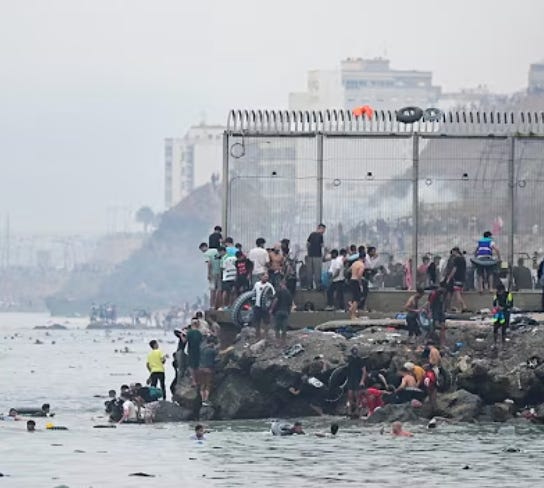
Around 50,000 to 60,000 migrants poured across the frontier from Morocco into the Spanish North African enclave of Ceuta in late July 2026, flooding the narrow strip of land and leaving Spanish authorities visibly overwhelmed—the worst crossing event since the May 2021 crisis. The images were harrowing enough to command the attention of the entire Western world. Yet as European governments debated emergency responses and humanitarian obligations, a strikingly different mood took hold among certain Israeli public figures.
Rather than extending any gesture of sympathy toward a NATO nation confronting a border catastrophe, some of the most prominent voices in Israeli politics seized the moment with barely concealed satisfaction. That reaction, far too visceral to be explained by the politics of any single news cycle, points toward something older and more elemental—a civilizational antagonism between Spain and Israel that has been accumulating across centuries, tracing its origins all the way back to the fires of the Spanish Inquisition.
The glee was immediate and unambiguous. National Security Minister Itamar Ben-Gvir went straight to social media, tweeting, “My congratulations to the President of the Government of Spain, Pedro Sánchez, for his profound commitment to welcoming immigration and ‘human diversity.’ As someone who demonstrates great concern for Hamas and the residents of Gaza, I call on you to translate words into actions: open the doors of Spain and grant refuge to the residents of Gaza who seek to emigrate. This is an excellent opportunity to contribute a little more to Spain’s ‘human diversity.’”

The Israeli Ambassador to the United Nations, Danny Danon, was equally pointed in his remarks, tweeting, “Spain, which never misses an opportunity to lecture Israel, has declared a state of emergency in Ceuta following the crisis over its immigration policy. Maybe before it continues lecturing us, it’s time it explained to the world why it still maintains colonial enclaves in Africa.” Yoav Kaufman, Vice President of Negev Direct Marketing, escalated the mockery further by posting a map dividing Spain into Moroccan-controlled zones and tweeting, “2 States for 2 Nations. Living side by side. In peace and prosperity.”


Max Abrahms, a Jewish international security professor who put on a pseudo-realist act in previous years had choice words for Spain during this recent migrant kerfuffle, proclaiming “Spain is getting what it deserves.”

Making sense of this reaction requires a close look at what the government of Pedro Sánchez has done to earn such hostility. Over the past two years, Sánchez has transformed Spain into arguably the most confrontational critic of Israel within the European Union. On September 8, 2025, he stood before the Spanish nation and formally charged Israel with genocide in Gaza, declaring, “This is not self-defence...it is the extermination of a defenceless people.” The announcement came packaged with nine concrete measures, among them a sweeping arms embargo, a prohibition on vessels carrying fuel for the Israeli military from entering Spanish ports, the closure of Spanish airspace to aircraft transporting defense materials to Israel, and a travel ban on individuals deemed responsible for war crimes, a provision that could have ensnared Benjamin Netanyahu and members of his government.
Spain’s legislature ratified the embargo into law in October 2025, and Madrid separately canceled a contract worth hundreds of millions of euros for Israeli anti-tank missile systems. Sánchez pressed even harder, calling for Israel’s removal from international sporting competitions and drawing an explicit comparison to Russia’s expulsion following its invasion of Ukraine.
The confrontation reached a new pitch when the United States and Israel launched “Operation Epic Fury” against Iran in February 2026. Sánchez condemned the strikes as an “unjustified, dangerous military intervention outside international law” and refused to allow Washington to use the Rota and Morón de la Frontera air bases for the campaign. Defense Minister Margarita Robles confirmed that no assistance of any kind had been extended, because the U.S. and Israel were acting “unilaterally without the support of an international resolution.” In a nationally televised speech, Sánchez warned that American leadership was playing “Russian roulette with the destiny of millions.” Taken together, these moves — the defense of Palestine, the opposition to the Iran war, the refusal of base access — form a coherent pattern of defiance that many analysts believe may well have contributed to Israel nudging Morocco to send tens of thousands of migrants crashing through the gates of Ceuta.
What makes this pattern so charged, however, is that Sánchez did not invent it. Ironically, he inherited it from an unlikely political corner. The posture of anti-Zionism as an instrument of Spanish state policy was established long before any living politician drew breath, by the dictator Francisco Franco himself. Franco refused to recognize the State of Israel from its founding in 1948 until his death in 1975, and Spain would not establish formal relations with Israel until 1986, more than a decade after the regime ended. When Franco made a tentative approach toward diplomatic recognition in 1949, Israeli Prime Minister David Ben-Gurion turned him away, unwilling to legitimize a government that had maintained such close ties with National Socialist Germany during World War II. Israel then voted against lifting UN sanctions on Spain, a rebuff that drove Franco firmly into the Arab camp.
From that point forward, Franco built Spain’s foreign policy around cultivating Arab alliances. He offered Arab nations a vision of Spain as a civilizational bridge between Europe and the Islamic world. The Palestine Liberation Organization opened an informal representative office in Madrid in 1972, under Franco’s watch, and Spain voted consistently in the PLO’s favor at the United Nations. During the Yom Kippur War of 1973, Franco blocked the United States from using Spanish military installations to resupply Israel. Even after Franco’s death, the transitional government of Adolfo Suárez continued the policy of non-recognition, and Suárez himself became the first Western European leader to officially receive PLO Chairman Yasser Arafat in 1979.
However, antagonism between Spain and Israel does not begin with Franco. It runs far deeper, into the marrow of history, and it is there that one finds the intellectual inheritance that almost certainly shapes how Benjamin Netanyahu reads the present moment That inheritance flows directly from his father, Benzion Netanyahu, born Benzion Mileikowsky in Warsaw in 1910, who became a leading authority on the Spanish Inquisition and medieval Iberian Jewry, serving as a professor of Judaic studies at Cornell. His magnum opus, the 1,384-page The Origins of the Inquisition in Fifteenth Century Spain (1995), permanently altered the scholarly landscape of Inquisition studies.
The received wisdom before Benzion Netanyahu was that most conversos—the Jews who converted to Christianity under duress or by choice—had continued practicing Judaism in secret, and that the Inquisition was a genuine religious campaign to expose and punish this hidden apostasy. Netanyahu demolished that framework. Drawing on more than 100 Hebrew texts overlooked by prior scholars, including rulings by North African rabbis who concluded the conversos were genuine Christians, not secret Jews, he argued that the majority of conversos had made sincere conversions, and that the Inquisition’s campaign against them was driven not by religion but by racial hatred—a persecution of people perceived as an impure bloodline regardless of their faith. He even noted that contemporary Jewish writings contained “cold-blooded assertions that the Marranos got their due, an open manifestation of glee over their ‘fall’”—a posture that would have been inconceivable had those same Jewish observers believed the conversos were secretly their own.
If the conversos were genuine Christians, then the Inquisition could not have been what the Church claimed it was. The elder Netanyahu’s conclusion was unsparing. The tribunal was not a religious institution rooting out heresy but, as he declared, a racially motivated political apparatus designed to destroy conversos. As early as his 1953 biography of Don Isaac Abravanel, he described what was unfolding in 15th century Spain as “a bitter and full-fledged racial war under the cover of religious agitation.” Netanyahu underscored that the Inquisition’s program targeting the descendants of Jews who had converted to Christianity, during the riots of 1391 and across the 15th century, constituted “the most radical anti-Jewish measure taken at any time in the Middle Ages.”
The Inquisition’s real purpose, he argued, was “not to eradicate a Jewish heresy from the midst of the Marrano group, but to eradicate the Marrano group from the midst of the Spanish people.” Rather than a search for genuine apostates, the institution was constructed to legitimize an ethnic purge, engineered to protect “Old Christians” from competition with the “New.” In his magnum opus, he went further still, describing the Inquisitors’ charges of widespread Judaizing as “atrocity propaganda” and “big lies,” and their racial theories as the focal point for those dedicated to “exterminating” the New Christians.
At the heart of this racial machinery was the doctrine of limpieza de sangre, or purity of blood, which decreed that Jewish lineage rendered a person permanently impure regardless of sincere Christian faith. Netanyahu traced this ideology to the city council of Toledo’s statute of 1449 and argued it represented a form of proto-racism whose consequences would extend for centuries, drawing explicit parallels between the racial anti-Semitism of late medieval Spain and that of Nazi Germany. He identified King Ferdinand of Aragon, not Queen Isabella, as the Inquisition’s true architect: Ferdinand’s motive, in Netanyahu’s telling, was not religious conviction but realpolitik—an attempt to forge a political alliance with anti-converso forces and consolidate royal power.
Most significantly for the present moment, Benzion Netanyahu refused to confine responsibility for the Inquisition to the Church or to the crown alone. He described the antagonism between “Old Christians” and “New Christians” as a structural feature of Spanish social life that produced a “bitter and full-fledged racial war under the cover of religious agitation”, implying that Spanish society at large, not merely the clergy or the crown, harbored and acted upon a deep racial enmity toward Jewish-descended people.
A Spanish academic analysis of his legacy concluded that his scholarship placed responsibility for the Inquisition in “Spain: its kings and its entire society” rather than attributing it exclusively to the Catholic Church. Professor Ignacio Molina, director of the Department of Political Science and International Relations at the Universidad Autónoma de Madrid, has gone further, arguing on X that Netanyahu and his family “have always felt an anti-Spanish prejudice”—a judgment that, he notes, has acquired greater visibility in the current context of political tension between Israel and the Spanish government, and that extends to the next generation. Molina observes that “that fixation on Spain has been inherited by his son Yair,” who has alluded to the idea of freeing “occupied Arab Islamic lands” in Ceuta and Melilla.
In the Netanyahu family the past does not stay in the archives. It ultimately shapes how they view Madrid in the present. The exploitation of the Ceuta migration crisis serves as a stark reminder that modern Spanish-Israeli relations are filtered through the lens of deep-seated ancestral grievances held by many Jews. The hostility directed toward Madrid is an expression of a long-held, personal enmity that treats current political insults as echoes of ancient persecutions.
This is not a dispute that can be settled with standard diplomacy, as the Jewish actors involved are driven by a perceived moral obligation to avenge historical slights. Consequently, Spain should anticipate a sharp pivot from diplomatic rebuke to active sabotage; expect Israel to utilize its formidable reach to fund subversive political elements such as the Vox party or execute silent, targeted maneuvers aimed at crippling the Spanish political establishment from within.
When such a petty bunch is empowered, there is no limit to the skulduggery World Jewry can achieve.
NEXT:
The Migration Weapon: How Israel and Morocco Punished Spain for Defying Them

The sudden surge of roughly 50,000 to 60,000 interlopers into the Spanish enclave of Ceuta in late July 2026 has ignited a firestorm of geopolitical debate. While mainstream narratives often attribute such events to spontaneous mass movement, a closer reading reveals a far more deliberate sequence of events. It involves Spain, Morocco, the United States…
If you like the content, feel free to continue supporting my work.
Buy Me A Coffee: https://buymeacoffee.com/josenino
The Spanish Inquisition is the central pillar of the Black Legend, a propaganda narrative created by Spain's rival powers in the 16th and 17th centuries that drastically exaggerated the tribunal's violence to delegitimize the Empire. While it was a repressive institution of religious control, modern historiography based on royal archives demonstrates that the procedural reality of the Holy Office was significantly more moderate, regulated, and involved fewer executions than the civil and religious courts of the rest of Europe during the same period. The number of victims: Protestant and Enlightenment propaganda spread the idea of millions of deaths. Modern studies of court records estimate that in its 350-year history, the actual number of executions ranged between 3,000 and 5,000 people, representing less than 2% of all those tried. Kamen, Henry.
The Spanish Inquisition: A Historical Revision (Crítica / Editorial Pasado & Presente). This is the essential international reference work. The renowned British Hispanist uses archival data to dismantle romantic myths and secular propaganda.
Henningsen, Gustav and Contreras, Jaime. Inquisition and Society in Early Modern Europe (1986). These two authors carried out a monumental statistical analysis of nearly 44,000 inquisitorial cases recorded between 1540 and 1700, scientifically establishing the low execution rates (around 1.9%). Henningsen, Gustav. The Witches' Advocate: Witchcraft and the Inquisition in the Basque Country (Alianza Editorial). A definitive monograph demonstrating how the methodological skepticism of Inquisitor Alonso de Salazar y Frías saved thousands of lives and curbed the witch hunts in Spain. Lea, Henry Charles. History of the Spanish Inquisition (4 volumes).
Although it is a text from the beginning of the 20th century (and the author had certain biases of his time), it is still valued for being the first major study that made massive use of royal archives
It’s all an act, Spains role is to continue to welcome the fallout,