

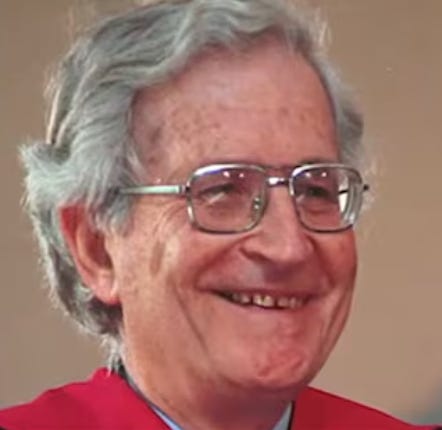
On February 1, 2026, the Department of Justice released millions of pages of documents related to Jeffrey Epstein’s network. Among them were hundreds of emails revealing that Noam Chomsky, a renowned leftist intellectual of Jewish extraction, maintained a close personal friendship with the convicted Jewish sex offender that extended years after Epstein’s 2008 guilty plea for soliciting prostitution from a minor.
The revelations were devastating. Chomsky had written an undated letter praising Epstein as “a highly valued friend and regular source of intellectual exchange and stimulation” with whom he had been in “regular contact” for about six years, engaging in “many long and often in depth discussions.” Chomsky boasted about Epstein’s global connections, recounting how Epstein once “picked up the phone and called the Norwegian diplomat who supervised” the Oslo Accords during a conversation, and how Epstein arranged a meeting for Chomsky with former Israeli Prime Minister Ehud Barak.
But the most damaging disclosure came from February 2019. After the Miami Herald’s bombshell investigation detailed Epstein’s sex trafficking network, Epstein wrote to Chomsky seeking advice on handling his “putrid press.” Chomsky responded sympathetically the same day, urging Epstein to ignore the news and avoid media “vultures.” He wrote that he was pained by “the horrible way you are being treated in the press and public.”
“What the vultures dearly want is a public response, which then provides a public opening for an onslaught of venomous attacks, many from just publicity seekers or cranks of all sorts,” Chomsky advised. He added that “even questioning a charge is a crime worse than murder” in the context of what he called “the hysteria that has developed about abuse of women.”
The emails revealed a relationship far deeper than Chomsky had previously acknowledged. In August 2015, Epstein wrote to Chomsky offering him use of his apartment in New York and inviting him to “visit New Mexico again.” Epstein owned Zorro Ranch, a compound south of Santa Fe where he has been accused of sex crimes with minors.
A photograph released by House Democrats showed Chomsky seated beside Epstein on what appears to be a private aircraft. Chomsky’s wife, Valeria Wasserman Chomsky, maintained independent correspondence with Epstein. In a January 2017 email, she wrote to Epstein, “Noam and I hope to see you again soon and have a toast for your birthday.” In a 2019 email introducing Chomsky to Steve Bannon, Valeria referred to Epstein as “a very dear friend.”
The relationship had an extensive financial component to it as well. A bank transfer record dated March 28, 2018, showed $270,000 dispersed to Chomsky through Epstein’s accounts. Chomsky insisted the money was his own, related to a difficult transaction involving his late wife Carol’s estate, and that Epstein was simply facilitating the transfer. “The simplest way seemed to be to transfer funds from one account in my name to another, by way of his office,” Chomsky explained.
The emails also showed Chomsky attending dinners with Epstein, Woody Allen, and Allen’s wife Soon-Yi Previn at Epstein’s Manhattan townhouse, the site where many of Epstein’s crimes allegedly occurred.
Chomsky’s relations with Epstein have only confirmed suspicions about the judeo-leftist intellectual functioning as a gatekeeper in anti-war leftist circles. For decades, Noam Chomsky occupied a unique position in American intellectual life. The MIT professor who gained prominence due to his contributions in the realm of linguistics became the left’s most prominent critic of U.S. foreign policy while maintaining an institutional home at a university receiving substantial Pentagon funding. He was never sanctioned, never fired, never truly threatened despite his radical rhetoric, all which should raise questions about Chomsky.
This contradiction troubled some observers. As one critic, Shyamoli Jana, noted at Ground Zero, “Why do these big, powerful criminals hang out with Chomsky? Can one imagine such a hangout involving a regular campus Leftist? No. The only ones allowed in are those that are guaranteed to play ball.”
The Epstein revelations intensified longstanding accusations that Chomsky functions as “controlled opposition,” a radical whose dissent remains within carefully policed boundaries that never credibly threatened Jewish power. Throughout his career, Chomsky took positions that aligned with establishment narratives on key issues while maintaining the facade as a fearless critic of the Judeo-American imperium.
Chomsky rose to prominence as a leftist intellectual while rejecting communist ideology, dismissing foul play in the assassination of JFK, and defending the official narrative about 9/11. On these and other questions of deep politics, Chomsky consistently sided with regime narratives. Though publicly recognized as a critic of American foreign policy, Chomsky serves a gatekeeper role by drawing a firm line against false flag theories, effectively limiting the scope of permissible criticism of the Jewish supremacist power configuration that dominates Western politics.
Nowhere is the accusation of gatekeeping more pronounced than on questions of U.S.-Israel relations and Jewish influence in American politics. While Chomsky built a reputation criticizing Israeli policies, his framework for understanding the relationship obfuscated organized Jewry’s role in shaping American policy in the Middle East.
Chomsky’s position is straightforward. He argues that U.S. support for Israel is driven not by the Israel lobby but by Israel’s role as a “strategic asset“ serving broader US imperial interests. In a 2006 response to John Mearsheimer and Stephen Walt’s “The Israel Lobby,” Chomsky argued that U.S. Middle East policy has been a “remarkable success“ for energy corporations and its broader imperial grand strategy for 60 years.
In a Journal of Palestine Studies interview, Chomsky was even more dismissive. Chomsky said the following: “It’s no secret that concentrated private capital has an overwhelming influence on government policy in all sorts of ways, so if in fact the “Lobby” is forcing the U.S. into policies that are against the interests of these people who effectively run the country; we should be able to convince them. And they would put the Israel Lobby out of business in about five seconds. The Lobby is peanuts compared to them. The military industry lobby alone vastly outspends and has much greater influence than the [Israel] Lobby does.”
Perhaps more damaging to his standing among Palestinian solidarity activists, Chomsky openly opposed the Palestinian-led BDS movement. He called it “hypocritical” because it targeted Israel but not the United States, which he considered more responsible for Israel’s crimes, conveniently ignoring how the Jewish capture of the commanding heights of the American economy, political process, and media ecosystem has allowed for Israel to act with virtual impunity.
At Harvard in 2003, Chomsky stated, “I am opposed and have been opposed for many years, in fact, I’ve probably been the leading opponent for years of the campaign for divestment from Israel and of the campaign about academic boycotts.” On the Palestinian right of return, he argued it was unrealistic and that insisting on it was “a virtual guarantee of failure.” In a 2004 interview with Stephen R. Shalom and Justin Podur, Chomsky added that “it is improper to dangle hopes that will not be realized before the eyes of people suffering in misery and oppression.”
These positions put Chomsky at odds with Palestinian civil society and the broader BDS movement, leading critics to ask whose interests he was actually serving. Jeffrey Blankfort, a longtime anti-Zionist activist who has tracked Chomsky’s positions for decades, has shed light on Chomsky’s blind spots with regards to Israel. In a 2010 article titled “Chomsky And Palestine: Asset Or Liability?” Blankfort wrote, “What we are dealing with in the case of Prof. Chomsky is nothing less than intellectual dishonesty parading as its opposite… At the end of the day, it is evident that Chomsky’s affection for Israel, his sojourn on a kibbutz, his Jewish identity, and his early experiences with anti Semitism have colored his approach to every aspect of Israel’s conflict with the Palestinians.”
In his younger days, Chomsky was affiliated with or close to Hashomer Hatzair (“The Young Guard”), a socialist Zionist youth movement, and intellectually connected to Avukah, an organization of left-wing Jews led in part by Zellig Harris, who later became Chomsky’s linguistics mentor at the University of Pennsylvania. In 1953, Chomsky and his wife Carol, then graduate students, traveled to Israel on a Harvard travel grant and lived for several months on Kibbutz HaZore’a, a Hashomer Hatzair kibbutz in the Jezreel Valley originally founded by German Jewish refugees in the 1930s. Chomsky found the experience deeply appealing on ideological grounds — he described the kibbutz as “a functioning and very successful libertarian community” and said he “came close to returning there to live.” In a 2010 interview with Tablet magazine, he confirmed: “I liked the kibbutz life and the kibbutz ideals… We thought we’d go back”. He even told an Israeli television interviewer as late as the 2000s that “up to five or six years ago, he had considered living there as an alternative to the United States.”
To further highlight Chomsky’s gatekeeping and refusal to confront the pernicious nature of Jewish power, Blankfort also cited former U.S. Senator James Abourezk, who wrote to him, “I can tell you from personal experience that, at least in the Congress, the support Israel has in that body is based completely on political fear, fear of defeat by anyone who does not do what Israel wants done. I see no desire on the part of Members of Congress to further any U.S. imperial dreams by using Israel as their pit bull.” This directly contradicted Chomsky’s thesis that Israel merely serves as an instrument of US imperial power.
David Miller, the Bristol University professor who won a landmark employment tribunal establishing anti Zionism as a protected belief in the United Kingdom, has also criticized Chomsky’s attempts to run cover for Jewish interests. On his Substack, “Tracking Power”, Miller published a 2023 flashback episode of Palestine Declassified titled “Tracing Noam Chomsky’s Zionist Past,” Miller argued that Chomsky “never really shed all of his Zionism.”
Miller pointed to Chomsky’s background as a Zionist youth leader, his time on a kibbutz, and his continued defense of the two state solution as key behavior patterns demonstrating Chomsky’s residual pro-Zionist instincts. “It is not a surprise to find him remaining a defender of the two state solution and opposing the Boycott Divestment and Sanctions movement. He is even on record as opposing calls of the right of return of Palestinians expelled by the Zionists on the grounds it is unrealistic.”
Miller also connected Chomsky’s political positions to the Epstein revelations. “Perhaps these views will help to explain how and why Chomsky came to be entangled with a known sex abuser Jeffrey Epstein and came to meet with Epstein’s close contact the former Israeli Prime Minister Ehud Barak?”
In his broader work, Miller has argued that the Zionist movement exercises significant independent influence over Western states, directly contradicting Chomsky’s thesis. In a 2024 interview, Miller stated that “within the counterterrorism and security apparatus of the UK, of the US, there are large numbers of Zionists, some of whom of course have dual citizenship with Israel, and that means of course that they tend to put Israel first above the interests for example of the US or the UK.”
Chomsky’s demonstrated affinity for Epstein, idealization of kibbutz life, and deflection of scrutiny from the Israel lobby evince his role as a subversive Jewish operative orchestrating a deliberate campaign of misdirection against gentile leftists. Far from reflecting mere personal convictions, his political postures delineate the precise non-Jewish leftist demographic he cultivates as a receptive audience for ideological obfuscation and control. This pattern constitutes not happenstance but a calculated ethnic strategy to neutralize potential threats through the manipulation of unwitting adherents.
NEXT:
From IDF Fitness Trainer to America's Most Wanted Dating App Bandit

A former Israeli Defense Forces fitness trainer turned Penthouse Pet stands accused of orchestrating an audacious crime wave across Southern California’s most exclusive neighborhoods.
If you like the content, feel free to continue supporting my work.
Buy Me A Coffee: https://buymeacoffee.com/josenino
It should be noted that Norman Finkelstein, who after the fall of Chomsky (and to his credit rejection of both Epstein and Dershowitz in private emails) is the go to example of the Pro-Palestine "good Jew" is ALSO against BDS. Furthermore for most of his career was a two state solution guy. Now his stance is "I don’t support two states. Actually, I don’t support one state. I support no states" AKA retard Anarchism, fully taking over Chomsky's "lead them to a dead end" role
I've long seen Chomsky as controlled opposition serving Jewish supremacism in America. So are Amy Goodman and Max Blumenthal, among many others. This is not to say that they are playing this role consciously, though this is possible. But we should not underestimate the Jewish capacity for self-deception.