

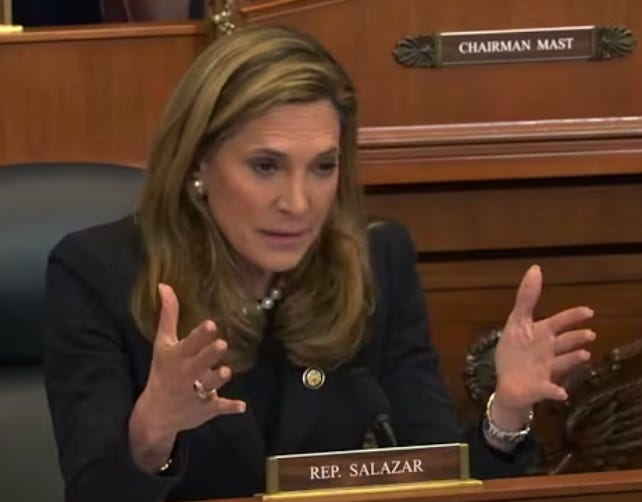
In the shadow of a war with Iran that has the country on edge, an ideological bait-and-switch is taking shape in the halls of Congress, where Donald Trump may soon seal the betrayal of his voters by signing amnesty legislation crafted and carried by Rep. Maria Elvira Salazar (R-FL).
On July 15, 2025, Salazar stood before cameras in Washington and unveiled H.R. 4393, the DIGNITY Act of 2025, a bill she co-authored with Rep. Veronica Escobar (D-TX) and backed by 20 Republican and 20 Democratic original co-sponsors—among them Reps. Mike Lawler (R-NY), David Valadao (R-CA), Dan Newhouse (R-WA), Brian Fitzpatrick (R-PA), Mario Díaz-Balart (R-FL), Adriano Espaillat (D-NY), Hillary Scholten (D-MI), Salud Carbajal (D-CA), and Jake Auchincloss (D-MA).
She marketed the legislation as a hardline compromise: “For 40 years, every president and Congress has looked the other way while millions have lived here illegally, many working in key industries that keep our economy running. The Dignity Act offers a commonsense solution: certain undocumented immigrants can earn legal status, not citizenship, by working, paying taxes, and contributing to our country. No handouts. No shortcuts. Just accountability and a path to stability for our economy and our future.”
The pitch sounds tough. The substance tells a different story, because this bill traces back through two earlier attempts and a consistent pattern of expanding legal status for people who entered the country illegally.
In the 117th Congress, Salazar announced her Dignity Plan in March 2021 and introduced the first version as H.R. 6637. On March 22, 2022, she hosted a Miami roundtable describing it as a complete immigration reform bill built on stopping illegal immigration, providing a “dignified” solution for immigrants already living in America, and strengthening the workforce. In plain English, she wants to pass amnesty.
In the 118th Congress, on May 23, 2023, Salazar and Rep. Veronica Escobar (D-TX) introduced H.R. 3599, the DIGNITY Act of 2023, co-sponsored by Rep. Jenniffer González-Colón (R-PR), Rep. Hillary Scholten (D-MI), Rep. Lori Chavez-DeRemer (R-OR), Rep. Kathy Manning (D-NC), Rep. Mike Lawler (R-NY), and Rep. Adriano Espaillat (D-NY). That version created a seven-year “Dignity Program” and an optional five-year Redemption Program that granted renewable legal status to illegal immigrants who met conduct and restitution requirements. The bipartisan Problem Solvers Caucus endorsed it, though it stalled in committee and never reached the floor.
The 2025 version, H.R. 4393, revived the same architecture with mandatory nationwide E-Verify, new Humanitarian Campuses for asylum processing, DNA testing authority for DHS, a conditional ten-year path for Dreamers toward permanent residency through work, military service, or education, and a Dignity Program covering illegal immigrants present before December 31, 2020, funding an Immigration Infrastructure Fund through a one percent payroll levy meant to help pay down the national debt by at least $50 billion. By the third attempt, the pattern is unmistakable: Salazar keeps repackaging expanded legal status for illegal immigrants under new marketing language while insisting she is closing the border.
Salazar’s rhetoric about accountability collapses once her voting record enters the picture. She was one of only nine House Republicans —alongside Reps. Don Bacon (R-NE), David Valadao (R-CA), Fred Upton (R-MI), Dan Newhouse (R-WA), Brian Fitzpatrick (R-PA), Christopher H. Smith (R-NJ), Carlos Gimenez (R-FL), and Mario Díaz-Balart (R-FL)— who voted yes on H.R. 6, the American Dream and Promise Act of 2021, which passed 228 to 197 on March 18, 2021. She said she wanted to “send the right message” about working with Democrats on expanding immigration. In the 119th Congress she became a Republican co-lead of the American Dream and Promise Act of 2025, H.R. 1589, sponsored by Rep. Sylvia Garcia (D-TX), and on July 21, 2025 signed a discharge petition to force a floor vote. “I am proud to co-lead the American Dream and Promise Act because it’s time for Dreamers and their families to live in the Promised Land as Americans,” she said. The bill grants conditional permanent residence to Dreamers and a path to permanent residency and eventual citizenship for eligible TPS and DED holders.
The contradictions do not stop with Dreamers. Salazar voted yes on H.R. 1603, the Farm Workforce Modernization Act of 2021, which passed 247 to 174 on March 18, 2021 with exactly 30 Republicans joining Democrats. That bill created a Certified Agricultural Worker (CAW) legalization program and reformed the H-2A guest worker visa system to bring more foreign labor into American fields.
Like many mass migration boosters, Salazar exploited the United States’ geopolitical misdeeds in Venezuela, specifically the Trump administration’s sanctions campaign that contributed to a massive exodus of Venezuelans across Latin America and the United States. On January 25, 2021, Salazar praised President Trump’s Deferred Enforced Departure protections for Venezuelans, commending the decision as “an act of solidarity” that provides the Venezuelan exile community “with much-needed assurance during these unprecedented times.” On March 8, 2021, she praised DHS’s grant of Temporary Protected Status to Venezuelans for 18 months, saying: “Nicolás Maduro is a murderous thug and I will always stand up for the victims of his socialist regime.” On May 8 and 9, 2025, she introduced the bipartisan Venezuela TPS Act of 2025, H.R. 3310, as Republican co-lead with Reps. Darren Soto (D-FL) and Debbie Wasserman Schultz (D-FL), covering roughly 600,000 Venezuelans after DHS Secretary Kristi Noem vacated the Biden-era TPS redesignation. On May 19, 2025, she announced on Twitter that she was “deeply disappointed” with the Supreme Court ruling that allowed termination of Venezuelan TPS. On March 25, 2026, she signed a discharge petition to force a vote on H.R. 3310.
She went further with a second Venezuela-specific bill modeled directly on Cold War precedent. The Venezuelan Adjustment Act, H.R. 1348, developed with Rep. Darren Soto (D-FL), mirrors the 1966 Cuban Adjustment Act and allows Venezuelan nationals who entered the United States before December 31, 2021 and maintained a year of physical presence to adjust straight to Lawful Permanent Resident status, covering an estimated 400,000 people currently holding temporary protections or humanitarian parole. Salazar said in a press release published on February 19, 2025: “The oppression of the Maduro regime and the failure of socialism of the 21st century has led to the world’s worst refugee crisis. As long as Nicolás Maduro forcibly remains in power, this crisis will only get worse. Hundreds of thousands of Venezuelans fled the Maduro regime and now face an uncertain future here in the United States. I am proud to reintroduce the Venezuelan Adjustment Act to provide refuge for those who have endured incredible suffering, so they do not have to return home to face the wrath of the dictatorship.”
Her justification for TPS for Haitians follows the same template. She was one of four House Republicans to sign the discharge petition on H.R. 1689—Rep. Laura Gillen’s (D-NY) bipartisan bill requiring DHS to designate Haiti for TPS for three years—reaching the 218-signature threshold on March 28, 2026 and forcing a floor vote. “From Haiti to Venezuela, we have to get this right,” Salazar posted on X. “TPS exists for a reason, to protect people who cannot safely return home.”
Her other floor votes reinforce the same trajectory. She stood as one of only three House Republicans supporting H.R. 7946 , the Veteran Service Recognition Act, which grants permanent resident status and deportation relief to non-citizen military veterans, in 2022. In a similar token, she has been an enthusiastic supporter of granting amnesty to Dreamers—illegal immigrants who were brought to the United States as children. She said, “Dreamers didn’t choose how they got here, but they chose what to do once they arrived. They studied, they worked, they served, they built. America is the only home they’ve ever known. Yet for years, they’ve had to live with a suitcase by the door, waiting for the next court ruling or the next president to decide their future.”
The recent endorsement of Maria Elvira Salazar’s re-election bid during the 2026 midterms by Donald Trump serves as a stark illustration of the chasm between populist rhetoric and tangible political outcomes. Despite the President’s vocal advocacy for aggressive immigration enforcement on the campaign trail, his support for a legislator so deeply embedded in the pro-amnesty, establishment renders his campaign promises meaningless. Salazar’s legislative history confirms her role as a key facilitator of the status quo that many Trump voters sought to overturn by pulling the lever for the real estate mogul from Queens. This endorsement signals a potential pivot toward amnesty, with Salazar poised to lead the effort under the cover of the lame duck phase of Trump’s presidency.
Politicians must be judged by their political actions not their rhetoric. As this author has previously noted, Trump’s overall time in office shows that he is a lousy champion of immigration restriction. The bottom line is Trump and Salazar serve as golems tasked with carrying out the will of organized Jewry on both the domestic and international fronts. Under such arrangements, the populist promise and the policy reality part ways at the Capitol steps, and it is ordinary Americans who absorb the difference.
NEXT:
Why Donald Trump’s Base Shouldn’t Trust Him On Immigration

Rep. María Elvira Salazar (R-Florida) spent this month celebrating. One year after she and Democrat Veronica Escobar introduced H.R. 4393, her office announced that the coalition behind the Dignity Act had passed 100 endorsements from employers, farm groups and faith leaders. Congress.gov now lists
If you like the content, feel free to continue supporting my work.
Buy Me A Coffee: https://buymeacoffee.com/josenino
JUST ANOTHER TRAGEDY OF POLITICS
I was hoping to see comments so I could possible understand the point of this article. Amnesty? Not being considered a criminal anymore for an alleged, or convicted crime. Are illegal or "undocumented" immigrants as some choose the euphemism, really criminals? Is it a crime to try to escape with your family from persecution, death and/or poverty and in doing so break entry quota rules,regulations or misdemeanors. Especially if the country you're escaping to is the reason you and your family are on the run. Is this a victimless crime or are you the victim?
Granted...this applies only if you are not a real criminal but have always tried to be a law abiding resident of where ever you happen to be, and are willing to work for your keep and care of family. Then there are those who are citizens and can't find work or are not willing to take the job an immigrant would gladly do even for less money. The role of business in this tragedy is another matter.
Is it your fault if you and your family get caught up as the victims of geopolitical imperialism? Did somebody tell you to go ahead and run you won't be caught and you will get help when you get there? That will be $500 if I help you. Only to be separated from your family and find yourself in the same kind of prison you were running from? Who is the victim here?
Some people think there's a plot to use immigrants as voters to win elections. Wouldn't that require complacency on the part of election officials? Or even payment for for your vote.
Some people think this is all just a plot to replace white protestants who found this country with dark skin foreigners. Have white people stopped giving birth or just stopped voting? Kinda like the reverse of what the native Americans were saying when the white man was running him off his land, except there was no voting then...not for them anyway. I am confused by Mr. Nino's article. If he's just trying to say that Trump was lying to you when you voted for him. Well, I knew Trump was a pathological liar and the Kamala is still an air head. So I didn't vote. We can all put that on the long list of what they said they'd do but never intended to.
Anyway this comment has gotten out of hand. I think I'll just make a substack out of it. Doesn't anybody care enough about this to comment?
https://substack.com/@wilrodx108853