

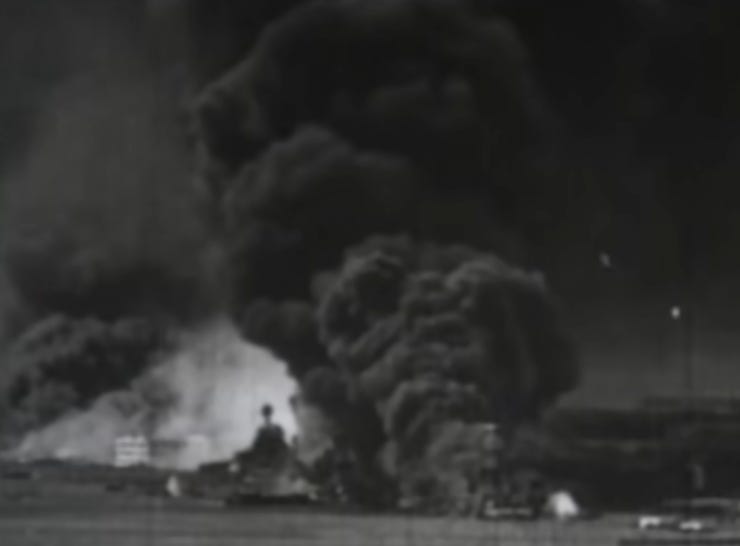
The 84th anniversary of Pearl Harbor has come and gone, with the usual somber ceremonies and reflections on a “day that will live in infamy.” Yet what remains conspicuously absent from these commemorations is any serious examination of the decade-long American campaign that created the conditions for Japan’s desperate strike. History textbooks have conveniently omitted this crucial context, leaving generations of Americans with a cartoonish narrative where unprovoked villains attacked an innocent nation without warning or reason.
Between 1931 and 1941, the United States transformed its response to Japanese expansionism in Asia from diplomatic disapproval into crippling economic strangulation. What started as moral denunciation of territorial aggression evolved into what can only be described as systematic asphyxiation, culminating in the 1941 oil embargo that severed Japan’s energy supply and set an irreversible countdown to war.
The Escalation: From Words to Weapons
Washington’s response to Japanese militarism followed a methodical trajectory—from diplomatic objections to informal barriers, and finally to comprehensive economic sanctions that functioned as acts of war in all but name.
The campaign began on January 7, 1932, with Secretary of State Henry Stimson’s declaration of what became known as the Stimson Doctrine. Following Japan’s 1931 invasion of Manchuria, Stimson issued a note announcing that the United States would refuse recognition of any treaty or agreement that compromised China’s independence or any territorial changes achieved through force. This established America’s policy of “non-recognition” regarding the puppet state of Manchukuo—a seemingly toothless diplomatic gesture that nevertheless marked the opening salvo.
President Roosevelt escalated the rhetorical pressure on October 5, 1937, when he delivered his Quarantine Speech in Chicago, calling for an international “quarantine” of aggressor nations. Though he named no countries explicitly, everyone understood he meant Japan, Germany, and Italy—the emerging Axis powers.
The first tangible economic measure came on July 1, 1938, with what the State Department euphemistically termed the “Moral Embargo.” Under this policy, the government notified American aircraft manufacturers that Washington strongly opposed selling planes and aeronautical equipment to nations allegedly using them to bomb civilian populations. Without requiring any formal legislative ban, this effectively halted aircraft exports to Japan.
On July 26, 1939, the United States delivered its most significant blow yet: formal notice terminating the 1911 Commercial Treaty with Japan. When this termination took effect on January 26, 1940, it removed—as Robert Higgs of the Independent Institute observed—the legal barrier preventing Washington from imposing trade restrictions, clearing the pathway for future embargoes.
The flood gates opened with the Export Control Act of July 2, 1940, which authorized the President to prohibit exports of essential defense materials. Roosevelt immediately wielded this authority to restrict aviation fuel, lubricants, and high-grade scrap metal.
George Morgenstern, in “The Actual Road to Pearl Harbor,” documented the relentless progression: “On July 2, 1940, Roosevelt signed the Export Control Act, authorizing the President to license or prohibit the export of essential defense materials.” Morgenstern further noted that under this authority, “[o]n July 31, exports of aviation motor fuels and lubricants and No. 1 heavy melting iron and steel scrap were restricted.” Then, in a transparently anti-Japanese maneuver, Roosevelt imposed an embargo effective October 16 “on all exports of scrap iron and steel to destinations other than Britain and the nations of the Western Hemisphere.” Finally, “on July 26, 1941, Roosevelt froze Japanese assets in the United States, thus bringing commercial relations between the nations to an effective end. One week later Roosevelt embargoed the export of such grades of oil as still were in commercial flow to Japan.”
The British and Dutch colonial administrations dutifully followed Washington’s lead, embargoing their own exports to Japan from Southeast Asian territories.
September 26, 1940 brought the total scrap iron ban. After Japan moved into northern Indochina, FDR expanded the embargo to encompass all grades of iron and steel scrap—a devastating blow given Japan’s heavy dependence on American scrap metal for industrial and military production. December 1940 saw the embargo list widen further to include iron ore, pig iron, copper, and brass, tightening the resource noose around Japan’s neck.
The Lend-Lease Act of March 11, 1941, though ostensibly designed to aid Britain, became a vehicle for funneling substantial war material to China—directly supporting Japan’s enemy in their ongoing conflict. Between 1941 and 1945, China received $1.6 billion in Lend-Lease assistance (approximately $22 billion in 2024 dollars), making it the fourth-largest recipient after the British Empire, the Soviet Union, and Free France.
On July 26, 1941, responding to Japan’s occupation of southern Indochina—a staging ground for potential attacks on Malaya and the Dutch East Indies—FDR signed Executive Order 8832, freezing all Japanese assets in the United States. This prevented Japan from accessing its currency reserves to purchase goods. Since trade required dollars, commercial relations between the two nations effectively ceased overnight.
The asset freeze resulted in a de facto total oil embargo that took effect on August 1, 1941. Given that Japan imported roughly 80 percent of its oil from the United States, this action started an inescapable countdown for the Japanese Navy, which possessed only about 18 months of fuel reserves. Japan now faced an existential choice: capitulate completely or strike south to seize the resource-rich territories it needed to survive.
The final provocation came on November 26, 1941, when Secretary of State Cordell Hull presented Japan with what became known as the Hull Note. This proposal demanded the complete withdrawal of all Japanese troops from China and Indochina. Japan interpreted this not as a negotiating document but as an ultimatum requiring the total relinquishment of their imperial holdings—effectively demanding they abandon everything they had fought for over the previous decade.
The Revisionist Case: Deliberate Provocation
Over the years, further scholarship has called into question the court historian’s account of what led to the Pearl Harbor attacks. Harry Elmer Barnes, widely regarded as the father of World War II revisionism, and Charles Beard, a towering figure in American historiography, argued that FDR confronted an impossible political dilemma. He wanted to enter the war against Adolf Hitler, but faced crushing isolationist sentiment at home—polls showed 80 percent of Americans opposed entering the war.
Since Hitler refused to take the bait of American naval provocations in the Atlantic, Roosevelt turned his attention to the Pacific theater. By provoking Japan into launching an overt attack, he could bypass isolationist opposition and unite the country behind the war effort.
In Pearl Harbor After a Quarter of a Century (1968), Barnes argued that “Roosevelt’s success in producing a surprise attack was an immensely, even uniquely, adroit achievement in piloting an overwhelmingly pacifically-inclined country into the most extensive and destructive war of history without any threat to our safety through aggressive action from abroad.”
Author Robert Stinnett, in his book “Day of Deceit,” brought attention to the McCollum Memo—a critical October 7, 1940 document from the Office of Naval Intelligence. This memorandum, authored more than a year before the Pearl Harbor attack by Lieutenant Commander Arthur H. McCollum, outlined the general situation of several nations embroiled in World War II. The memo recommended an eight-point course of action for the United States regarding the Japanese Empire in the South Pacific, explicitly suggesting that Washington provoke Japan into committing an “overt act of war.”
The plan included “keeping the main strength of the US fleet now in the Pacific” (positioned at Hawaii) and instituting a complete embargo against Japana—precisely the policies Roosevelt subsequently implemented.
The Harry Dexter White Connection and Soviet Manipulation
In revisionist and alternative historical accounts—most extensively detailed in John Koster’s “Operation Snow” and corroborated by Venona project decrypts—Harry Dexter White emerges not merely as a Soviet intelligence asset, but as the hidden architect of the Pacific War. White, himself of Lithuanian Jewish extraction, labored relentlessly behind the scenes to steer the United States into World War II by any means necessary.
According to these revisionist accounts, White (a top Treasury official and Soviet agent codenamed “Jurist” or “Richard”) successfully manipulated the Roosevelt administration into adopting an inflexibly hardline position toward Japan. His specific mission, allegedly ordered by the NKVD, was to force Japan to attack the United States (the “Southern Road”) rather than invading the Soviet Union (the “Northern Strategy”), thereby sparing the USSR from fighting a catastrophic two-front war against both Hitler and Hirohito.
By 1941, the Soviet Union was locked in a desperate struggle for survival against National Socialist Germany. Stalin feared that Japan, Germany’s ally, would invade Siberia from the east, trapping the Red Army in a lethal pincer movement between two fronts.
Soviet intelligence services needed to redirect Japanese aggression away from Siberia and toward the resource-abundant British and American colonial possessions in the south. Koster identified a clandestine May 1941 meeting between White and NKVD officer Vitali Pavlov as the pivotal moment. In this encounter (the centerpiece of the “Operation Snow” thesis), Pavlov allegedly instructed White to leverage his influence to instigate a US-Japan war that would occupy the Japanese military in the Pacific.
Koster revealed that White was the actual author of the Hull Note of November 26, 1941—the document widely recognized as the immediate trigger for the Pearl Harbor attack.
While Secretary of State Cordell Hull was contemplating a modus vivendi (a temporary truce) that would have relaxed certain sanctions in exchange for a partial Japanese withdrawal, White intervened decisively.
White drafted a harsh memorandum demanding that Japan completely withdraw from China and Indochina and renounce its Tripartite Pact with Germany. Revisionists maintain that White, fully aware these terms were unacceptable to Japan without committing national suicide, passed this draft to Treasury Secretary Henry Morgenthau, who then pressured Hull to adopt it.
Hull discarded the truce proposal and presented the Japanese with White’s demand. As Koster emphasized, the “Hull note—based on White’s two memoranda—was, as far as the Japanese were concerned, a declaration of war,” leading directly to the decision to strike Pearl Harbor.
As a senior Treasury official, White wielded direct authority over the implementation of American economic policy. White played an instrumental role in the July 1941 freezing of Japanese assets and the subsequent oil embargo. He allegedly advocated for the most severe interpretation of these sanctions, ensuring that any potential loopholes were sealed and that Japan was effectively strangled of energy resources.
Whenever the State Department attempted to moderate the economic pressure to preserve diplomatic channels, White used his position to insist on rigid enforcement, accelerating Japan’s desperation.
Ironically, while ostensibly provoking war to “defend” China, White later delayed gold shipments and financial aid to the Nationalist Chinese government led by Chiang Kai-shek. According to testimony from Soviet spy Elizabeth Bentley, detailed in Kathryn S. Olmsted’s “Red Spy Queen: A Biography of Elizabeth Bentley,” this obstruction weakened the Nationalists and ultimately facilitated the postwar rise of the Chinese Communist Party under Mao Zedong—perfectly aligning with long-term Soviet strategic interests in Asia.
Yet these inconvenient historical realities remain systematically excluded from textbooks, museums, and public commemorations. The cartoonish narrative of Pearl Harbor—unprovoked villains attacking innocent victims—has calcified into unquestionable orthodoxy, reinforced by decades of Hollywood productions that traffic in moral simplicity rather than historical nuance.
This deliberate amnesia isn’t accidental; it’s essential to maintaining public support for America’s imperial project of perpetual warfare. When citizens believe their military only responds to unprovoked attacks, they’re far more willing to endorse the next intervention, the next regime change operation, the next war.
The central lesson—that sanctions, asset freezes, and trade embargoes constitute acts of economic warfare that can provoke military retaliation—remains deliberately unlearned by. Washington continues deploying these weapons against Iran, North Korea, Russia, Venezuela, and numerous other nations, apparently convinced that economic strangulation will never again trigger the violent response it engineered in 1941. Until Americans demand honest accounting of how their government maneuvered Japan into attacking Pearl Harbor, they tacitly authorize the provocations that will generate the wars of tomorrow.
NEXT:
Why Invading Venezuela Won't Be a Walk in the Park

As American warships patrol Caribbean waters and F-35 fighters prowl Venezuelan airspace, hawkish voices in Washington paint an enticing picture: A swift military operation to topple Nicolás Maduro, similar to the easy interventions in Grenada (1983) and Panama (
Venezuela will be more costly than we can imagine.
As an old soldier I know how vastly different South America is from what our generals think it is.
Now that we've gotten most of the fags out of the Army, we have a better fighting force, for sure.
But nowhere near the numbers of soldiers needed.
It will be a hell of a mess.
Could Japan once again choose a Pearl Harbor–style strike—this time against a far stronger China—rather than submit to crippling economic warfare?