

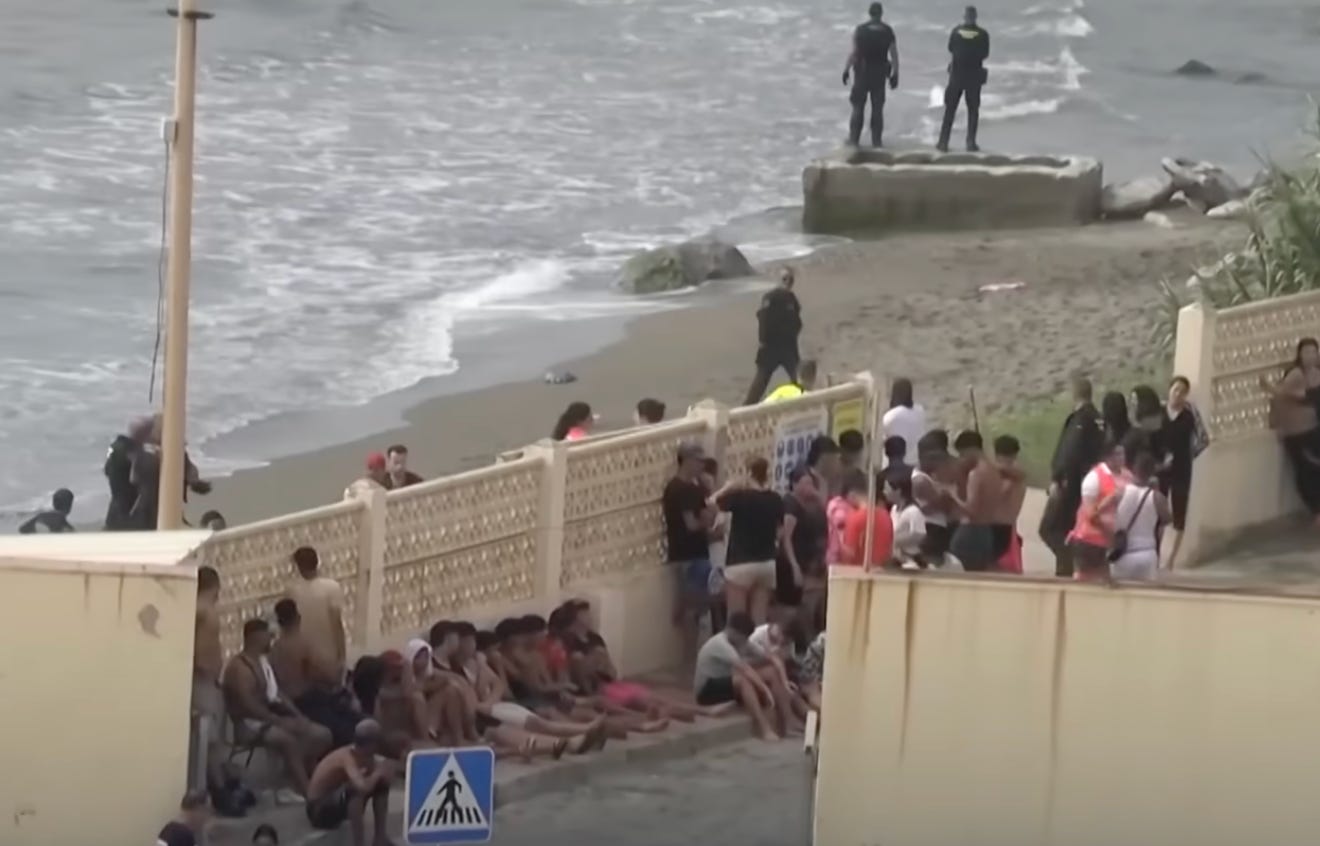
The sudden surge of roughly 50,000 to 60,000 interlopers into the Spanish enclave of Ceuta in late July 2026 has ignited a firestorm of geopolitical debate. While mainstream narratives often attribute such events to spontaneous mass movement, a closer reading reveals a far more deliberate sequence of events. It involves Spain, Morocco, the United States, and Israel in a web of competing interests that has been tightening for years, further complicated by Spain’s controversial domestic immigration policies and bold foreign policy stances against Israel and the United States.
The events in Ceuta cannot be viewed in isolation. Morocco has a documented history of utilizing migration flows as leverage against Spain. Geopolitical analyst Wally Rashid captured the pattern succinctly: “Morocco has a history of blackmailing Spain by flooding Spain’s two autonomous cities in North Africa, Ceuta and Melilla, with migrants. Whenever Spain warms relations with Algeria, Morocco’s adversary, Morocco opens the floodgates.”


The pattern surfaced once more when Madrid turned toward Algiers. Spain repaired diplomatic relations with Algeria—suspended since 2022 over Madrid’s support for Morocco on Western Sahara—and on July 20, 2026, Prime Minister Pedro Sánchez visited Algiers for the first time in four years, accompanied by executives from Spain’s largest energy companies, and secured a deal to increase Algerian gas imports by 10%, primarily through the Medgaz undersea pipeline—the sole direct pipeline link between the two countries since Algeria closed the Maghreb-Europe route through Morocco in 2021.
Spanish political analyst Alex_politics outlined the precise sequence preceding the 2026 crisis on Twitter: “Right after the visit to Algeria, Morocco facilitates the mass entry of thousands of Moroccans into the autonomous cities. There is obviously diplomatic blackmail here.”

On the ground, the New York Times documented the scale of the disorder through the account of Mohammed Ahmidho, 37, a Moroccan man who learned through social media that the border crossing was unguarded and made his way to the front of a crowd tens of thousands strong. What struck him most was not the crowd itself but the conduct of Moroccan police, who he recalled urging those gathered to “come to Spain.” People scaled fences, forced their way through gaps in the chain-link, and swam across the maritime boundary. “At least 60 people died in the mayhem,” Jason Horowitz reported.
Spain’s domestic landscape provided fertile ground for the crisis. Right-wing critics targeted Prime Minister Sánchez’s amnesty program—a royal decree bypassing parliament and taking effect in April 2026 that allowed illegal aliens who had lived in Spain for at least five consecutive months before January 1, 2026, to apply for one-year work and residency permits. By the close of the June 30 application deadline, more than 1 million people had applied—double the government’s original estimate of 500,000—prompting a high court challenge from the conservative opposition. The program ended up drawing over 1 million applications. Figures like European People’s Party leader Manfred Weber argued that granting legal status to over 500,000 irregular immigrants created a “pull factor” signaling leniency.
A similar legal trigger cited by critics is a ruling Spain’s Supreme Court issued on June 29, 2026—publicly released July 8—holding that migrants intercepted while swimming toward Ceuta cannot be subjected to immediate summary pushbacks without due process, because they did not cross the physical border infrastructure referenced in Spanish law. The ruling was narrow in how it distinguished sea arrivals from migrants who climb or cross the land border fence and did not grant blanket protection from deportation. Sánchez asserted that human-trafficking networks seized on it, spreading their own interpretation through social media to convince migrants that swimming into Ceuta guaranteed protection from expulsion. “This ruling has spread like wildfire through the social networks of the human trafficking mafias and has produced an avalanche,” he said.
The Morocco-Spain crisis runs through a deeper realignment that the Abraham Accords helped crystallize. When Morocco normalized ties with Israel in December 2020, it brought to the surface a relationship that had been quietly operational for more than six decades. The human thread binding the two countries runs deep: Morocco was home to the largest Jewish community in the Arab world before Israel’s founding, and today nearly one million Israelis trace their ancestry to Morocco, making them the second-largest ethnic community in the country.
The intelligence dimension is just as striking. In a 2016 interview with the Israeli newspaper Yedioth Ahronoth, former Military Intelligence chief Maj. Gen. Shlomo Gazit disclosed that King Hassan II secretly recorded the closed-door deliberations of Arab heads of state at a September 1965 Casablanca summit—a meeting where Arab military commanders spoke openly about their readiness for war against Israel—and passed the tapes to Israeli intelligence. The Mossad chief at the time, Meir Amit, called the operation “one of the crowning glories of Israeli intelligence.” Gazit said those recordings, which revealed deep Arab divisions and military unpreparedness, gave Israel the confidence to launch its preemptive strike on June 5, 1967 and win the Six-Day War in a decisive manner.
This formalized partnership has emboldened Rabat to press its territorial claims over Ceuta and Melilla. Moroccan writer Amine Ayoub articulated this dynamic in a piece published at Ynet. “In January 2026, Israel and Morocco signed a joint military work plan for the year... This bilateral architecture gives Israel something it has rarely possessed in North African politics: direct strategic stake in Rabat’s regional success.” The partnership was publicly affirmed on July 30, 2026, when Israeli Foreign Minister Gideon Sa’ar posted on Twitter, “Congratulations to King Mohammed VI of Morocco as he marks the 27th anniversary of his accession to the throne. Under his leadership we are working to further cement the ties between our two countries.”

That warmth toward Rabat has a sharper edge when set against Israel’s posture toward Madrid. Since October 7, 2023, Prime Minister Sánchez has emerged as one of the most senior European leaders to formally accuse Israel of committing genocide in Gaza. On September 8, 2025, he declared, “This is not self-defense...it is the extermination of a defenseless people.” He unveiled a sweeping package of measures, including a total arms embargo, a ban on ships carrying fuel for Israel’s military, and the closure of Spanish airspace to aircraft transporting defense material to Israel.
Spain’s parliament formally codified the arms embargo into law in October 2025. Madrid canceled a €285 million contract with Israeli weapons manufacturer Rafael and even withdrew its ambassador from Tel Aviv. Sánchez went further by calling for Israel’s exclusion from international sporting events, asking, “Why was Russia expelled after invading Ukraine, yet Israel faces no expulsion after invading Gaza?”
Spain’s defiance reached its peak on February 28, 2026, when the U.S. and Israel launched “Operation Epic Fury,” an act of war against Iran. Sánchez condemned the strikes as an “unjustified, dangerous military intervention outside international law,” and prohibited the U.S. from using the Rota and Morón de la Frontera air bases for operations against Iran. Defense Minister Margarita Robles announced that “no assistance of any kind” had been provided, compelling at least 15 U.S. military aircraft to leave the Andalusian bases. In a televised address on March 4, 2026, Sánchez warned that the U.S. administration was playing “Russian roulette with the destiny of millions.”
This refusal to allow the U.S. access to its military bases during the Iran campaign, combined with its failure to meet NATO defense spending targets, opened a rift with Washington that Morocco and Israel actively exploited. Ayoub noted that an internal Pentagon email outlined options including suspending Spain from NATO. “Critically, Article 6 of the Washington Treaty explicitly excludes territories in continental Africa from NATO’s collective defense obligations, meaning Ceuta and Melilla stand legally exposed.”
This vulnerability was underscored by Michael Rubin of the American Enterprise Institute, who in March 2026 argued that Morocco should reclaim the enclaves. “With Spain’s Socialist Prime Minister Pedro Sánchez embracing the language of decolonization, Mohammed VI should reclaim the spirit of the Green March to finalize the expulsion of Spanish colonists from Moroccan soil,” Rubin wrote. The AEI senior fellow was unambiguous about NATO’s limits, writing that “Sánchez and the Spanish press bleat, but they have no grounds to act. Nor, for that matter, would NATO.”
What Rubin called for in print, Congress had already set in motion. The congressional dimension was exposed by Rep. Thomas Massie (R-KY), who accused Republican colleagues of engaging in hypocrisy. “Don’t fall for the fake Fox/GOP outrage,” he wrote on August 1. “Two weeks ago the House passed a bill that greenlighted the transfer of Spanish territory to Morocco. Every Republican except me voted for it, but now THEY are acting shocked at the invasion.”


In Spanish alternative political circles, the Ceuta crisis has fed into a darker theory already circulating for years. In May 2022, Spain confirmed that Sánchez’s phone had been infected with Pegasus spyware—developed by Israel’s NSO Group—in May 2021, with more than 2.5 gigabytes of data extracted. Defense Minister Margarita Robles suffered the same breach a month later. Spain’s investigation was shelved in January 2026 after Israel refused to cooperate with five separate judicial requests, with the presiding judge ruling that Israel’s refusal violated “the principle of good faith” between nations.
Morocco has been widely identified as the likely operator of the hack, which coincided with the acute Western Sahara diplomatic crisis and targeted more than 200 Spanish mobile numbers. Against that backdrop, a theory circulates in Spanish alternative media holding that the Spain-Morocco-Israel triangle operates as an arrangement in which Israel provides surveillance technology and diplomatic cover for Morocco to press its territorial interests, and that Sánchez tolerates the migration flows because he is being blackmailed with material extracted from his phone.
In a similar vein, Kevin Barrett, writing on Substack, questioned the spontaneous nature of the migration surge, pointing to the precedent of 2021 when only 8,000 people crossed after explicit news that border guards had withdrawn. “Why did 60,000 suddenly decide to do it on July 29, 2026 for no particular reason, at a moment when success seemed extremely unlikely?” Barrett speculated that Israeli psy-ops experts, drawing on Israelis of Moroccan origin who speak fluent Moroccan Arabic, could have seeded social media to trigger the mass movement.
Spanish geopolitical analyst Rubén Gisbert framed the stakes in stark terms: “WHY CEUTA and NOT MELILLA? If Spain loses Ceuta, it LOSES CONTROL of the Strait of Gibraltar. Between Gibraltar (United Kingdom) and Morocco, the Anglo-Zionist axis would have total control of the passage to the Mediterranean, sidelining Spain.” AFD MEP Tomasz Froelich synthesized the foreign and domestic dimensions of this migrant incursion, writing, “The sudden storming of Ceuta by 50,000 people is no coincidence, but a hybrid attack serving Moroccan, American, and Israeli interests: Pedro Sánchez has sided with the Palestinians and drawn closer to Algeria. This displeases Washington, Tel Aviv, and Rabat. At the same time, Sánchez has facilitated such an attack through his disastrous migration policy. Against him, one can unhesitatingly wield the migration weapon.”


This is no spontaneous crisis, but a deliberate act of sabotage in a world shackled by Jewish influence and a Washington beholden to Tel Aviv. As the evidence mounts, the Hebraic hidden hand directing this migration wave will be unmasked, ensuring that any further Spanish resistance to the Judeo-American empire’s wars is met with even more vicious retaliation from the power brokers who demand total compliance.
NEXT:
IsraAID: Humanitarian Giant or State-Sponsored Influence Operation?

Few organizations in the world of international humanitarian aid generate as much quiet fascination as IsraAID. Founded in 2001 and operating in over 60 countries, the Israeli NGO has pulled survivors from earthquake rubble, treated trauma survivors on the shores of Greece, and evacuated Afghan judges from Taliban-controlled territory. It has been prais…
If you like the content, feel free to continue supporting my work.
Buy Me A Coffee: https://buymeacoffee.com/josenino
It’s funny all that comes to light when you take off your “Israel is Special” glasses.
Should have sank the fuckin boats