

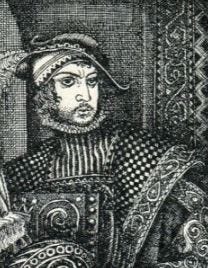
The story begins in Portugal around 1524, where a boy named João Miques was born into a family that had been forced to convert to Christianity under the Inquisition. His father, Agostinho Micas, was a physician and professor at the University of Lisbon who died in 1525, when Joseph was barely a year old. Through his aunt Doña Gracia Mendes Nasi, the family was connected to the Mendes banking dynasty, one of the wealthiest and most powerful Jewish merchant houses in Europe, but that wealth could not protect them from the relentless pressure of the Portuguese Inquisition.
When the Inquisition intensified its pressure around 1537, the young João followed his aunt Doña Gracia Mendes Nasi to Antwerp, where the family had established one of the most extensive banking and trading houses in Europe. He studied at the University of Louvain, graduating on September 1, 1542 as Dominus Johannes Micas. There he cultivated close personal relationships with Emperor Charles V, Queen Mary of the Netherlands, and the future Emperor Maximilian II.
None of it mattered. The constant performance of a false Catholic identity gnawed at him and his family. They lived as marranos, outwardly Christian but secretly Jewish, always one denunciation away from the stake. They resolved to escape to Ottoman territory, where Jews could practice their faith openly under the protection of the Sultan.
The odyssey from Portugal to freedom was treacherous. After stops in Antwerp and France, the family moved to Venice around 1549. However, the Republic proved hostile territory. Doña Gracia was imprisoned around 1549 on charges of Judaizing (the act of openly practicing Judaism.) She was denounced before Venetian authorities by her own sister Brianda, in a dispute over the family estate, which led to the confiscation of her property. Joseph subsequently intervened, appealing directly to Sultan Suleiman I through the court physician Moses Hamon, and secured her release through Ottoman diplomatic pressure. She then fled to Ferrara, where she openly resumed her Jewish identity for the first time.
By 1554, Nasi arrived in the imperial capital. He was circumcised, publicly reclaimed his Jewish identity, took the name Joseph Nasi, and married his cousin Reyna, the daughter of Doña Gracia. Constantinople, the heart of the most powerful empire on earth, became his permanent home. From there, he began to build something unprecedented.
His first major power play was backing Selim, the future Sultan, against his rival brother Bayezid in the succession struggle—a bet that would pay off enormously. When Selim II ascended the throne in 1566, Nasi became his closest confidante and favorite at court. He accumulated extraordinary economic privileges. A monopoly on the wine trade through the Black Sea brought him substantial annual revenue, while the beeswax trade with Poland fell under his control as well. Nasi also dominated commerce with Moldavia, where he maneuvered to keep pro-Nasi princes on the throne.
In 1566, Sultan Selim II formally appointed Nasi Duke of Naxos and the adjacent Cyclades archipelago—including Andros, Paros, and Santorini. It was an unprecedented honor for a Jewish man in the Christian-dominated Mediterranean world. He governed his duchy remotely from his palace at Belvedere near Constantinople, paying an annual tribute of 14,000 ducats while keeping the rest of the proceeds for himself.
Acting as a de facto foreign minister, he drew on an unmatched network of agents, spies, and commercial contacts across Europe to shape Ottoman strategic decisions. He played a central role in brokering the 1562 peace between Poland and Turkey, backed rival princes in Moldavia and Wallachia to keep pro-Ottoman rulers in power, and maintained contact with William of Orange, actively encouraging the Dutch revolt against Spain and so weakening the Ottomans’ arch-rival, the Habsburgs. Holy Roman Emperor Maximilian II maintained direct personal correspondence with Nasi on matters of political consequence. Foreign powers regularly used him as an intermediary to gain concessions from the Sublime Porte.
Nasi also knew how to use Ottoman power for personal vengeance. The French crown owed him approximately 150,000 scudi, a debt that Charles IX had voided on the grounds that Jews could not legally lend to Christians in France. Nasi obtained a Sultan’s firman (royal mandate) ordering the confiscation of French ships at Alexandria as repayment. After protests, the Sultan revoked the broader order but kept roughly 42,000 ducats worth of French goods. A man the French crown had cheated now had the ear of the most powerful sovereign in the world.
The most consequential act of Nasi’s career was his role in engineering the Ottoman-Venetian War over Cyprus. In 1569, Nasi threw his full weight behind the war faction in Constantinople, and contemporary reports widely cast him as the conflict’s chief political instigator. He bore a deep resentment toward Venice and hoped to be named King of Cyprus once it was conquered, having already commissioned a crown and a royal banner to that end.
The Ottomans conquered Cyprus in 1571, but suffered a catastrophic naval defeat at the Battle of Lepanto at the hands of the Holy League. After Lepanto, the peace faction led by Grand Vizier Sokollu gained dominance at court, and Nasi’s influence began its terminal decline. The Cyprus kingship never materialized.
Yet even as his political fortunes crested and fell, Nasi had already embarked on something that would outlast his lifetime and anticipate movements centuries ahead. In 1561, Nasi obtained a formal grant giving him full authority over Tiberias and seven surrounding villages in Galilee in exchange for an annual payment to the treasury. What followed was unprecedented. Nasi rebuilt the walls of Tiberias, planted mulberry trees, and attempted to build up a silk and wool textile industry that would make the colony economically self-sustaining, while circular letters went out to Jewish communities across Italy inviting mass emigration.
The settlement ultimately faltered. The outbreak of the Ottoman-Venetian War cut off Italian Jewish emigration routes. Pope Pius V’s 1569 bull banishing Jews from the Papal States had spurred interest in Tiberias, and the community of Cori in the Campagna—numbering about 200 souls—decided to emigrate in a body. But a 1569 transport of 102 Pesaro Jews was captured by Maltese pirates and sold into slavery. Local opposition harassed the rebuilding efforts. Political intrigues by Nasi’s enemies at court undermined his focus. Crucially, Nasi himself never visited Tiberias. Nevertheless, he remained its titular lord until his death, and historians cite this as the only practical attempt to establish a Jewish political center in Palestine between the 4th and 19th centuries.
Nasi accumulated enemies as readily as he accumulated influence. When Pope Paul IV burned Jewish conversos at the stake in Ancona, Doña Gracia and Joseph organized an international economic boycott of the port, redirecting Ottoman Jewish merchant traffic to the rival port of Pesaro. The boycott collapsed due to internal divisions within the Jewish community, competing commercial interests winning out over solidarity.
His relative Abraham Benveniste was arrested in 1570 on charges of having set fire to the Venetian Arsenal in September 1569, sabotage allegedly instigated by Nasi himself in the tense lead-up to the Cyprus War. The charge was never definitively proven but illustrated how far Nasi’s covert operations reached. His clandestine negotiations with the Jewish community of Famagusta in Venetian-held Cyprus were uncovered in June 1568, resulting in the expulsion of the city’s non-native Jewish population.
After the Battle of Lepanto and the death of his patron Selim II in 1574, Nasi was effectively frozen out of active politics. He spent his final years at his Belvedere palace, patronizing Jewish scholars and maintaining a Hebrew printing press. He died on August 2, 1579. His widow Reyna maintained his library, opened it to scholars, and operated the Hebrew printing press into the late 1590s.
Historian Cecil Roth, who wrote the definitive biography, judged that while Nasi’s career produced few direct lasting results, it proved that a Jew could function as a prominent public official and sovereign power in the 16th-century world. His Tiberias project, though a practical failure, is now widely regarded as the first concrete political attempt at Jewish territorial resettlement—three centuries before Theodor Herzl.
Joseph Nasi’s career serves as an early, definitive display of how organized Jewry can penetrate and manipulate the highest levels of a host empire’s government. By re-positioning himself from a persecuted converso to a primary power broker in Constantinople, Nasi demonstrated that the apparatus of a great power could be successfully hijacked to serve the specific, ethno-centric interests of his people. Centuries later, this same operational methodology would be perfected by Jewish neoconservatives—from Irving Kristol to Douglas Feith—who mirrored Nasi’s efforts by steering U.S. foreign policy toward the strategic goals of organized Jewry rather than the welfare of the American people.
Nasi’s career as a courtly architect of foreign policy served as a precursor to the modern neoconservative capture of the U.S. government, further proving that organized Jewry can repeatedly commandeer a superpower to advance its own ethnic interests.
NEXT:
Villains of Judea: Douglas Feith

Few individuals embody the conflict between American national interest and the demands of world jewry as sharply as Douglas Feith. Throughout his career, Feith has operated as a consummate advocate for the Jewish state, positioning himself within the highest echelons of the U.S. government to ensure that American military and foreign policy served as a …
If you like the content, feel free to continue supporting my work.
Buy Me A Coffee: https://buymeacoffee.com/josenino
one issue: I don't think nasis family had to lie and say they wereChristian. they wanted to in order to have the benefits. the inquisition only was for false conversions such as nasis people did