

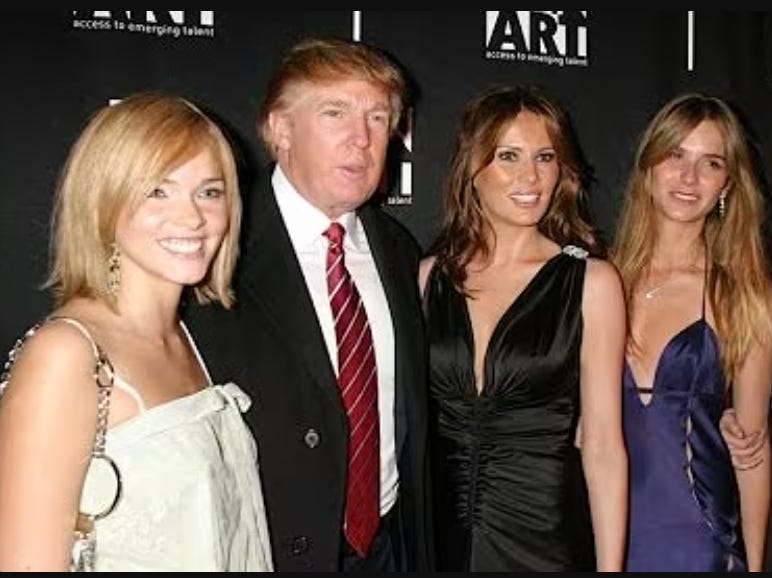
Donald Trump built his political career on fiery populist promises to defend American workers from the deleterious effects of mass migration, yet his private business practices tell a radically different story.
Long before he entered politics, Trump profited directly from the very immigration loopholes he later denounced on the campaign trail. In 1999, Trump founded Trump Model Management and held an 85 percent stake in the agency. According to the personal financial disclosure his campaign filed in May 2016, Trump earned nearly $2 million from the company, Mother Jones reported. That filing covered all of 2015 plus the first four and a half months of 2016. While Trump campaigned against DC’s mass migration agenda, his agency routinely relied on foreign talent and faced explosive allegations of immigration fraud and wage exploitation.
The agency’s appetite for foreign labor was no secret. A 2015 Reuters analysis of Labor Department records found that Trump Model Management and a sister company, Trump Management Group LLC, had sought visas for nearly 250 foreign fashion models. Yet in March 2016, Trump issued a campaign statement vowing, “I will end forever the use of the H-1B as a cheap labor program, and institute an absolute requirement to hire American workers first for every visa and immigration program. No exceptions.”
During the 2016 presidential race, a Mother Jones investigation by reporter James West documented the accounts of three former models who said they worked for Trump Model Management without proper work authorization. Financial and immigration records from a lawsuit showed that a fourth model had done the same. Canadian model Rachel Blais signed with the agency in March 2004 and spent roughly six months modeling in the United States on only a tourist visa. An immigration lawyer secured her a work visa in the fall of 2004, and the agency eventually obtained an H-1B visa for her. During that gap, Blais appeared in a 2004 episode of The Apprentice, modeling outfits designed by Trump’s contestants as Trump looked on from the front row.
Blais paid as much as $1,600 a month for a bunk in a room she shared with five others, inside a crowded East Village apartment near Tompkins Square Park. After nearly three years with the agency, she walked away with a single check for $8,427.35. “It is like modern-day slavery,” Blais told the magazine. She added, “Honestly, they are the most crooked agency I’ve ever worked for, and I’ve worked for quite a few.”
The fourth model, Jamaican national Alexia Palmer, signed an exclusive contract with the agency in January 2011 at age 17. According to records in her 2014 lawsuit alleging fraud and wage theft, she began working in the United States about nine months before her work authorization took effect in October 2011. Palmer said she paid a 20 percent commission on every job plus other fees and earned only $3,880.75 over three years. A New York judge dismissed her claim in March 2016, partly because she had not first gone to the Department of Labor, and the Department of Labor dismissed her complaint that August. Lawyers for the agency called the suit “frivolous” and “without merit.”
The agency did not respond to Mother Jones. Trump campaign spokeswoman Hope Hicks declined to address the agency’s use of foreign labor, saying, “That has nothing to do with me or the campaign.” The Trump Organization shuttered the agency in April 2017, after an 18 year run.
These controversies expose how easily corporate interests manipulate the H-1B visa system, which has sat at the center of populist discourse throughout Trump’s second administration. The program’s roots trace back to the original H-1 category, which the Immigration and Nationality Act of 1952 created for temporary workers. The Immigration Nursing Relief Act of 1989 split nurses off into a separate H-1A class. Section 205 of the Immigration Act of 1990 then built the modern H-1B, letting holders pursue green cards for the first time and imposing the program’s first annual cap of 65,000.
After industry pushback, the Miscellaneous and Technical Immigration and Naturalization Amendments of 1991 added fashion models of distinguished merit and ability to the classification. Today the H-1B covers temporary, employer sponsored workers in specialty occupations requiring highly specialized knowledge and at least a bachelor’s degree or its equivalent, alongside those models. Rather than restricting entry to rare geniuses, the program distributes 65,000 regular annual slots plus 20,000 places for graduates of U.S. advanced degree programs. Renewals and hires by certain universities and research employers fall outside the cap entirely.
State Department visa statistics show the government issued roughly 4.36 million H-1B visas between fiscal years 1991 and 2024. Annual issuances climbed from about 50,000 in 1991, the program’s first year, to a record 265,777 in 2023. The decade totals tell the story, rising from 573,412 in the 1990s to 1,596,302 in the 2010s. In 2024 alone, the State Department issued 219,659 H-1B visas. U.S. Citizenship and Immigration Services also reported 406,348 approved petitions in fiscal year 2025. Roughly 7 in 10 of those approvals extended or renewed employment for workers already in H-1B status, so the figure counts petitions rather than new arrivals. Computer related roles captured 62 percent of approvals, followed by engineering at 10.4 percent and education at 6 percent. Beneficiaries born in India accounted for nearly 70 percent of all approvals, and those born in China accounted for about 12 percent.
Trump knew this machinery intimately because his own companies used it aggressively. A 2015 Reuters investigation of Labor Department records revealed that Trump businesses had sought at least 1,100 foreign worker visas since 2000 under the H-1B, H-2A, and H-2B programs. That total included nearly 250 visas for foreign fashion models requested by Trump Model Management and a sister company, Trump Management Group LLC. A 2016 CNNMoney analysis of federal data found that the modeling agency had brought in around 30 foreign models on H-1B visas, and that about half of their applications listed the same $75,000 annual salary.
During a March 10, 2016 Republican debate in Miami, Washington Times reporter Stephen Dinan pressed Trump on the program, and Trump openly admitted the contradiction. “I know the H1B very well. And it’s something that I frankly use and I shouldn’t be allowed to use it,” Trump said. He then added, “I’m a businessman and I have to do what I have to do.” Yet by December 2024, amid a feud between Elon Musk and immigration hardliners inside his coalition, he reversed himself. “I’ve always liked the visas, I have always been in favor of the visas. That’s why we have them,” Trump told the New York Post. “I have many H-1B visas on my properties. I’ve been a believer in H-1B. I have used it many times. It’s a great program.”
This same transactional opportunism defines Trump’s second term immigration policies. True America First restrictionists demand an immediate immigration moratorium and the complete abolition of the H-1B program, yet the elite driven American political system structurally blocks genuine restriction. Instead of dismantling mass migration, Trump has offered marginal executive measures that remain vulnerable to judicial injunctions or future presidential reversals.
In September 2025, Trump signed a proclamation imposing a $100,000 payment on certain new H-1B petitions for workers outside the United States. On September 18, 2026, he renewed it through September 2027. The courts have split over the fee. A federal judge in Washington, D.C. upheld it in December 2025. In June 2026, Judge Leo Sorokin in Massachusetts struck down the fee as an unlawful tax that Congress never authorized. On September 30, 2026, just 12 days after the renewal, Judge Haywood Gilliam Jr. in California blocked federal agencies from enforcing it under both proclamations. The administration has appealed both losses.
His administration also finalized a wage weighted lottery that gives the highest paid applicants 4 entries for every 1 entry for the lowest paid applicants. It launched Project Firewall, under which the Labor Secretary personally certifies the start of H-1B investigations for the first time in the department’s history. A September 2026 executive order mandated layoff scrutiny of employers that recently laid off, or plan to lay off, similarly situated American workers, along with expanded data sharing between agencies. The State Department also restricted third country visa stamping by directing nonimmigrant visa applicants to interview in their country of nationality or residence.
Meanwhile, major proposals like a separate $103,265 cap subject fee, higher prevailing wage rules, and eliminating the 60-day grace period sit unfinished in rulemaking. The Labor Department’s wage rule reached White House review in November but has not been published. Even if all 3 are finalized, a future administration could unwind them through its own rulemaking, and Trump’s proclamations can be revoked with a single signature.
Worse still, Trump has repeatedly signaled his readiness to betray his base by cutting a sweeping amnesty deal with Democrats. He has signed no permanent law reducing overall legal immigration levels, and his first term still naturalized roughly 2.94 million immigrants, according to federal data. Every temporary restriction therefore remains on the chopping block. In June 2025, Trump lamented on Truth Social that “our very aggressive policy on immigration is taking very good, long time workers away from them,” referring to farmers and the hotel industry. Immigration officials briefly paused workplace raids at farms, hotels, and restaurants before reversing course days later. Trump then floated “some kind of a temporary pass where people pay taxes.” That echoes his 2018 flirtations with Democratic leaders like Chuck Schumer and Dick Durbin over DACA amnesties, when he promised Congress “a bill of love.”
The November 2026 midterms handed Democrats control of both chambers of Congress. Days later, Trump told CBS’s 60 Minutes that his deportation policy “might be too tough” and floated a deal with Democrats. “Let the people that are here and in some cases here for 10 and 15 years, work a deal for them,” Trump said. At a November 20, 2026 White House press conference, a reporter asked whether he would veto Rep. Maria Elvira Salazar’s (R-FL) Dignity Act amnesty bill, and Trump never answered. Instead, he praised “very hardworking people that came in, in some cases, years ago.” He also boasted that Democrats and the governor elect of Texas, Democrat Gina Hinojosa, had called him. He then falsely claimed that no one had entered the country illegally in the past 18 months, even though Customs and Border Protection recorded 8,288 Southwest border apprehensions in October 2026 alone.
Ultimately, politicians must be judged by their concrete deeds in both business and governance rather than their campaign slogans. Donald Trump functions as an ideological blank slate onto which naive analysts project their nationalist hopes, all while ignoring his consistent record of self-enrichment and dealmaking on immigration matters.
By engaging in cynical demagoguery on the stump while importing cheap foreign labor in his businesses and entertaining amnesties in the White House, Trump proves that neither he nor the mainstream MAGA movement possesses the seriousness required to dismantle the system keeping America’s mass migration floodgates wide open.
This is a feature not a bug of the Judeo-capitalist system. It is high time those on the Right recognize this and snap out of the pro-Trump trance they have been placed under so they can channel their energy into more productive political endeavors.
NEXT:
40 Years Since Ronald Reagan’s Amnesty Betrayal

40 years ago today, on November 6, 1986, President Ronald Reagan signed the Immigration Reform and Control Act, codifying a tragic turning point in American history. A date that should live in infamy, it marked the moment Washington formally surrendered the rule of law, rewarded millions of lawbreakers with the gift of American legal residency, and laid…
If you like the content, feel free to continue supporting my work.
Buy Me A Coffee: https://buymeacoffee.com/josenino