

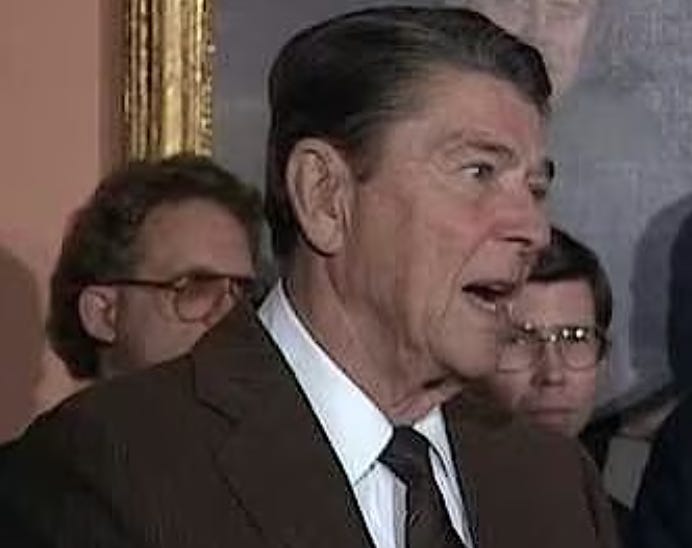
40 years ago today, on November 6, 1986, President Ronald Reagan signed the Immigration Reform and Control Act, codifying a tragic turning point in American history. A date that should live in infamy, it marked the moment Washington formally surrendered the rule of law, rewarded millions of lawbreakers with the gift of American legal residency, and laid the groundwork for the permanent erasure of national sovereignty.
Two years earlier, in a 1984 debate with Walter Mondale, Reagan said, “I believe in the idea of amnesty for those who have put down roots and lived here, even though sometime back they may have entered illegally,” as NPR reported. In his official signing statement, he called the legislation “the most comprehensive reform of our immigration laws since 1952” and told the American people, “The employer sanctions program is the keystone and major element.” He then naively predicted that “Future generations of Americans will be thankful for our efforts to humanely regain control of our borders.” Four decades later, that solemn promise stands exposed as a monumental disaster that shattered the country’s demographic and civic balance.
The legislative coalition that engineered this catastrophe was a bipartisan cartel of politicians who prioritized cheap corporate labor and ethnic constituency pandering over the interests of Middle America. Guided by the recommendations of the Hesburgh Commission, Sen. Alan Simpson (R-WY) and Rep. Romano Mazzoli (D-KY), who had both served on that commission, spent from 1982 to 1986 maneuvering their proposal through Congress. When the measure stalled in 1986, then-Rep. Chuck Schumer (D-NY) teamed up with California Democrats Leon Panetta and Howard Berman on the Special Agricultural Worker compromise, a farmworker legalization deal that addressed growers’ demands and rescued the package from defeat. As Congress finished its work in October 1986, Schumer acknowledged the gamble, telling the New York Times, “The bill is a gamble, a riverboat gamble. There is no guarantee that employer sanctions will work or that amnesty will work. We are headed into uncharted waters.” The House approved the conference agreement 238 to 173 on October 15, and the Senate passed it 63 to 24 two days later, sending the legislation to Reagan’s desk.
The bargain also drew support from Jewish organizations. In a 1986 legislative update preserved at the Reagan Library, the American Jewish Congress said that it and numerous other Jewish organizations had actively supported the Rodino-Mazzoli bill, citing the Jewish people’s own experience. The Jewish Telegraphic Agency later reported that Jewish organizations backed the law from the beginning, though Israelis were the only group of Jews expected to take part in the amnesty in significant numbers. Rep. Barney Frank (D-MA) won an anti-discrimination amendment barring employers from discriminating against authorized workers because of national origin or citizenship status, a provision the Reagan administration opposed on the grounds that existing law already addressed discrimination.
A handful of conservatives warned of the coming disaster during the final debates. On October 9, 1986, Rep. Bill McCollum (R-FL) offered an amendment on the House floor to strip the legalization section from the bill. He called it a “reward for lawbreakers” and warned that it would “send a signal” that “we’ve done it once, so we would probably do it again,” as the Center for Immigration Studies recounted. The House rejected his amendment 199 to 192 and passed the bill later that night. Decades later, Edwin Meese, Reagan’s attorney general, wrote in the Wall Street Journal that the promised crackdowns never happened, writing, “Only amnesty prevailed.” Phyllis Schlafly told a House Judiciary subcommittee in July 2006 that “We got amnesty, but we did not get border security or employer sanctions,” adding that there was “massive fraud” and that the illegal population quadrupled.
The concrete consequences of the Simpson Mazzoli Act devastated American sovereignty. An INS report found that nearly 2.7 million people received permanent residence, close to nine in ten of those who applied for temporary status, and about 1.1 million of them legalized through the agricultural program.
The farmworker provisions unleashed an unprecedented tsunami of document fraud, with corrupt notarios manufacturing fake employment affidavits out of thin air. The Center for Immigration Studies, working from an INS draft report released in October 2000, argued that the amnesty failed to arrest illegal migration. CIS reported that by early 1997 the former illegal aliens had been entirely replaced by new ones, and that the unauthorized population again stood above 5 million. CIS research director Steven Camarota said the figures showed the amnesty “actually attracted more illegal immigration.” Executive director Mark Krikorian made the case in National Review, writing that the 1986 amnesty of 2.7 million illegal aliens led to a surge in new illegal immigration. Separately, NumbersUSA’s Ruark estimated that chain migration added 2.5 million to 3 million more relatives, which would put the amnesty’s total footprint at 5.2 million to 5.7 million.
Since the 1986 Reagan amnesty, the illegal alien population has ballooned far beyond official estimates. A 2018 study in PLOS ONE by Mohammad Fazel-Zarandi of MIT Sloan and Edward Kaplan and Jonathan Feinstein of Yale estimated that about 22.1 million illegal aliens lived in the United States in 2016, roughly double the common 11.3 million figure, with a range of 16.2 to 29.5 million.
That grim 40-year arc now reaches an urgent, perilous climax in the modern political landscape. With Donald Trump navigating the lame duck phase of his final presidential administration, the threat of another catastrophic immigration compromise looms over the country once again. Free from the democratic constraints of future re-election campaigns, a second-term president is no longer accountable to the populist grassroots base that elevated him to power. Trump has previously demonstrated an erratic willingness to entertain sweeping immigration compromises with Democratic leaders, repeatedly floating deals that trade border security concessions for permanent legal protections for millions of illegal aliens.
For Trump, immigration is ultimately a transaction rather than a principle. That is why the marginal restrictions implemented during his second term will prove fleeting at best, and they would disappear entirely if an amnesty passes on his watch.
None of this is baseless speculation. Trump’s words and deeds should be cause for concerns. On June 12, 2025, Trump posted on Truth Social that farmers and hotel operators told him his enforcement “is taking very good, long time workers away from them, with those jobs being almost impossible to replace.” He added, “We must protect our Farmers, but get the CRIMINALS OUT OF THE USA. Changes are coming!”
At a White House event that same day, he went further. “They have very good workers. They’ve worked for them for 20 years; they’re not citizens, but they’ve turned out to be ... great, and we’re going to have to do something about that.” Within days, ICE paused worksite arrests at farms, restaurants and hotels, and then it reversed course. Weeks later, Trump floated a temporary pass for those industries that would give farmers “a little control as opposed to you walk in and take everybody away.”
He has handled DACA the same way. In September 2017, Trump ended the program and gave Congress 6 months to replace it. He promised on Twitter to “revisit” the issue if lawmakers failed, and then he sank every attempt they made. On January 11, 2018, Sens. Dick Durbin and Lindsey Graham brought him a Gang of Six compromise. It paired a path to citizenship with the $1.6 billion in wall money Trump had requested, an end to the diversity visa lottery and limits on family sponsorship. Trump rejected it on the spot and dismissed it the next day as “a big step backwards.” On January 19, Senate Minority Leader Chuck Schumer offered roughly $20 billion for the border wall in exchange for protecting DACA recipients. Trump initially agreed and then backed out within hours, and the government shut down that night.
On February 15, 2018, the Senate voted on 4 immigration amendments. Two drew bipartisan support. Outgoing Sen. Susan Collins (R-ME) and the Common Sense Coalition brokered the first, sponsored by Sens. Mike Rounds (R-SD) and Angus King (I-ME). It offered 1.8 million Dreamers a path to citizenship of 10 to 12 years alongside $25 billion in border security. Trump blasted it as a “total catastrophe,” and the White House threatened a veto. It failed 54 to 45. The second, from Sens. John McCain and Chris Coons, offered a narrower DACA fix and failed 52 to 47. None cleared the 60 vote threshold. The Grassley bill Trump backed fared worst of all, drawing only 39 votes.
In December 2024, Trump reopened the door. “I will work with the Democrats on a plan,” he told Meet the Press. “And if we can come up with a plan, but the Democrats have made it very, very difficult to do anything. Republicans are very open to the Dreamers.”
Two years later, the midterms handed Democrats control of both the House and the Senate, and Trump again signaled his openness. “We could work with them on immigration, I think. Immigration is a big deal. I’ve always felt we should be able to work on immigration,” he told Fox News anchors Bret Baier and Martha MacCallum on November 4, 2026. He did hold one line. “Now, could I work with them on an open border?” he asked, after boasting that he had closed the border.
The pattern holds in every episode, from 2017 to the week after the 2026 midterms. Trump treats DACA as a bargaining chip rather than a settled principle, and he will embrace immigration expansion whenever the right concessions are on the table. A Democratic Congress now gives him a new negotiating partner.
More strikingly, his record goes beyond rhetoric. Migration Policy Institute data for Fiscal Years 1977 through 2024 rank Trump’s first term 3rd in total naturalizations, with roughly 2.94 million immigrants sworn in as citizens. Only Joe Biden’s term (3.475 million) and George W. Bush’s second term (3 million) surpassed him. That places Trump squarely within the high naturalization pattern both parties share. If history is any guide, the trend will likely continue through his second term.
The danger compounds dramatically in Congress, where robust Democratic majorities control both legislative chambers, eager to enact a comprehensive amnesty program. These left-wing lawmakers find ready, enthusiastic partners among open-border Republicans like Rep. Maria Elvira Salazar and her clique of Cuban Republicans, whose Dignity Act represents a transparent reboot of the Simpson-Mazzoli framework. Eager to curry favor with regional business donors and expand foreign worker quotas, corporate-backed moderates are aggressively preparing to cross the aisle and manufacture a bipartisan immigration deal.
The tragedy of 1986 was born from the naive belief that an amnesty could resolve an enforcement crisis. The sobering lesson of the past four decades is that every legislative surrender generates an even larger crisis of unlawful migration, encouraging millions more to illegally and legally enter the country in anticipation of the next political cave-in. If the lessons of Ronald Reagan’s disastrous capitulation are ignored today, the American nation will face an irreversible betrayal that extinguishes the rule of law and completes its transformation into a Tower of Babel where Judeo-capital thrives and plunders at will.
NEXT:
Why Donald Trump’s Base Shouldn’t Trust Him On Immigration

Rep. María Elvira Salazar (R-Florida) spent this month celebrating. One year after she and Democrat Veronica Escobar introduced H.R. 4393, her office announced that the coalition behind the Dignity Act had passed 100 endorsements from employers, farm groups and faith leaders. Congress.gov now lists
If you like the content, feel free to continue supporting my work.
Buy Me A Coffee: https://buymeacoffee.com/josenino
There is a blog site that started many moons ago and he labelled it "The Age of Treason". I was a 3x Trump voter but with "Epstein Who", the war crimes in Gaza, and the bombing of Iran the first time--I threw all my Trump stuff away; I now despise him and hate his guts.
And if he signs any amnesty---my hatred of him will quadruple. And he just might do that. I hope God judges him soon.
Will he make money off it then a certainty. The Trump crime family led by his son in law will bounce back.